










Mittal Sections Limited reports ₹1.98 crore H1FY27 loss
Key highlights
- Mittal Sections reported a ₹1.98 crore net loss in H1FY27, versus a ₹2.34 crore profit in H1FY26.
- Revenue from operations declined 3.5% year on year to ₹67.79 crore in H1FY27.
- Total expenses rose 5.9% year on year to ₹70.92 crore, exceeding total income of ₹68.18 crore.
- Long-term borrowings rose to ₹49.71 crore on September 30, 2026, from ₹13.49 crore on March 31, 2026.
powered by IRIS
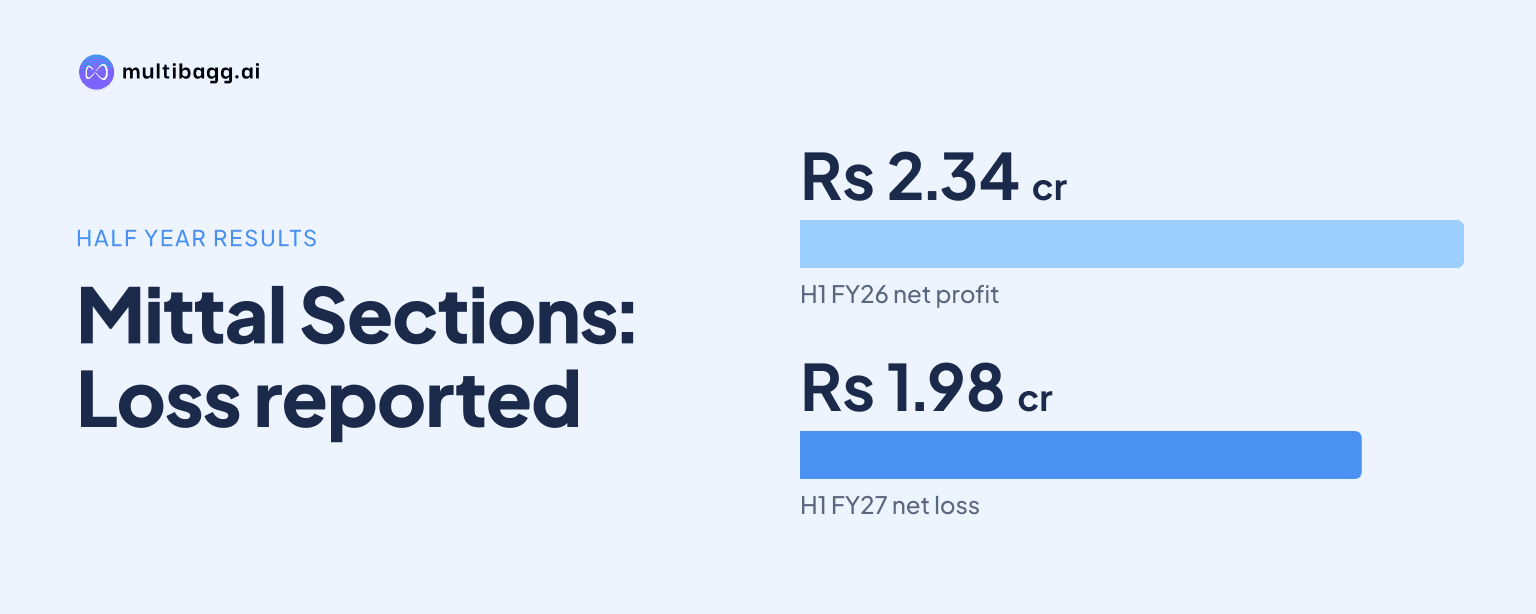
Mittal Sections Limited reported a net loss of ₹1.98 crore for the half year ended September 30, 2026, compared with a ₹2.34 crore net profit a year earlier, as revenue from operations fell to ₹67.79 crore and expenses increased. The Board approved the unaudited standalone results on November 7, 2026.
Know Mittal Sections inside out
Results, valuation, peers and who's buying, in one view.
What did Mittal Sections report for H1FY27?
Mittal Sections reported a loss before tax of ₹2.74 crore in H1FY27, against a profit before tax of ₹3.30 crore in the corresponding half year of the previous fiscal year. The post-tax result was a loss of ₹1.98 crore, marking a reversal from the ₹2.34 crore profit recorded in H1FY26.
Revenue from operations declined 3.5% year on year to ₹67.79 crore from ₹70.25 crore. Total income for the period was ₹68.18 crore, while total expenses were ₹70.92 crore. The difference between total income and revenue from operations reflects other income included in the broader income measure disclosed by the company.
The company said the loss before tax was affected by higher employee benefits and finance costs, alongside lower other-income contributions compared with earlier periods. Total expenses rose 5.9% from the corresponding period even as revenue contracted, putting pressure on profitability.
When were the half-yearly results approved?
Mittal Sections approved the unaudited financial results for the half year ended September 30, 2026, at its Board of Directors meeting held on November 7, 2026. The financial statements were accompanied by a Limited Review Report from statutory auditor Milind Nyati & Co. LLP.
The company had earlier notified the stock exchange that its board would meet to consider the unaudited half-yearly results. It also closed the trading window for designated persons and their immediate relatives from October 1, 2026, until 48 hours after the results declaration, as required under applicable SEBI regulations.
The latest disclosure follows the approval of audited standalone financial results for FY26 at a board meeting on May 29, 2026. Milind Nyati & Co. LLP had issued an unmodified audit opinion on those FY26 financial results, according to the company’s earlier announcement.
Why did Mittal Sections move from profit to loss?
Mittal Sections moved into a loss because costs increased while operating revenue declined. Revenue fell by ₹2.46 crore year on year, while total expenses rose by 5.9%, resulting in a significant compression in the company’s earnings for the six-month period.
Finance costs were ₹2.42 crore in H1FY27. The reported rise in borrowing is relevant to this expense movement: long-term borrowings stood at ₹49.71 crore as of September 30, 2026, compared with ₹13.49 crore as of March 31, 2026. The disclosed figures show a substantial increase in leverage during the half year.
For context, Mittal Sections had remained profitable in FY26. It reported revenue from operations of ₹148.58 crore and net profit of ₹3.46 crore for the year ended March 31, 2026, compared with revenue of ₹136.86 crore and net profit of ₹3.44 crore in FY25. FY26 profit before tax was ₹5.11 crore.
Got a follow-up? Ask IRIS
What does the cash-flow and balance-sheet data show?
Mittal Sections reported total assets of ₹131.51 crore as of September 30, 2026. Total equity and liabilities were also ₹131.51 crore, as required by the balance-sheet equation. The reported increase in long-term borrowing is therefore an important change in the company’s capital structure during the period.
Net cash used in operating activities was ₹7.88 crore for H1FY27. Investing activities used a further ₹24.45 crore, while financing activities generated ₹32.37 crore. The financing inflow offset the cash outflows from operations and investing, leaving a net increase in cash and cash equivalents of ₹0.04 crore.
Cash and cash equivalents at the end of the period were ₹2.63 crore. The cash-flow pattern indicates that financing inflows supported the company’s cash position during the half year while operational and investment-related activities recorded net outflows.
How do these results matter for investors?
The H1FY27 result highlights a weaker earnings position than the company’s FY26 performance. Investors will note the combination of lower revenue, higher total expenses, a ₹2.42 crore finance cost and a shift to a post-tax loss. These reported changes are more material than the small increase in closing cash during the period.
The rise in long-term borrowings from ₹13.49 crore at March 31, 2026, to ₹49.71 crore at September 30, 2026, adds focus to the company’s financing and interest-cost profile. The results do not specify the individual use of the additional borrowings, so the financial statements establish the change in debt but do not provide a separate project-level allocation in the available disclosure.
Conclusion
Mittal Sections recorded a ₹1.98 crore H1FY27 net loss after reporting a ₹2.34 crore profit in the comparable prior-year half. A 3.5% decline in revenue from operations and a 5.9% rise in expenses, including higher finance costs, led to the reversal in profitability. Operating and investing cash outflows were funded by net financing inflows during the period.
Investors will watch subsequent disclosures for revenue performance, expense control, finance costs and the movement in long-term borrowings after the September 2026 balance-sheet date. The company’s next reported financial update will provide the clearest disclosed basis for assessing whether the H1FY27 loss and cash-flow trends have changed.