










Mobavenue international mix nearly doubles to 23.8% in Q2
Key highlights
- Mobavenue’s international revenue mix rose to 23.8% in Q2 FY27 from 12.3% in Q2 FY26.
- Mobavenue reported Q2 FY27 consolidated revenue of Rs 76.7 crore, up 41.3% year-on-year.
- Mobavenue’s Singapore hub covers Southeast Asian markets including the Philippines, Indonesia, Thailand and Malaysia.
- Mobavenue reported a Q2 FY27 EBITDA margin of 21.1% and profit after tax of Rs 11.3 crore.
powered by IRIS
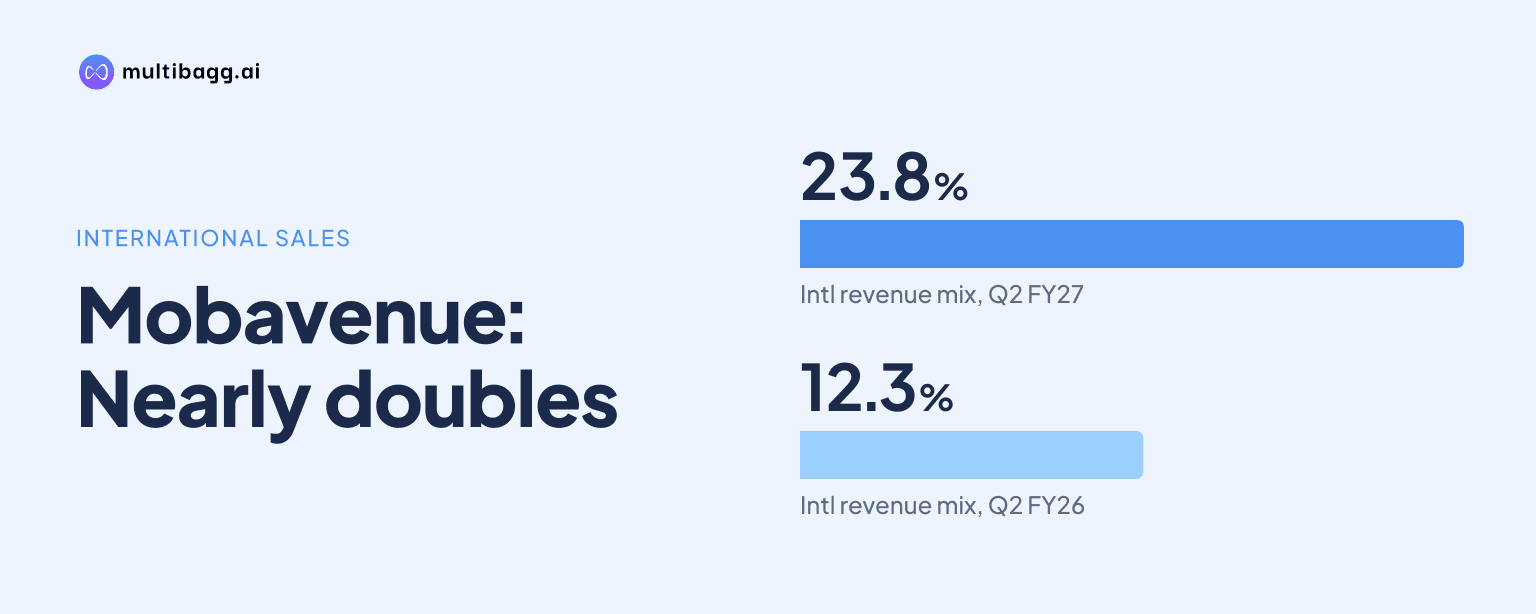
Mobavenue AI Tech Limited increased international revenue’s share to 23.8% in Q2 FY27 from 12.3% a year earlier, nearly doubling overseas mix as its Singapore office became a Southeast Asia hub and it began establishing a US subsidiary for direct customers. Consolidated quarterly revenue rose 41.3% year-on-year to Rs 76.7 crore.
Know Mobavenue AI Tech inside out
Results, valuation, peers and who's buying, in one view.
How much did Mobavenue’s international revenue mix increase?
Mobavenue’s international revenue contribution rose 11.5 percentage points to 23.8% in Q2 FY27 from 12.3% in Q2 FY26. That represents a 1.9-times increase in the overseas share, although India remained the company’s primary market and the base for its technology and operating capabilities.
The higher international mix came as Mobavenue served about 170 brands across 13 countries in Q2 FY27. Management identified the UK, US, Singapore, Southeast Asia, Latin America and the Middle East among its markets, with clients in quick commerce, banking, financial services and insurance, fintech, super apps, entertainment, travel and commerce.
Mobavenue’s direct clients accounted for 64.7% of Q2 FY27 revenue, with the remaining 35.3% generated through agencies, holding companies, resellers and other partners. Management said this combination supports direct enterprise relationships while using partners to extend distribution in global markets.
How is Mobavenue building its overseas operating structure?
Mobavenue said its Singapore office now operates as a regional hub for Southeast Asia, where it is already doing business in the Philippines, Indonesia and Thailand. In its response to an analyst, management also included Malaysia in the Singapore business unit, describing a structure designed to cover several markets from one regional location.
In the US, Mobavenue has made local hires and initiated the setup of a subsidiary to onboard direct customers. The company appointed Eric Lin as country head for its activation platform and said he brings more than two decades of experience in the ad-tech ecosystem. Management said the US structure could support expansion across Canada, Latin America, the UK and Europe.
The company is supporting those overseas operations from its Indian technology centre of excellence. Its platforms process about 1.4 billion consumer and campaign signals daily, reach around 2.7 billion devices globally and make decisions in under 15 milliseconds, according to management. Mobavenue said its asset-light model enables expansion across developed and emerging markets with limited incremental infrastructure investment.
The overseas build-out follows management’s stated investment in people, account management, sales and agency partnerships. Management said it had spent the preceding 12 to 18 months setting up international locations, beginning with the UK, expanding in the US and establishing the Singapore regional hub.
What changed in Mobavenue’s Q2 FY27 financial performance?
Mobavenue reported consolidated revenue of Rs 76.7 crore in Q2 FY27, up 41.3% from Rs 54.3 crore in Q2 FY26 and 5.4% from Rs 72.8 crore in Q1 FY27. Management attributed year-on-year growth broadly to quick commerce, BFSI, fintech, entertainment, travel, super apps and new client wins.
For H1 FY27, revenue was Rs 149.6 crore, compared with Rs 100.7 crore in the comparative figure cited by management, representing 48.6% growth. Management said the first-half performance reflected a diversified sector mix and deeper client relationships, while overseas markets accounted for a larger share of quarterly revenue than a year earlier.
Supply-end data cost declined to 58.5% of Q2 FY27 revenue from 61.5% in Q2 FY26 and 60.4% in Q1 FY27. The lower ratio lifted Q2 gross margin to 41.5%, while the earnings call reported an earnings before interest, tax, depreciation and amortisation, or EBITDA, margin of 21.1%, compared with 20.3% a year earlier.
Employee-benefit expense increased to Rs 9.9 crore in Q2 FY27 from Rs 6.1 crore in Q2 FY26 and Rs 8.4 crore in Q1 FY27. Management said the increase reflected deliberate investment in talent, technology and global teams to build capacity ahead of growth. Profit after tax rose 54.8% year-on-year to Rs 11.3 crore, while its margin increased to 14.7% from 13.4%.
Got a follow-up? Ask IRIS
What has Mobavenue disclosed about international revenue per outcome?
Mobavenue said revenue per outcome, or RPO, increased by more than 10% year-on-year in Q2 FY27 and reached Rs 50.67, according to management’s answer to an analyst. The company uses RPO to assess the value generated per outcome and linked the improvement to its models, signals and campaign optimisation.
Management did not disclose separate RPO figures for India, Southeast Asia, the US or the UK. It said emerging markets such as Indonesia and the Philippines have RPO that is “slightly better” than India, while the US and UK are more value-driven markets with lower volumes. It declined to provide regional ranges because international operations are still at an early stage.
The company instead tracks blended RPO across the business. Management said the Q2 FY27 increase reflects both overseas growth and domestic premiumisation, including work across streaming, over-the-top television, digital out-of-home advertising and Apple-related products. It did not quantify the respective contributions of India and international markets.
Mobavenue’s product platform is also being developed for wider sales activity. The Mobavenue Neural Engine is its shared artificial-intelligence intelligence layer, while PiiX is its AI-powered Apple ads platform. Management said advertisers are live on PiiX and that it is adding keyword, competitor, bid-optimisation and custom-product-page capabilities, without disclosing product revenue or international revenue from PiiX.
What is Mobavenue’s plan for further international growth?
Mobavenue described international operations as one of its main growth pillars alongside continued growth in India. Management said it expects to select new regions and countries through its three corporate structures, starting from what it characterised as a low revenue base in overseas markets. It did not provide an international revenue-share target for the next six to eight quarters.
Management reiterated its longer-term “rule of 50” framework, defined as annual revenue growth above 30% and an EBITDA margin of at least 20%. In H1 FY27, Mobavenue reported revenue growth of 48.6% and an EBITDA margin of 21.1%. Management said the framework guides its 2030 vision rather than serving as quarterly guidance.
The company’s expansion plan depends on adding customers, sales capacity and partnerships rather than a disclosed country-level revenue target. Its US subsidiary remains in the setup stage, while Singapore is already functioning as the Southeast Asia hub. The call did not disclose separate overseas profitability, customer counts by country or the capital committed to international operations.
Conclusion
Mobavenue’s Q2 FY27 results show a material shift in geographic revenue mix: international markets contributed 23.8%, compared with 12.3% a year earlier, while total revenue reached Rs 76.7 crore. The increase occurred alongside lower supply-end data cost as a share of revenue, a 21.1% EBITDA margin and higher employee spending for technology and global teams.
The next issue to watch is execution of the Singapore hub and the planned US subsidiary against management’s long-term framework of more than 30% annual revenue growth and an EBITDA margin of 20% or above. Mobavenue has not disclosed an overseas revenue target, country-level RPO figures or international profitability, leaving these as unresolved measures of the expansion’s progress.