








MOIL projects 49.79 lakh-tonne EC capacity for 2026-27
MAX Plan at ₹4,999/yr

Find your next multibaggerBe a Pro Investor
Research stocks and track your picks on the go. Download the app.
Key highlights
- MOIL projects EC capacity of 49.79 lakh tonnes in 2026-27, versus 33.29 lakh tonnes on 1 October 2026.
- Balaghat represents 7.98 lakh tonnes of MOIL’s 13.65 lakh tonnes of EC expansion under process.
- MOIL reported 127 Mt of reserves and resources on 1 April 2026, up 41% from 90 Mt in 2020.
- MOIL’s 660-metre Balaghat shaft is nearing completion and supports access to deeper ore.
powered by IRIS
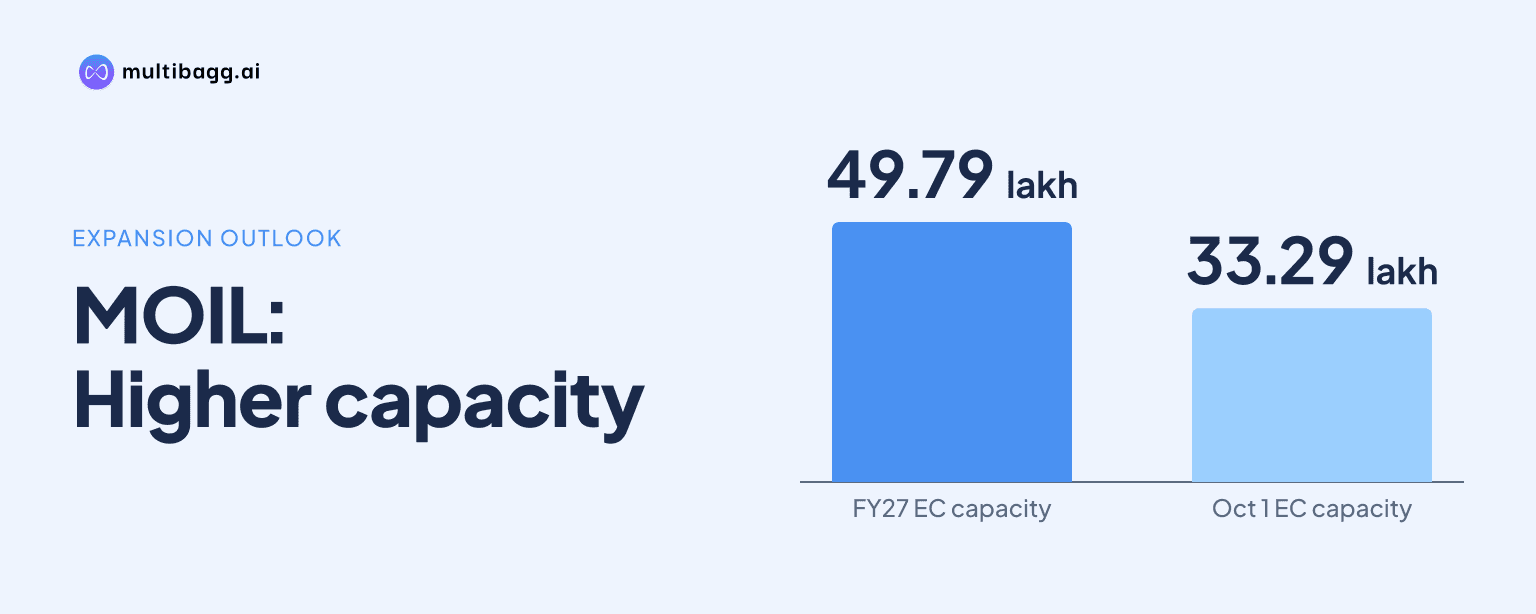
MOIL projects environmental-clearance capacity of 49.79 lakh tonnes for 2026-27, up from 33.29 lakh tonnes on 1 October 2026 through 16.50 lakh tonnes of planned regulatory additions. Its mine-development programme also includes a 660-metre high-speed shaft at Balaghat and supports management’s stated path to 3.5 million tonnes (Mt) of output.
Know MOIL inside out
Results, valuation, peers and who's buying, in one view.
How much environmental-clearance capacity is MOIL targeting?
MOIL is targeting total environmental clearance (EC) capacity of 49.79 lakh tonnes after proposed actions in 2026-27, compared with 33.29 lakh tonnes as of 1 October 2026. EC is the regulatory approval governing permitted capacity. The projected total comprises the existing 33.29 lakh tonnes, 13.65 lakh tonnes of expansions under process and 2.85 lakh tonnes of additional capacity for which applications are planned.
The increase totals 16.50 lakh tonnes, equivalent to about 50% of the capacity reported on 1 October 2026. MOIL describes 49.79 lakh tonnes as projected EC capacity rather than approved operating capacity. Accordingly, the 13.65 lakh tonnes under process and the 2.85 lakh tonnes still to be applied for remain separate stages in the regulatory plan.
Which mines account for MOIL’s EC expansion?
MOIL’s EC expansions under process in 2026-27 total 13.65 lakh tonnes a year, with Balaghat accounting for 7.98 lakh tonnes. Dongri Buz contributes 3.80 lakh tonnes, while Ukwa adds 0.96 lakh tonnes and Tirodi adds 0.91 lakh tonnes. Balaghat is therefore the largest identified element of the expansion-under-process programme.
MOIL also plans to apply for 2.85 lakh tonnes a year of additional EC capacity during 2026-27. Chikla accounts for 2 lakh tonnes of that amount and Tirodi accounts for 0.85 lakh tonnes. Tirodi is the only mine named in both groups, with 0.91 lakh tonnes under process and a further 0.85 lakh tonnes to be applied for.
The programme separates projects by regulatory status rather than treating all 16.50 lakh tonnes as a completed expansion. The 13.65 lakh tonnes under process is about 4.8 times the 2.85 lakh tonnes of applications planned, making the processing pipeline the larger contributor to the 49.79 lakh-tonne projection.
How has MOIL’s reserves and resources base changed since 2020?
MOIL reported reserves and resources of 127 Mt as of 1 April 2026, up 41% from 90 Mt on 1 April 2020. Reserves rose to 53.25 Mt from 32.81 Mt over that period, while resources increased to 73.75 Mt from 57.19 Mt. The total increase was therefore 37 Mt across the two classifications.
MOIL said it added 16.07 Mt in financial year (FY) 2024-25, its highest-ever year for exploratory core drilling. That annual addition is equivalent to about 43% of the 37 Mt increase between 1 April 2020 and 1 April 2026, although the presentation does not provide a year-by-year reconciliation between drilling additions and changes in reported reserves or resources.
Got a follow-up? Ask IRIS
What shafts is MOIL developing to reach deeper ore?
MOIL has two shafts nearing completion and three ongoing shaft projects, with the deepest being a 660-metre high-speed vertical shaft at Balaghat Mine. The other nearing-completion project is a 350-metre high-speed vertical shaft at Gumgaon Mine. MOIL says its shaft programme is intended to provide access to ore at depths of up to 660 metres when the shafts are ready.
The three ongoing projects are at Dongri Buzurg and Kandri. Dongri Buzurg has east and west ventilation shafts of 250 metres and 260 metres, respectively, plus a separate 505-metre shaft-sinking project. Kandri Mine has a 425-metre shaft-sinking project. The ventilation works are specifically described as supporting better working air in the mines.
MOIL says high-speed shafts support its path to 3.5 Mt of output, while the new shaft infrastructure is also intended to extend mine life through sustained production over future years. The presentation does not state a completion date for the 505-metre Dongri Buzurg shaft or the 425-metre Kandri shaft, nor does it quantify production capacity attributable to each shaft.
What other operating changes accompany MOIL’s mine expansion?
MOIL identifies mechanised development at different mines, new shaft-sinking contracts and a transition from cut-and-fill mining to the long-hole open-stope method among its key initiatives. It also describes a move towards Mining 5.0 through digitalisation and mechanisation. The presentation does not attach a capital cost, timetable or mine-by-mine production target to these initiatives.
MOIL lists eight digital initiatives under “MOIL 2.0”, including underground mine connectivity, remote operation of machinery from a surface control room, mine-planning software and artificial-intelligence-based strata monitoring. Other listed systems include automatic personal protective equipment detection, miner tracking and a company-wide shift to SAP S/4HANA enterprise resource planning software.
MOIL is also pursuing value addition from low-grade manganese fines. The presentation says material below 20% manganese that was once left on dumps can be upgraded through jigging and briquetting into saleable ore above 35% manganese for steel and ferro-alloy makers. This processing initiative sits alongside the capacity plan, but MOIL does not quantify its expected tonnage or revenue contribution.
Conclusion
MOIL’s 2026-27 plan combines a projected rise in EC capacity from 33.29 lakh tonnes to 49.79 lakh tonnes with deeper-access infrastructure led by a 660-metre shaft at Balaghat. Its reported mineral inventory also increased from 90 Mt on 1 April 2020 to 127 Mt on 1 April 2026, providing a larger stated reserves-and-resources base for the regulatory and mine-development agenda.
The next points to watch are progress on the 13.65 lakh tonnes of EC expansions under process, applications for the further 2.85 lakh tonnes, and completion of the three ongoing shaft projects at Dongri Buzurg and Kandri. Management’s stated path to 3.5 Mt depends on high-speed shafts, but the presentation gives no project completion dates or mine-level output schedule.

