








MOIL targets 3.5 Mt output as India's demand hits 15 Mt
MAX Plan at ₹4,999/yr

Find your next multibaggerBe a Pro Investor
Research stocks and track your picks on the go. Download the app.
Key highlights
- MOIL plans to produce 3.5 Mt of manganese ore in 2029-30, versus 2.585 Mt planned for 2026-27.
- India’s manganese ore demand is projected to rise from 10.8 Mt in FY 2025-26 to 15 Mt in 2030.
- MOIL produced 1.91 Mt in FY 2025-26, up 5.8% from 1.80 Mt in FY25.
- MOIL expects capital expenditure of Rs 400 crore in FY 2026-27, 22.8% above FY26.
powered by IRIS
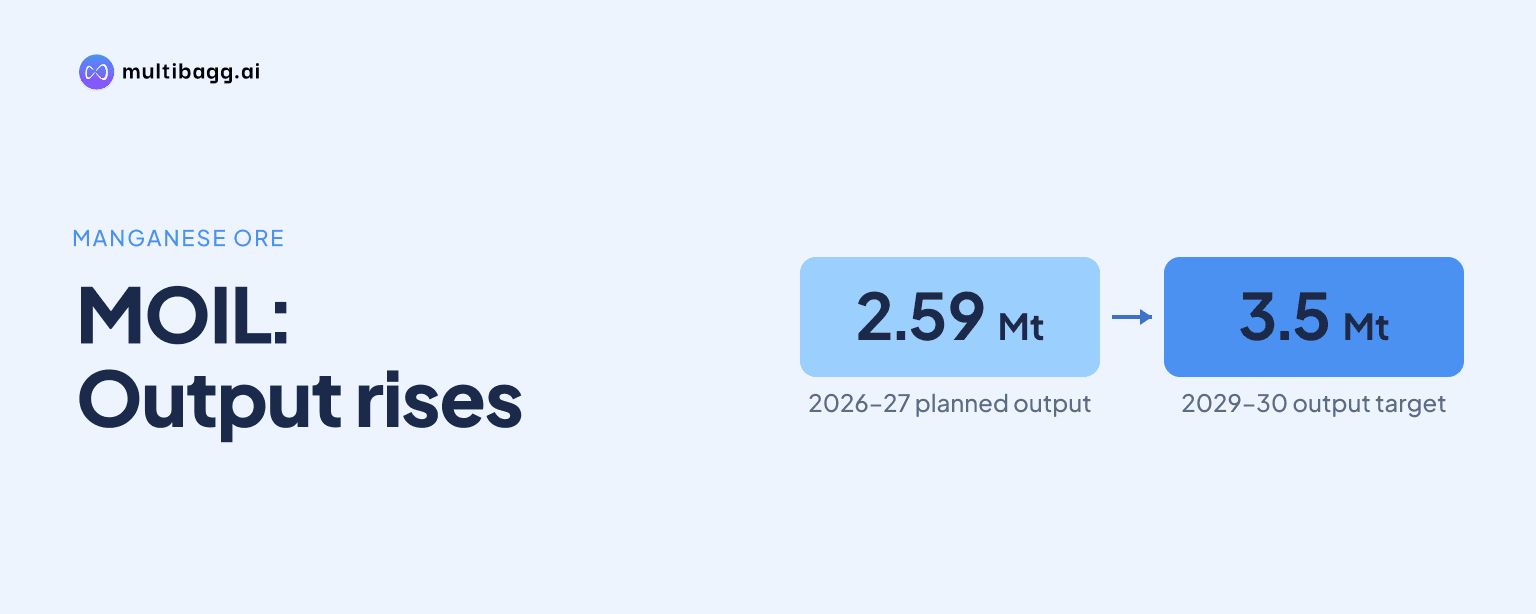
MOIL plans to produce 3.5 million tonnes (Mt) of manganese ore in 2029-30, compared with 2.585 Mt planned for 2026-27, as India’s manganese ore demand is projected to reach 15 Mt by 2030. MOIL says the plan would increase its share of Indian demand from 17% to 23%.
Know MOIL inside out
Results, valuation, peers and who's buying, in one view.
Why will India need more manganese ore by 2030?
India is projected to require 15 Mt of manganese ore in 2030, versus 10.8 Mt used in FY 2025-26. The presentation links the increase to the National Steel Policy outlook, which projects crude steel capacity of 294 Mt and crude steel production of 250 Mt in 2030, compared with 220 Mt and 170 Mt, respectively, in FY 2025-26.
The demand projection extends beyond 2030, with manganese ore demand shown at 22 Mt in 2035, 28 Mt in 2040 and 34 Mt in 2047. In FY 2025-26, alloy producers accounted for 89% of manganese ore usage, while chemical and other users accounted for 11%, tying most demand to alloy production.
India’s FY 2025-26 supply balance shows the scale of import dependence. Domestic manganese ore production was 3.9 Mt against consumption of 10.8 Mt, while imports were 6.9 Mt, or about 64% of consumption. Imports in the first half of FY27 rose 40% to 4.05 Mt from 2.89 Mt in the corresponding prior-year period.
India was the world’s second-largest manganese ore importer at 6.9 Mt in 2024, behind China at about 29 Mt, according to the presentation. Globally, South Africa is estimated to produce 7.6 Mt of manganese content in 2025, representing 38% of estimated world mine output of 20 Mt.
How has MOIL's manganese ore production changed?
MOIL produced 1.91 Mt of manganese ore in FY 2025-26, up 5.8% from 1.80 Mt in FY 2024-25. Output was also 55% above the 1.23 Mt reported in FY22, indicating that production had expanded before the 2029-30 target period.
MOIL’s sales did not match the FY26 rise in production. Sales remained at 1.59 Mt in FY25 and FY26 despite the 0.11 Mt increase in output, although sales rose 31% from 1.21 Mt in FY22 to 1.59 Mt in FY26.
MOIL accounted for 47% of India’s 3.9 Mt domestic manganese ore production in FY 2025-26. Sandur Manganese produced 0.59 Mt, up 16% from 0.51 Mt in FY25, while other producers contributed about 1.4 Mt; Maharashtra and Madhya Pradesh accounted for an estimated 33% and 30%, respectively, of national output.
Got a follow-up? Ask IRIS
What production path has MOIL set through 2029-30?
MOIL’s production plan rises from 2.585 Mt in 2026-27 to 3.5 Mt in 2029-30, an addition of 0.915 Mt. MOIL describes this as 35% growth over its 2026-27 production level.
The planned additions vary by year rather than following a uniform progression. The 0.315 Mt increase planned for 2027-28 is followed by a 0.20 Mt increase in 2028-29, before the largest addition of 0.40 Mt in 2029-30; the presentation lists annual growth of 12.2%, 6.9% and 12.9%, respectively.
MOIL says 3.5 Mt of production against projected national demand of 15 Mt would give it a 23% share by 2030, compared with 17% currently. This is a share of total Indian demand, rather than domestic mine production, and is set against a 4.2 Mt increase in demand from FY 2025-26 consumption of 10.8 Mt.
How will MOIL support its planned production growth?
MOIL identifies mechanised development, new shaft-sinking contracts and deeper mining as measures supporting output growth. It also plans to transition from Cut and Fill mining to Long Hole Open Stope mining, alongside full G1 exploration and digitalisation and mechanisation under its Mining 5.0 initiative.
Capital expenditure was Rs 325.79 crore in FY 2025-26, compared with Rs 215.58 crore in FY 2021-22, an increase of 51.1%. MOIL expects capital expenditure of Rs 400 crore in FY 2026-27, 22.8% above FY26, alongside the first year of its 2.585 Mt production outlook.
MOIL reported FY 2025-26 revenue of Rs 1,473 crore, total income of Rs 1,566 crore and earnings before interest, tax, depreciation and amortisation of Rs 508 crore. Net worth increased 26.5% to Rs 2,709 crore in FY 2025-26 from Rs 2,142 crore in FY 2021-22.
For April to September 2026, MOIL produced 9.61 lakh tonnes of manganese ore, 1.77% above the corresponding period of last year, and sold 7.78 lakh tonnes, up 9.61%. Revenue for the half year was Rs 740 crore, up 9%, while the reported earnings before interest, tax, depreciation and amortisation margin was 36.27%, up 15.14% from the corresponding period of last year.
Conclusion
MOIL’s 3.5 Mt target is aligned with a market expected to expand from 10.8 Mt of manganese ore use in FY 2025-26 to 15 Mt in 2030. Its FY26 production of 1.91 Mt represented 47% of domestic mine output, while its stated 23% target is measured against total Indian demand, much of which is currently met through 6.9 Mt of imports.
The next disclosed milestone is Rs 400 crore of expected capital expenditure and planned production of 2.585 Mt in FY 2026-27. Progress can then be assessed against the subsequent production targets of 2.90 Mt in 2027-28, 3.10 Mt in 2028-29 and 3.5 Mt in 2029-30, as well as changes in India’s import requirement.

