








Goel Construction lifts EBITDA margin to 10.1% in FY26
MAX Plan at ₹4,999/yr

Find your next multibaggerBe a Pro Investor
Research stocks and track your picks on the go. Download the app.
Key highlights
- GCC reported FY 2026 revenue of Rs 657 crore, compared with Rs 206 crore in FY 2022.
- GCC's adjusted EBITDA margin rose to 10.1% in FY 2026 from 9.0% in FY 2022.
- GCC's PAT margin increased to 7.0% in FY 2026 from 5.2% in FY 2022.
- GCC reported a FY 2027 order book of Rs 2,375 crore, about 3.6 times FY 2026 revenue.
powered by IRIS
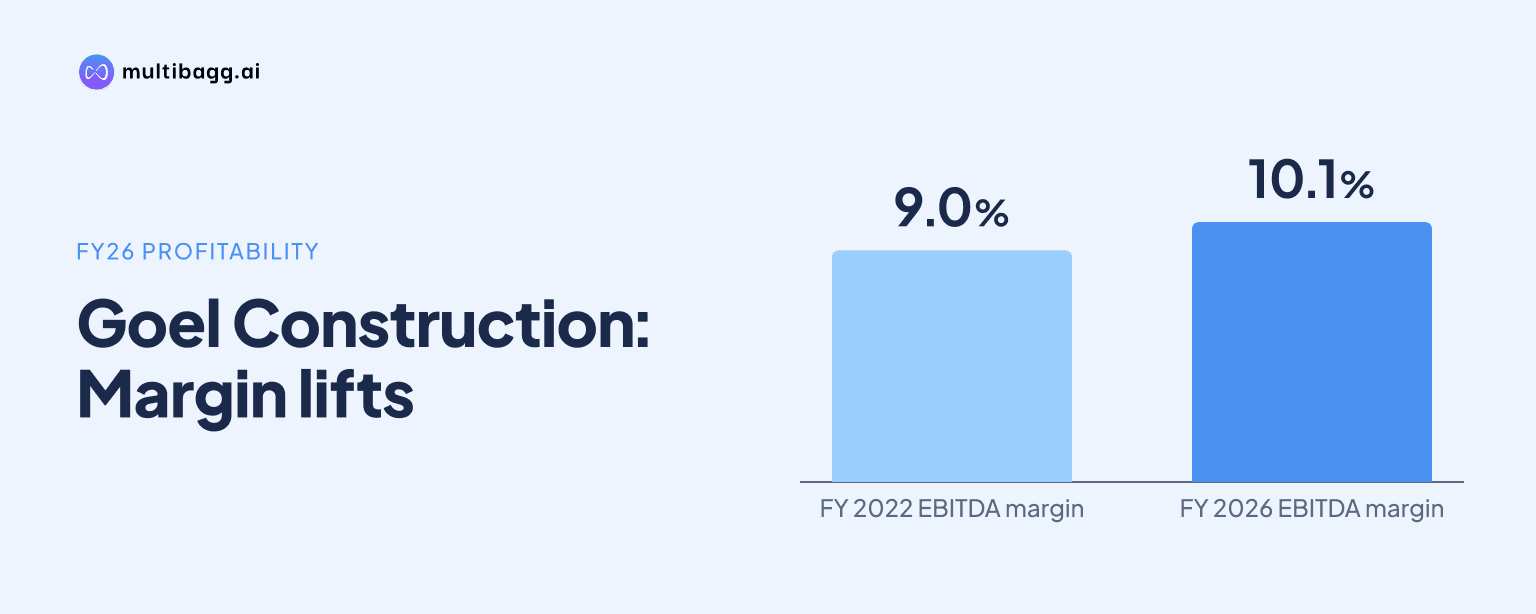
Goel Construction (GCC) reported a 10.1% adjusted EBITDA margin in FY 2026, compared with 9.0% in FY 2022, while revenue increased to Rs 657 crore from Rs 206 crore and profit after tax margin rose to 7.0% from 5.2%. The presentation reports faster growth in EBITDA and PAT than revenue over FY22-FY26.
Know Goel Construction Company inside out
Results, valuation, peers and who's buying, in one view.
How did GCC's revenue and profit grow from FY22 to FY26?
GCC increased revenue from Rs 206 crore in FY 2022 to Rs 657 crore in FY 2026, a rise of Rs 451 crore across the five financial years shown. EBITDA increased from Rs 19 crore to Rs 67 crore, while profit after tax, or PAT, rose from Rs 11 crore to Rs 46 crore.
The presentation reports a compound annual growth rate, or CAGR, of 33.6% for revenue over FY22-FY26. Its stated EBITDA CAGR was 37.6% and PAT CAGR was 44.1%, meaning both reported profit measures grew at higher annual rates than revenue during the period.
Revenue rose in every reported year, although the annual increase moderated to Rs 67 crore in FY 2026 from Rs 204 crore in FY 2025. EBITDA increased by Rs 9 crore in FY 2026 after rising Rs 22 crore in FY 2025, and PAT added Rs 8 crore after a Rs 15 crore increase in the previous year.
How did GCC's EBITDA margin reach 10.1%?
GCC's reported EBITDA margin increased by 1.1 percentage points, to 10.1% in FY 2026 from 9.0% in FY 2022. The presentation defines EBITDA as adjusted for letter-of-credit, or LC, discount charges, and reports FY 2026 EBITDA of Rs 67 crore on revenue of Rs 657 crore.
The margin did not rise in every year. It declined to 8.6% in FY 2023, despite EBITDA increasing to Rs 23 crore from Rs 19 crore, before moving to 9.4% in FY 2024, 9.8% in FY 2025 and 10.1% in FY 2026.
The largest disclosed increase was 0.8 percentage points between FY 2023 and FY 2024, when revenue rose from Rs 271 crore to Rs 386 crore and EBITDA grew from Rs 23 crore to Rs 36 crore. From FY 2025 to FY 2026, margin expanded by 0.3 percentage points as revenue grew by Rs 67 crore.
Management describes the margin trend as operational efficiency in its financial highlights and says topline growth was driven by order execution. The presentation does not provide a cost bridge or line-item explanation for the move from the 9.8% EBITDA margin in FY 2025 to 10.1% in FY 2026.
What changed in GCC's PAT margin over the period?
GCC's PAT margin rose by 1.8 percentage points, reaching 7.0% in FY 2026 from 5.2% in FY 2022. PAT increased in each financial year presented, from Rs 11 crore in FY 2022 to Rs 14 crore in FY 2023, Rs 23 crore in FY 2024, Rs 38 crore in FY 2025 and Rs 46 crore in FY 2026.
The margin rose gradually from 5.2% to 5.3% in FY 2023, then increased to 5.9% in FY 2024, 6.5% in FY 2025 and 7.0% in FY 2026. The stated 44.1% PAT CAGR exceeded the 37.6% EBITDA CAGR, but the source does not disclose depreciation, finance costs, tax expense or other items needed to reconcile EBITDA with PAT by year.
Management attributes the PAT trend to effective cost management in the financial-highlight commentary. That attribution sits alongside a Rs 35 crore increase in PAT between FY 2022 and FY 2026, while the reported PAT margin increased by 1.8 percentage points over the same period.
Got a follow-up? Ask IRIS
What execution changes accompanied GCC's profitability trend?
GCC's FY 2026 profitability trend coincided with its stated move from civil packages to integrated engineering, procurement and construction, or EPC, work. The company says its earlier typical civil-construction project size was about Rs 100 crore, whereas two Adani Group cement contracts with expanded scope are sized at Rs 300 crore to Rs 400 crore.
Those contracts include mechanical works and commissioning, structural fabrication and erection, electrification, instrumentation, and fire-fighting alongside civil construction. GCC says this adds five scope areas beyond civil work, represents projects that are three to four times larger, and retains the same billing terms with limited incremental working-capital requirements.
The presentation also states that GCC's FY 2027 order book was Rs 2,375 crore, about 3.6 times FY 2026 revenue of Rs 657 crore. It describes the order book as 17 times the Rs 143 crore level in FY 2022, alongside an increase in average project size from Rs 10 crore to Rs 20 crore to Rs 200 crore to Rs 300 crore.
How have order mix, cash flow and working capital changed?
GCC's disclosed order-book mix became less concentrated in cement, whose share fell to 77% in FY 2027 from 96% in FY 2022. Power accounted for 9%, steel for 7%, logistics for 6% and dairy for 1% in FY 2027, with the company saying it entered steel-plant and logistics-park segments in FY27.
The differing project mix carries differing stated execution periods: 12 months for cement plants, 12 to 18 months for dairy plants, and 18 to 24 months for power, steel and logistics projects. GCC does not provide FY 2027 revenue or margin guidance, so the Rs 2,375 crore order book does not specify the timing of revenue conversion.
Cash flow from operations rose to Rs 63 crore in FY 2026 from Rs 17 crore in FY 2022, after reaching Rs 24 crore, Rs 48 crore and Rs 38 crore in FY 2023, FY 2024 and FY 2025, respectively. GCC attributes its cash-flow profile to mobilisation advances, monthly billing and collection cycles, and reports cash flow from operations equal to 94.2% of operating profit.
Net working capital was Rs 11 crore in FY 2026, down from Rs 21 crore in FY 2022 and Rs 20 crore in FY 2025, though above the Rs 6 crore reported in FY 2024. The presentation also reports Rs 146 crore of cash reserves, while its core return on capital employed table shows 40% in FY 2026 after 42% in FY 2025.
Conclusion
GCC's financial record from FY 2022 to FY 2026 shows revenue growth alongside higher reported margins. Revenue rose from Rs 206 crore to Rs 657 crore, adjusted EBITDA margin increased from 9.0% to 10.1%, and PAT margin moved from 5.2% to 7.0%, with the stated PAT CAGR of 44.1% exceeding the 33.6% revenue CAGR.
The next disclosed items to watch are execution of the Rs 2,375 crore FY 2027 order book, the shift in cement's order-book share from 96% to 77%, and delivery of Rs 300 crore to Rs 400 crore integrated EPC contracts. GCC's stated timelines range from 12 months for cement projects to 18 to 24 months for power, steel and logistics projects, while the presentation provides no FY 2027 revenue or margin target.

