








Goel Construction’s order book grows 17-fold as mix broadens
MAX Plan at ₹4,999/yr

Find your next multibaggerBe a Pro Investor
Research stocks and track your picks on the go. Download the app.
Key highlights
- GCC’s FY2027 order book is Rs 2,375 crore, compared with Rs 143 crore in FY2022.
- Cement’s order-book share fell to 77% in FY2027 from 96% in FY2022.
- Power, steel and logistics represent about 22% of GCC’s FY2027 order book.
- GCC reported FY2026 revenue of Rs 657 crore and an EBITDA margin of 10.1%.
powered by IRIS
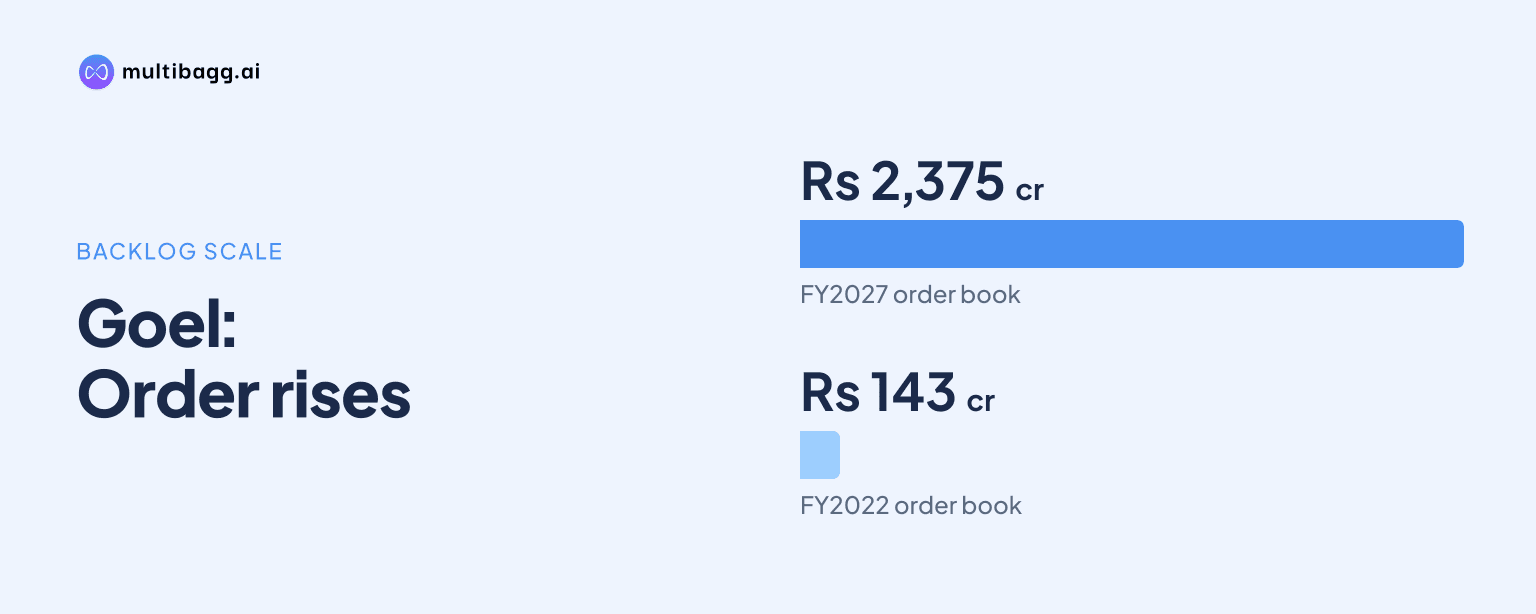
Goel Construction’s FY2027 order book stands at Rs 2,375 crore, 17 times the Rs 143 crore reported in FY2022, while cement’s share declined to 77% from 96%. GCC says power, steel and logistics together now account for about 22% of the backlog, which is about 3.6 times FY2026 revenue of Rs 657 crore.
Know Goel Construction Company inside out
Results, valuation, peers and who's buying, in one view.
How large is GCC’s order book now?
GCC’s current FY2027 order book is Rs 2,375 crore, compared with Rs 143 crore in FY2022. The presentation describes this as 17-fold growth over five years. Against FY2026 revenue of Rs 657 crore, GCC states that the backlog is about 3.6 times annual revenue, providing a disclosed measure of work relative to its latest reported sales year.
The increase in backlog coincides with larger contract values. GCC says average project size has increased from Rs 10-20 crore to Rs 200-300 crore, while its FY2022-25 scale-up phase included individual projects worth Rs 150-250 crore or more. Revenue rose to Rs 657 crore in FY2026 from Rs 590 crore in FY2025 and Rs 206 crore in FY2022.
GCC’s order book spans 14 states, compared with seven states in FY2022. Jharkhand represents 16% of the current book and Gujarat 14%, followed by Assam at 11%; Andhra Pradesh, Madhya Pradesh and Maharashtra each account for 9%. Bihar contributes 8%, Chhattisgarh 6%, Uttar Pradesh 6%, Rajasthan 6%, Karnataka 5% and Punjab 1%.
How has GCC reduced its reliance on cement projects?
GCC reduced cement’s stated share of its order book to 77% in FY2027 from 96% in FY2022. The 19-percentage-point shift leaves cement as the largest disclosed segment, while the remaining FY2027 mix comprises power at 9%, steel at 7%, logistics at 6% and dairy at 1%.
Power, steel and logistics together account for about 22% of the FY2027 order book. GCC says it entered steel plant and logistic park segments in FY2027. Its power-plant offering covers civil, structural and architectural work for balance of plant, including coal handling, water treatment, ash handling, silos, chimneys, cooling towers and water systems.
The sector shift also introduces different execution periods. GCC states that cement-plant projects have a 12-month timeline and dairy projects take 12-18 months, while power, steel and logistics projects take 18-24 months. Its cement work includes integrated engineering, procurement and construction, or EPC, assignments for clinkerisation and grinding units, including pre-heaters, cement mills, packing plants and silos.
Got a follow-up? Ask IRIS
What is changing in GCC’s project execution model?
GCC is moving from civil construction packages toward integrated EPC assignments that include mechanical, structural, electrification, instrumentation and fire-fighting work. The presentation cites two Adani Group cement contracts with expanded scope, stating that project size can rise to Rs 300-400 crore from an earlier typical level of about Rs 100 crore.
The company identifies five new scope areas beyond civil construction: mechanical works and plant commissioning, structural fabrication and erection, electrification, instrumentation, and fire-fighting. GCC says Rs 300-400 crore projects are three to four times larger than earlier Rs 100 crore projects, while terms of trade remain unchanged and incremental working-capital needs are limited.
Execution capacity is part of this model. GCC reports owning more than 280 construction equipment units, employing a dedicated team of more than 1,600 professionals and skilled workers, and having a manpower base exceeding 8,000 personnel. It also says it can undertake specialised high-elevation construction work up to 150 metres, relevant to structures including silos, chimneys and cooling towers.
What do GCC’s reported financial figures show?
GCC’s revenue rose to Rs 657 crore in FY2026 from Rs 206 crore in FY2022, and the company reports a compound annual growth rate of 33.6% over FY2022-26. Earnings before interest, tax, depreciation and amortisation, or EBITDA, increased from Rs 19 crore to Rs 67 crore, while EBITDA margin rose to 10.1% from 9.0%.
Profit after tax, or PAT, increased to Rs 46 crore in FY2026 from Rs 11 crore in FY2022. PAT margin increased from 5.2% to 7.0%, and GCC reports a FY2022-26 PAT compound annual growth rate of 44.1%. The presentation reports EBITDA after adjustment for letter-of-credit discount charges.
The latest annual comparison shows revenue growth in absolute rupees slowed from the prior year, while margins increased. Revenue rose by Rs 67 crore between FY2025 and FY2026, from Rs 590 crore to Rs 657 crore, versus a Rs 204 crore increase from FY2024 to FY2025. EBITDA increased from Rs 58 crore to Rs 67 crore and EBITDA margin advanced from 9.8% to 10.1%.
Conclusion
GCC’s backlog expansion has combined a larger geographic presence, rising project values and a broader industrial mix. Cement still accounts for more than three-fourths of the FY2027 order book, but the disclosed power, steel, logistics and dairy shares show that the company’s Rs 2,375 crore backlog is no longer as concentrated in one segment as it was in FY2022.
What to watch next is the conversion of the backlog into revenue across GCC’s stated 12-24 month execution timelines and its plan to increase participation in power, steel, logistics and other high-potential segments. The presentation also identifies a Rs 260 crore Adani Group power-plant order as GCC’s largest order win in its FY2026 new-growth phase.

