








MONIKA sees imported spirits reaching Rs 33,013 crore by 2029P
MAX Plan at ₹4,999/yr

Find your next multibaggerBe a Pro Investor
Research stocks and track your picks on the go. Download the app.
Key highlights
- India’s imported BIO spirits market is projected at Rs 33,013 crore in 2029P, versus Rs 17,989 crore in 2024.
- Imported BIO spirits hold 68% of the category with an MRP above Rs 1,000, according to MONIKA.
- India’s premium and luxury alcohol market is projected to reach Rs 50,000 crore in 2029P from Rs 28,751 crore in 2024.
- Customs and state duties account for 60.9% of BIO spirit MRP in Karnataka and 59.0% in Maharashtra in MONIKA’s examples.
powered by IRIS
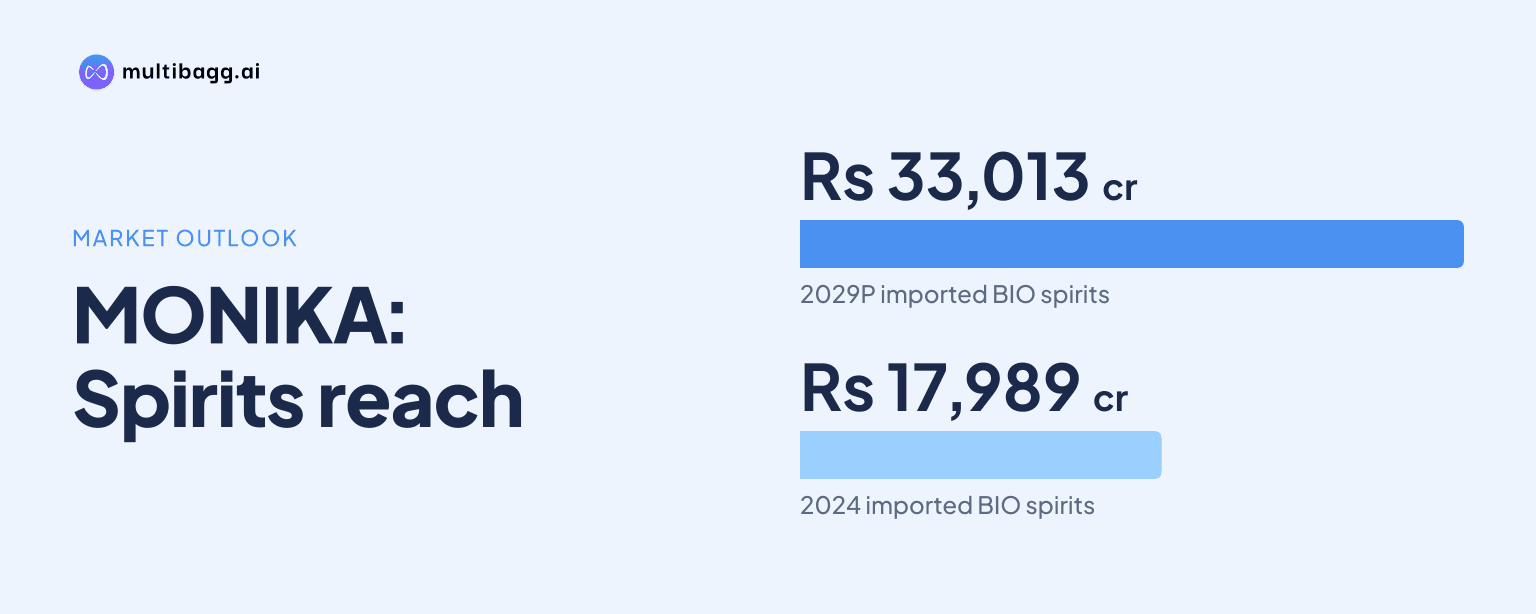
MONIKA Alcoholic Beverages Limited projects India’s imported bottled-in-origin spirits market at Rs 33,013 crore in 2029P, up from Rs 17,989 crore in 2024, as premium alcohol demand expands. The presentation also identifies state duties as a material constraint, representing 35.2% to 60.9% of maximum retail price in its three market examples.
Know Monika Alcobev inside out
Results, valuation, peers and who's buying, in one view.
How large could India’s imported BIO spirits market become?
India’s imported bottled-in-origin, or BIO, spirits market is projected to reach Rs 33,013 crore in 2029P, compared with Rs 17,989 crore in 2024 and Rs 6,722 crore in 2019. MONIKA groups Indian-made foreign liquor, or IMFL, and bottled-in-India, or BII, products within the domestic premium-and-above spirits category.
BIO added Rs 11,267 crore between 2019 and 2024, while domestic IMFL plus BII added Rs 4,307 crore over the same period. Between 2024 and 2029P, MONIKA projects BIO value to rise by Rs 15,024 crore, against a Rs 4,379 crore projected increase for the domestic category.
In 2024, BIO value was about 2.5 times that of domestic IMFL plus BII, based on Rs 17,989 crore versus Rs 7,220 crore. By 2029P, the difference is projected to widen to Rs 21,414 crore, with BIO at Rs 33,013 crore and domestic products at Rs 11,599 crore.
What is driving premium alcohol consumption in India?
MONIKA attributes premium alcohol growth to rising household incomes, including a projected increase in upper-middle-income households to 168 million in FY2030P from 107 million in FY2023. This income group, defined as annual household income of $10,000 to $50,000, is projected to represent 42% of households in FY2030P, up from 33%.
High-income households earning more than $50,000 annually are projected to increase to 12 million in FY2030P from 6 million in FY2023. Low-income households earning below $5,000 are projected to decline to 72 million, or 18% of households, from 77 million, or 24%.
The premium and luxury alcohol market is projected to reach Rs 50,000 crore in 2029P from Rs 28,751 crore in 2024 and Rs 12,291 crore in 2019. Its share of India’s total alcohol beverage market rose to 8.8% in 2024 from 5.6% in 2019 and is projected at 10% in 2029P.
How do demographics support MONIKA’s market opportunity?
MONIKA cites India’s median age of 29.5 years and population of about 1.4 billion as demographic support for alcohol consumption growth. India’s median age is below Brazil’s 34.7 years, the United States’ 38.5 years and China’s 39.8 years in the presentation’s comparison.
About 68% of India’s population is in the working-age bracket, while 33% is aged 21 to 40 and 22% is aged 41 to 60. A further 35% is below age 20, which MONIKA identifies as below the legal drinking age, or LDA, and says could reshape the consumption landscape over time.
MONIKA also identifies urbanisation, wider availability and higher brand engagement as industry drivers. Its operating model imports global spirits, wines and liqueurs through shipments, supplies licensed distributors and corporations, and uses an in-house trade-marketing team for on-trade and off-trade execution.
Got a follow-up? Ask IRIS
How do state duties affect BIO spirit retail prices?
Customs and state duties account for 59.0% of BIO maximum retail price, or MRP, in Maharashtra and 60.9% in Karnataka, according to MONIKA’s illustrative examples. Haryana has a lower stated duty share of 35.2%, showing how tax structures can create different retail-price compositions across states.
Cost, insurance and freight, or CIF, makes up 10.4% of MRP in Maharashtra, 8.8% in Karnataka and 17.2% in Haryana. Trade margin represents 30.5% in Maharashtra, 30.3% in Karnataka and 47.5% in Haryana, alongside Haryana’s lower duty share.
MONIKA says duties may vary according to applicable criteria and that state-driven taxes result in non-uniform pricing. Maharashtra, Goa, Assam and Delhi-NCR are listed under a distributor model, while Rajasthan, Karnataka and Telangana use a corporation model in which the state corporation buys from the company and sells to retailers.
What capabilities does MONIKA cite for serving this market?
MONIKA says it operates in more than 25 states with a sales and marketing team of more than 150 members across Tier 1 and Tier 2 cities. Its network includes a master bonded warehouse at Nhava Sheva, Maharashtra, plus bonded warehouses serving Delhi, Haryana and Uttar Pradesh in the north, Maharashtra in the west, and Karnataka in the south.
The company reported more than 800 on-trade and experiential activations in FY26. MONIKA also says it onboarded Jinro Soju and Licor 43 and entered Kerala in FY26, followed by the onboarding of Angostura and Remy Cointreau brands in H1FY27.
Conclusion
The presentation links the projected expansion of imported BIO spirits with a wider premium alcohol market, rising higher-income household groups and BIO’s 68% share of spirits priced above an MRP of Rs 1,000. The state-level duty range of 35.2% to 60.9%, however, means market value growth operates within differing tax, pricing and distribution structures.
The next disclosed developments to watch are MONIKA’s execution following its FY26 Kerala entry and the brand additions reported in H1FY27. Its more-than-25-state presence, more-than-150-member sales and marketing team, bonded-warehouse network and state-specific distribution arrangements are the mechanisms MONIKA identifies for managing that expansion.

