








Monika Alcobev Limited shifts mix to white spirits and West
MAX Plan at ₹4,999/yr

Find your next multibaggerBe a Pro Investor
Research stocks and track your picks on the go. Download the app.
Key highlights
- White spirits represented 54% of Monika revenue in H1FY27, up from 39% in FY23.
- West contributed 40% of Monika revenue in H1FY27, compared with 28% in FY23.
- Travel Retail & Sub-continent declined to 6% of revenue in H1FY27 from 24% in FY24.
- Monika reported 7,500 actively tapped touchpoints in H1FY27 and targets about 20,000 by FY28.
powered by IRIS
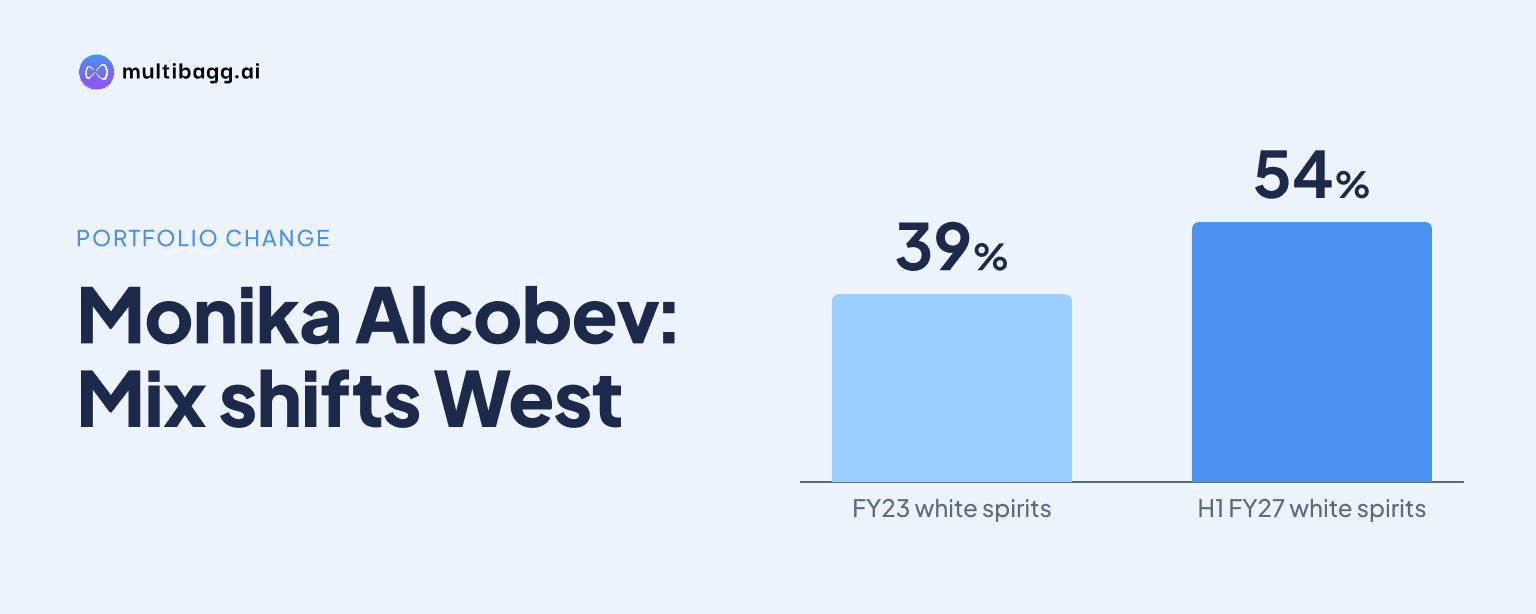
In the first half of fiscal year 2027 (H1FY27), Monika Alcobev Limited reported that white spirits supplied 54% of revenue and West supplied 40%, compared with 39% and 28%, respectively, in fiscal year 2023 (FY23). The reported mix therefore shifted 15 percentage points toward white spirits and 12 percentage points toward West over the period.
Know Monika Alcobev inside out
Results, valuation, peers and who's buying, in one view.
How has Monika’s product revenue mix changed?
Monika’s product mix has shifted toward white spirits, whose revenue contribution rose from 39% in FY23 to 54% in H1FY27. White spirits became the largest disclosed category in FY26, when they represented 55% of revenue, ahead of brown spirits at 34%, and remained the largest category despite easing by 1 percentage point in H1FY27.
Brown spirits were Monika’s largest category in FY23, at 43%, and FY24, at 46%, but their share fell to 36% in H1FY27. Wine declined from 14% of revenue in FY23 to 5% in H1FY27, while liqueurs stayed within a 4% to 5% range across the five reported periods. These are revenue-mix measures, and the presentation does not disclose absolute revenue by product category.
The annual progression shows the largest change occurred between FY25 and FY26. White spirits increased from 42% to 55% over that year, while brown spirits declined from 44% to 34%; wine also moved from 9% to 7%. In H1FY27, white spirits held 18 percentage points more of Monika’s revenue mix than brown spirits, at 54% against 36%.
Why are white spirits Monika’s largest disclosed category?
White spirits are Monika’s largest disclosed category because their 54% H1FY27 revenue share exceeded brown spirits’ 36% share by 18 percentage points. The category had trailed brown spirits by 2 percentage points in FY25, at 42% versus 44%, before overtaking it in FY26 at 55% versus 34%.
Monika identifies entry into new product categories and sub-segments across premium, luxury and emerging trends as a strategic growth pillar. It names Jinro, Licor43 and Angostura as newer brands expanding its portfolio, but does not disclose the revenue of any brand or quantify the contribution of those additions to white spirits’ 54% mix share.
Monika also says it can price products state-wise in response to differing excise duties and tax structures. That is a disclosed operating mechanism rather than a stated explanation for the category shift. The presentation does not allocate category revenue by state, brand, retail channel or price point, so it does not establish the drivers of the FY25-to-FY26 increase in white spirits.
Got a follow-up? Ask IRIS
How has Monika’s geographic revenue mix changed?
Monika’s West revenue share rose to 40% in H1FY27 from 28% in FY23, making it the second-largest reported geography behind North at 41%. West gained 12 percentage points over the period, while North gained 2 percentage points from its FY23 share of 39%.
Travel Retail & Sub-continent recorded the largest geographic decline, falling from 17% of revenue in FY23 to 6% in H1FY27. Its share first rose to 24% in FY24, then fell to 14% in FY25 and 9% in FY26. The presentation reports the movement but does not provide a reason for the decline.
West increased in every full year shown, from 28% in FY23 to 30% in FY24, 35% in FY25 and 38% in FY26, before reaching 40% in H1FY27. North reached 44% in FY26 before declining 3 percentage points to 41% in H1FY27. South moved from 14% in FY23 to 12% in H1FY27, while Central & East was 1% after reaching 0.4% in FY25.
What plans could influence Monika’s future revenue mix?
Monika plans to expand its portfolio and geographic reach while increasing sales per retail outlet and per brand through upselling, cross-promotion and brand education. It reported 7,500 actively tapped touchpoints in H1FY27, compared with 6,607 in FY26 and 2,124 in FY23, and has set a target of about 20,000 touchpoints by FY28.
The company reported 800 experiential activations in FY26, up from 550 in FY25. Management says it intends to build consumer awareness through influencer collaborations and on-ground brand activations, while adding brand offerings and stock-keeping units (SKUs) across price points. The presentation does not forecast the future revenue share of white spirits, West or any other category or geography.
Monika says its FY27 revenue-growth outlook remains intact and that working-capital levels are expected to rationalize going forward. Its net working-capital days rose from 399 in FY25 to 472 in FY26, with inventory days increasing from 294 to 348 over the same period. Management says higher inventory in FY26 was intended to support market expansion and manage demand volatility.
Conclusion
Monika’s reported revenue mix has become more concentrated in white spirits and West, which accounted for 54% and 40%, respectively, in H1FY27. Brown spirits declined to 36%, wine to 5%, and Travel Retail & Sub-continent to 6%, indicating changes across both product categories and sales geographies since FY23.
The next disclosed benchmark is Monika’s target of about 20,000 actively tapped touchpoints by FY28, from 7,500 in H1FY27. Management’s FY27 revenue-growth outlook and expectation of rationalising working capital will be relevant to whether portfolio additions, retail activity and geographic expansion continue to alter the reported mix.

