










Monolithisch India raises approved capacity to 17.48 lakh tonnes
Key highlights
- Monolithisch India received its second Nawada quartzite block through a Bihar government e-auction on 17 November 2026.
- The new Nawada block adds approved annual mining capacity of 10.38 lakh metric tonnes.
- Combined approved annual capacity across Monolithisch India’s two adjacent Nawada blocks is 17.48 lakh metric tonnes.
- The new block has a five-year extraction approval of 51.90 lakh metric tonnes and royalty-inclusive consideration of Rs 274.50 crore.
powered by IRIS
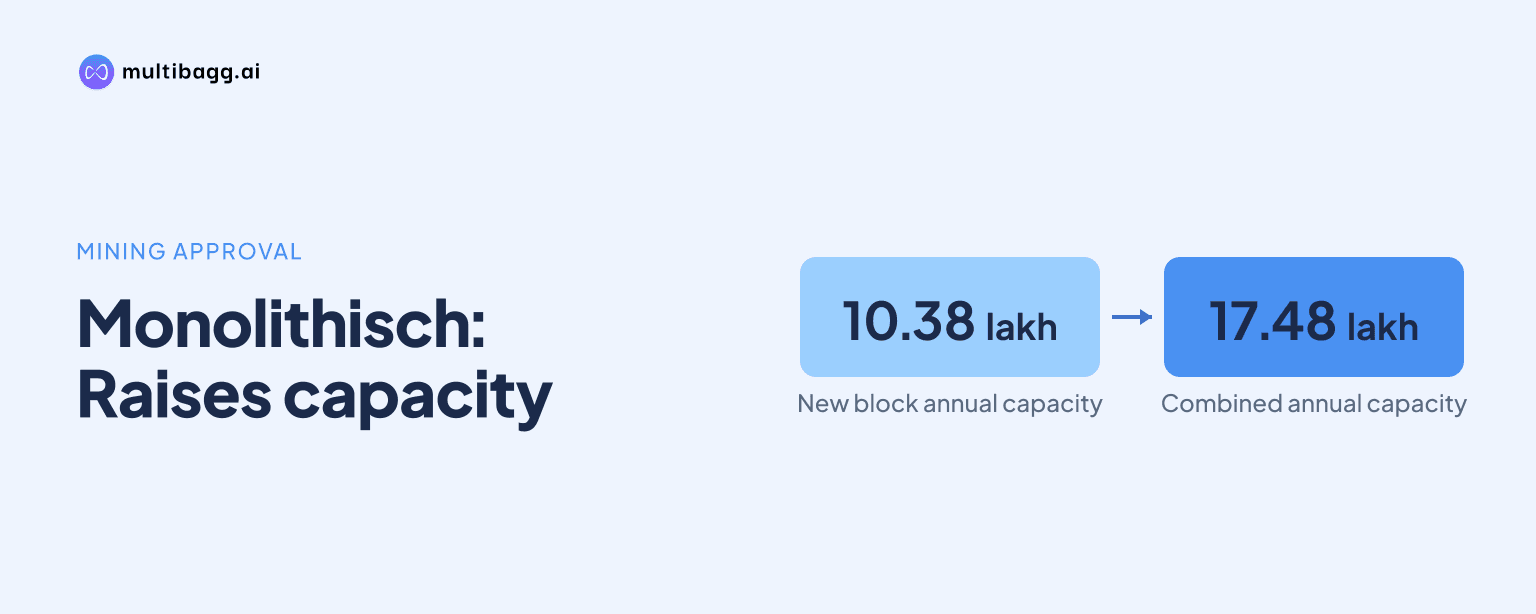
Monolithisch India Limited said on 17 November 2026 that its second allotted quartzite block in Nawada, Bihar, raises combined government-approved annual mining capacity to 17.48 lakh metric tonnes, including 10.38 lakh metric tonnes a year from the new block. The block also has approved cumulative extraction of 51.90 lakh metric tonnes over five years.
Know Monolithisch India inside out
Results, valuation, peers and who's buying, in one view.
What did Monolithisch India win in Nawada?
Monolithisch India won its second quartzite stone block in Nawada district, Bihar, through an e-auction conducted by the Mines and Geology Department of the Government of Bihar on 17 November 2026. The company disclosed the allotment under Regulation 30 of the Securities and Exchange Board of India Listing Obligations and Disclosure Requirements Regulations, 2015.
The new Nawada block is adjacent to Monolithisch India’s previously allotted mining block in the district. The company said the two-block raw-material base supports its existing operations and its plan to build an integrated silica and advanced-materials platform, including potential silica-based industrial products.
How much mining capacity does the second block add?
The new block adds approved annual mining capacity of 10.38 lakh metric tonnes, taking Monolithisch India’s total approved capacity across the two Nawada blocks to 17.48 lakh metric tonnes a year. The previously allotted block has approved annual capacity of 7.10 lakh metric tonnes, so the total approved capacity has increased by the full 10.38 lakh metric tonnes a year allocated to the new block.
The new block has approved cumulative extraction of 51.90 lakh metric tonnes over five years. That quantity is consistent with the disclosed 10.38 lakh metric tonnes of annual approved capacity for the new block, while the announcement does not state a five-year extraction quantity for the earlier 7.10 lakh metric tonne annual-capacity block.
The disclosed figures are government approvals rather than reported mining output. Monolithisch India said actual mining from the new 10.38 lakh metric tonne annual-capacity block is targeted only after statutory approvals and clearances are obtained.
What will Monolithisch India pay for the new block?
Monolithisch India disclosed royalty-inclusive total consideration of Rs 274.50 crore for the newly allotted Nawada block. The company said this consideration will be paid in multiple tranches over five years, the same period covered by the 51.90 lakh metric tonne cumulative extraction approval.
The announcement does not provide the size or due dates of the individual payment tranches within the Rs 274.50 crore consideration. It also does not split the royalty-inclusive amount into royalty and other components, so the disclosure does not establish a standalone royalty rate or a per-tonne acquisition cost.
Monolithisch India plans to extract material through a per-tonne pay-raising contract. The filing identifies that mining model but does not name a contractor, disclose a per-tonne contract price, specify mine-development expenditure or provide an initial production volume for the 10.38 lakh metric tonne annual-capacity block.
Got a follow-up? Ask IRIS
When does Monolithisch India plan to begin mining?
Monolithisch India is targeting April 2027 for the start of mining at the newly allotted Nawada block, subject to statutory approvals and clearances. The April 2027 date is a target rather than a confirmed start because the company specifically attached regulatory conditions to operational commencement.
The period from the 17 November 2026 allotment to the April 2027 target covers the approvals and clearances identified in the announcement. Monolithisch India did not list each required approval, provide a construction or development timetable, or state what production level it expects at the start of mining.
Management linked the block’s operationalisation to the company’s silica-products programme. Managing Director Harsh Tekriwal said Monolithisch India aims to progressively develop commercially viable silica-based products alongside operationalisation of the new block, subject to technical, regulatory and commercial evaluations.
Which products could Nawada quartzite support?
Monolithisch India said the expanded raw-material base could potentially support foundry-grade silica, glass-grade silica, speciality silica for paints and industrial applications, and tile adhesives and related construction chemicals. These are product areas under consideration rather than products that the 17 November 2026 announcement says are in commercial production.
The company said it used raw material sourced from the relevant mining area in 2019 and assessed the quartzite’s quality and suitability for targeted industries. Based on that assessment, Monolithisch India said the enlarged Nawada resource base could support potential development of foundry-grade sand, glass-grade sand and speciality silica for paint and adhesive applications.
Mr. Tekriwal said management has conducted preliminary demand assessments and evaluated processing technologies for possible value-added products, including foundry-grade silica, industrial-grade silica sand and tile adhesive. He said product development would proceed progressively only where the technical, regulatory and commercial evaluations support viable products.
Conclusion
The second Nawada allotment increases Monolithisch India’s approved annual mining capacity from 7.10 lakh metric tonnes at its earlier block to 17.48 lakh metric tonnes across two adjacent blocks. The new block supplies 10.38 lakh metric tonnes of annual approved capacity, a five-year extraction approval of 51.90 lakh metric tonnes and a royalty-inclusive consideration of Rs 274.50 crore.
The next disclosed operating milestone is Monolithisch India’s April 2027 target for starting mining, subject to statutory approvals and clearances. Progress on the per-tonne pay-raising arrangement and the company’s technical, regulatory and commercial evaluations for silica products will determine whether the larger resource base supports the planned diversification.