










Monolithisch India Adds Nawada Block, Capacity Reaches 17.48 Lakh TPA
Key highlights
- Monolithisch India secured its second Nawada quartzite block for ₹274.50 crore over five years.
- The new Nawada block has approved mining capacity of 10.38 lakh tonnes per annum.
- The two Nawada blocks raise Monolithisch India’s combined approved capacity to 17.48 lakh tonnes per annum.
- The second block is targeted to begin commercial operations in April 2027.
powered by IRIS
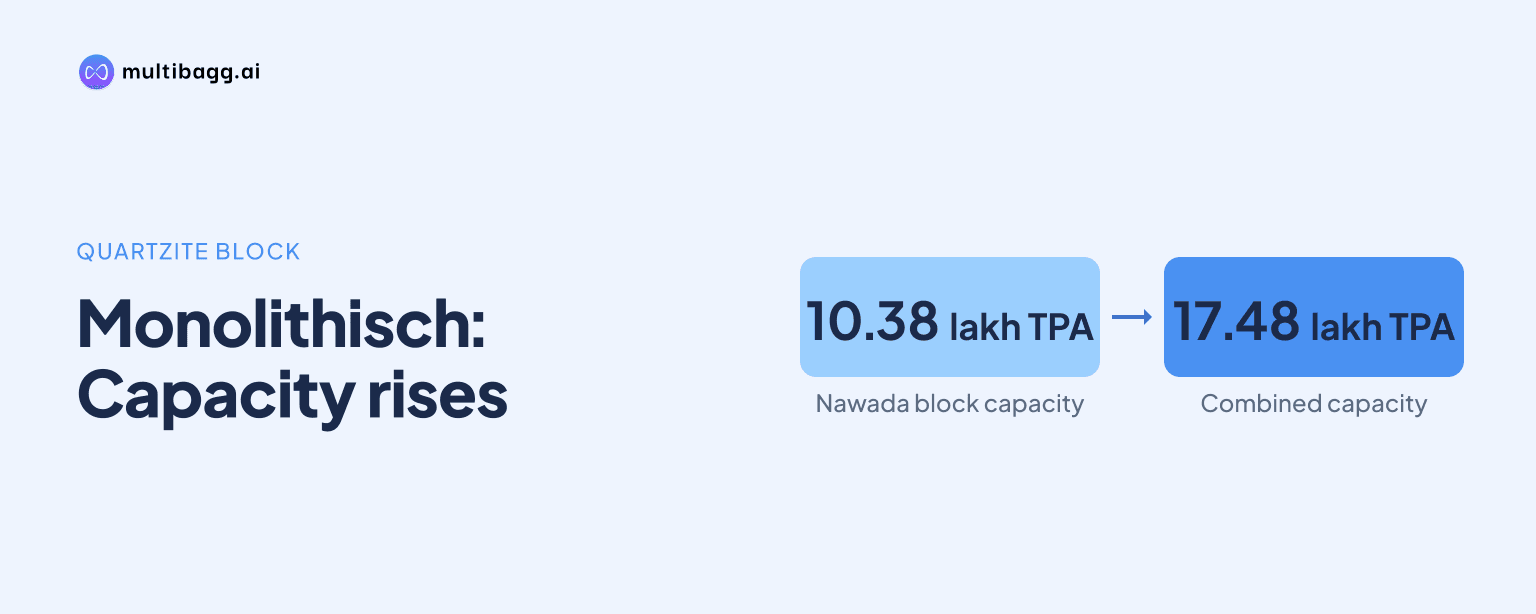
Monolithisch India Ltd. has secured a second quartzite mining block in Nawada, Bihar, for ₹274.50 crore over five years, lifting its combined approved mining capacity in the district to 17.48 lakh tonnes per annum. The new block has approved capacity of 10.38 lakh tonnes per annum and is targeted to begin operations in April 2027.
Know Monolithisch India inside out
Results, valuation, peers and who's buying, in one view.
What did Monolithisch India secure in Nawada?
Monolithisch India secured its second adjacent quartzite mining block in Nawada through a Bihar government e-auction on 17 November 2026. The company will pay ₹274.50 crore over five years under a royalty-inclusive, per-tonne contract structure for the newly allotted block.
The approved annual mining capacity of the second block is 10.38 lakh tonnes. Added to the 7.10 lakh tonnes per annum capacity of the first Nawada block secured in September, the company’s combined approved capacity reaches 17.48 lakh tonnes per annum.
Quartzite is a source of silica, an input used across refractory, foundry, glass and speciality silica applications. The new allotment therefore extends Monolithisch India’s raw-material sourcing base as it pursues expansion in these end-use categories, including tile adhesives.
How does the second block fit Monolithisch India’s strategy?
The second allotment expands Monolithisch India’s backward-integration strategy by bringing another quartzite source into its supply chain. The company has indicated that the additional material availability is intended to support its foundry, glass, speciality silica and tile-adhesive expansion plans.
The two blocks are adjacent in Nawada, which places the company’s newly allotted mining capacity in the same district. The available information does not provide production estimates, sales volumes or financial contributions from either block, but it establishes the approved capacity and the respective five-year allotment terms.
For the earlier block, Monolithisch India had said mining would be undertaken through per-tonne raising contracts. It also disclosed plans to establish a beneficiation and storage unit near the site. Commercial activity on that block remains subject to statutory clearances.
The latest block also uses a per-tonne contract arrangement and carries a target of April 2027 for the start of operations. The stated timeline is later than the February or March 2027 expectation disclosed for the first block.
Got a follow-up? Ask IRIS
Why is quartzite supply important for the company?
Quartzite supply is important because the mineral provides silica used in industrial applications such as refractories, foundry products and glass. Securing mining blocks can give an industrial user or processor a defined source of raw material rather than relying entirely on external purchases.
Monolithisch India’s September allotment was described as a move to strengthen raw-material security and improve inventory efficiency. The second block adds 10.38 lakh tonnes of approved annual capacity to that initial 7.10 lakh tonnes capacity base.
The company’s earlier disclosures also referred to additional facilities planned in Udaipur, Rajasthan, and near Hospet, Karnataka. Those facilities were expected to add combined capacity of 3 lakh tonnes per annum, with estimated investment of ₹45 crore. The supplied information does not specify how their commissioning schedules align with the Nawada mining operations.
The mining allotments are separate from those planned facilities, but both form part of the company’s stated expansion activity. Investors will need to assess future disclosures on approvals, operating ramp-up and the eventual use of mined quartzite across the company’s businesses.
What are the financial and operating details investors should track?
Investors should track the ₹274.50 crore consideration for the new block, which is payable over five years and is described as royalty-inclusive. This is the winning consideration for the second block and should not be treated as a disclosed combined cost for both Nawada allotments.
The first block was won for ₹157 crore and has a five-year term. Its approved capacity was stated at 7.10 lakh tonnes annually, or 35.5 lakh tonnes across the five-year period. Comparable total-life capacity for the second block was not stated in the supplied information.
The main operational milestones are statutory approvals for the first block and the targeted start dates. Monolithisch India expects commercial operations from the first block in February or March 2027, while the second block is targeted for an April 2027 start.
No share-price movement, revenue projection, margin impact or funding arrangement was provided with the announcement. As a result, the immediate market relevance lies in the scale of approved mining capacity, the five-year contractual commitments and execution against the stated operating timetable.
Conclusion
Monolithisch India’s second Nawada allotment materially increases its approved quartzite mining capacity to 17.48 lakh tonnes per annum. The ₹274.50 crore, five-year contract adds 10.38 lakh tonnes of annual capacity and strengthens the company’s stated effort to secure raw material for several silica-linked industrial applications.
The next points to watch are statutory clearances and the expected start of the first block in February or March 2027, followed by the April 2027 target for the second block. Further company disclosures on mining ramp-up, beneficiation infrastructure and the use of quartzite in its expansion plans will clarify the operating impact.