










Compuage Infocom Limited Faces Liquidation Application in CIRP
Key highlights
- Compuage Infocom Limited's CIRP was admitted by the NCLT, Mumbai Bench on 2 November 2023.
- The committee of creditors considered liquidation of CIL at its meeting on 14 August 2025.
- The resolution professional's liquidation application, IA(LIQ.)/94/2025, was recorded in an order delivered on 2 December 2025.
- Gajesh Labhchand Jain was appointed as CIL's resolution professional by an NCLT order dated 29 April 2024.
powered by IRIS
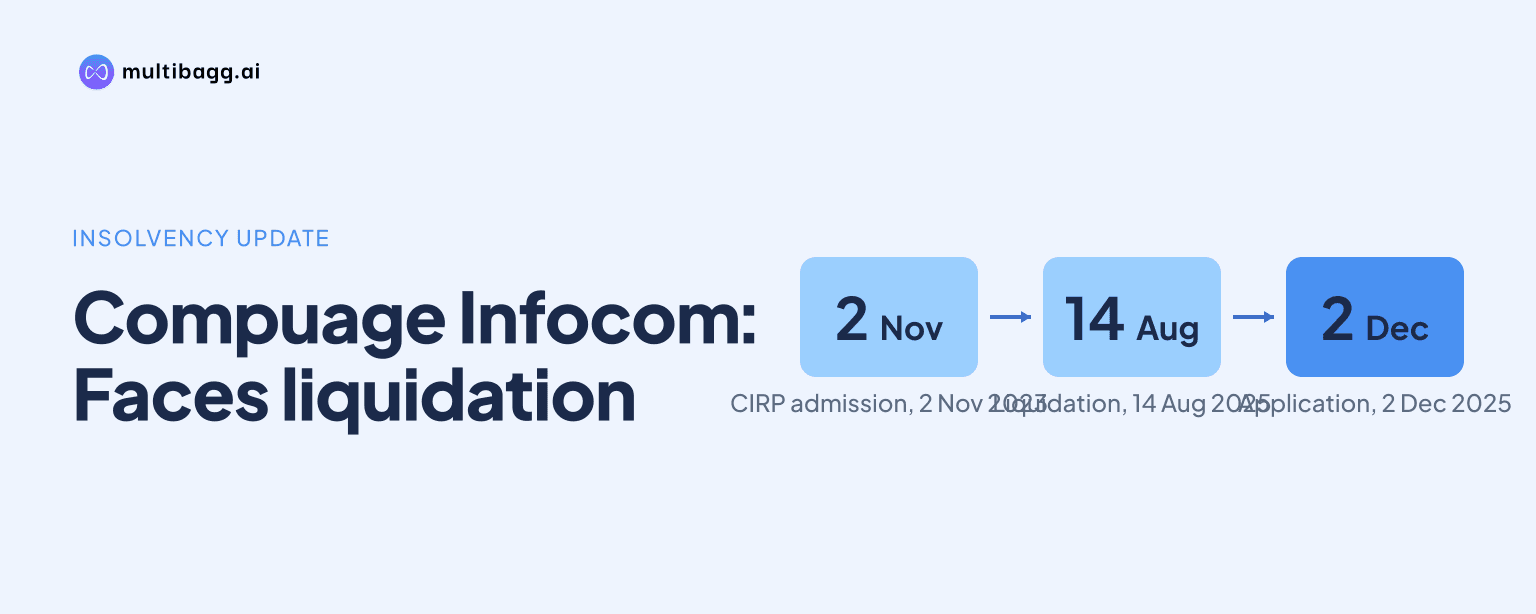
Compuage Infocom Limited faced a liquidation application during its corporate insolvency resolution process after the committee of creditors considered a resolution for liquidation at its 14 August 2025 meeting. The National Company Law Tribunal, Mumbai Bench had admitted the company into the process on 2 November 2023, while the available records do not state that a final liquidation order has been passed.
Know Compuage Infocom inside out
Results, valuation, peers and who's buying, in one view.
Why does Compuage Infocom Limited face a liquidation application?
Compuage Infocom Limited, referred to as CIL in the insolvency records, faces the application because its resolution professional sought liquidation under Section 33 of the Insolvency and Bankruptcy Code, 2016. The application, numbered IA(LIQ.)/94/2025 in CP(IB)/329(MB)2023, was placed before the National Company Law Tribunal, Mumbai Bench.
The order delivered on 2 December 2025 records that the committee of creditors, or CoC, convened on 14 August 2025. Under agenda item 12, members were to discuss liquidation of CIL. The resolution professional's counsel submitted that a resolution to liquidate the corporate debtor under Section 33(2) of the IBC had been proposed and that the CoC members had voted on it.
The extract supplied from the order does not disclose the voting outcome, the voting share supporting the proposal, or an order directing liquidation. Counsel for the resolution professional told the tribunal that liquidation was the only option and requested issuance of notices to respondents who were CoC members. Therefore, the available material establishes that a liquidation application was pursued, not that CIL has already entered liquidation.
How did Compuage Infocom Limited enter the insolvency process?
CIL entered the insolvency process after a creditor initiated a Section 7 CIRP application on 20 March 2023. The NCLT's order of 2 November 2023 admitted the application and directed the commencement of CIRP against CIL in case CP(IB)/329/MB/2023.
The 2 November order also appointed an interim resolution professional. Gajesh Labhchand Jain subsequently replaced the interim professional as CIL's resolution professional under an NCLT order dated 29 April 2024, which was received on 9 May 2024 according to a public notice cited in the source material.
Under the IBC framework described in the records, management powers vested with the interim resolution professional are transferred to the appointed resolution professional. Public notices stated that CIL's affairs, business and assets were being managed by Jain during CIRP. The resolution professional also invited bids for the sale of CIL inventory through e-auction on an "as is where is", "as is what is", "whatever there is" and "without recourse" basis in the ordinary course of business.
Got a follow-up? Ask IRIS
What does the IBC process mean for CIL's operations and creditors?
The IBC permits a corporate debtor to move into liquidation if no resolution plan is proposed or accepted by the NCLT. Section 33(1), as referred to in the source material, sets out this route when a resolution plan does not emerge or obtain approval. Section 33(2) concerns a CoC decision to liquidate.
A resolution professional manages the company during CIRP rather than its prior management. This is significant for creditors, customers, suppliers and other counterparties because asset sales, claims handling and operational decisions take place through the insolvency process. The inventory e-auction notice indicates that asset disposal was being pursued during the process, although the material does not provide sale proceeds, inventory value or bidder details.
For financial stakeholders, the liquidation application is a procedural development rather than a disclosed recovery outcome. The source does not state the amount of admitted claims, CIL's liabilities, asset value, creditor recoveries or any approved resolution plan. These figures would be needed to assess the financial consequences for individual creditor classes.
What is the Singapore court's role in CIL's insolvency case?
A Singapore court recognised CIL's Indian CIRP as a foreign main proceeding under Singapore's cross-border insolvency framework. The recognition related to the CIRP admitted by the NCLT on 2 November 2023 and recognised Jain as the foreign representative for purposes of the UNCITRAL Model Law framework adopted in Singapore.
The court granted OA 1272 except for the requested additional power allowing Jain to repatriate or return CIL assets or proceeds in Singapore to the Indian estate. It ordered that no assets, or proceeds from them, could be repatriated or returned to CIL's estate in India without leave of the Singapore court.
This condition creates a separate judicial safeguard for assets located in Singapore. It does not alter the Indian CIRP admission or establish a liquidation outcome in India. Instead, it means that any movement of Singapore assets or sale proceeds back to the Indian insolvency estate requires further court permission.
Conclusion
CIL's insolvency process has progressed from a creditor's March 2023 application to NCLT admission in November 2023, a change in the resolution professional in April 2024, and a liquidation application considered after the CoC's August 2025 meeting. The records support the existence of the application and the CoC discussion, but do not confirm a final NCLT order placing the company into liquidation.
The next material development is any NCLT decision on IA(LIQ.)/94/2025 or a further CoC action on liquidation. Stakeholders should also watch for court permissions concerning assets or proceeds in Singapore, as the Singapore court has required leave before they can be returned to CIL's estate in India.