










Lords Chloro Alkali reaches 40% renewable power after solar expansion
Key highlights
- Lords Chloro Alkali commissioned 21 MW DC of captive solar capacity with a Battery Energy Storage System.
- Total captive and group-captive renewable capacity has reached 47 MW DC.
- Renewable sources now meet about 40% of Lords Chloro Alkali's total energy consumption.
- Power and fuel expenses declined Rs 5 crore quarter-on-quarter to Rs 37.79 crore.
powered by IRIS
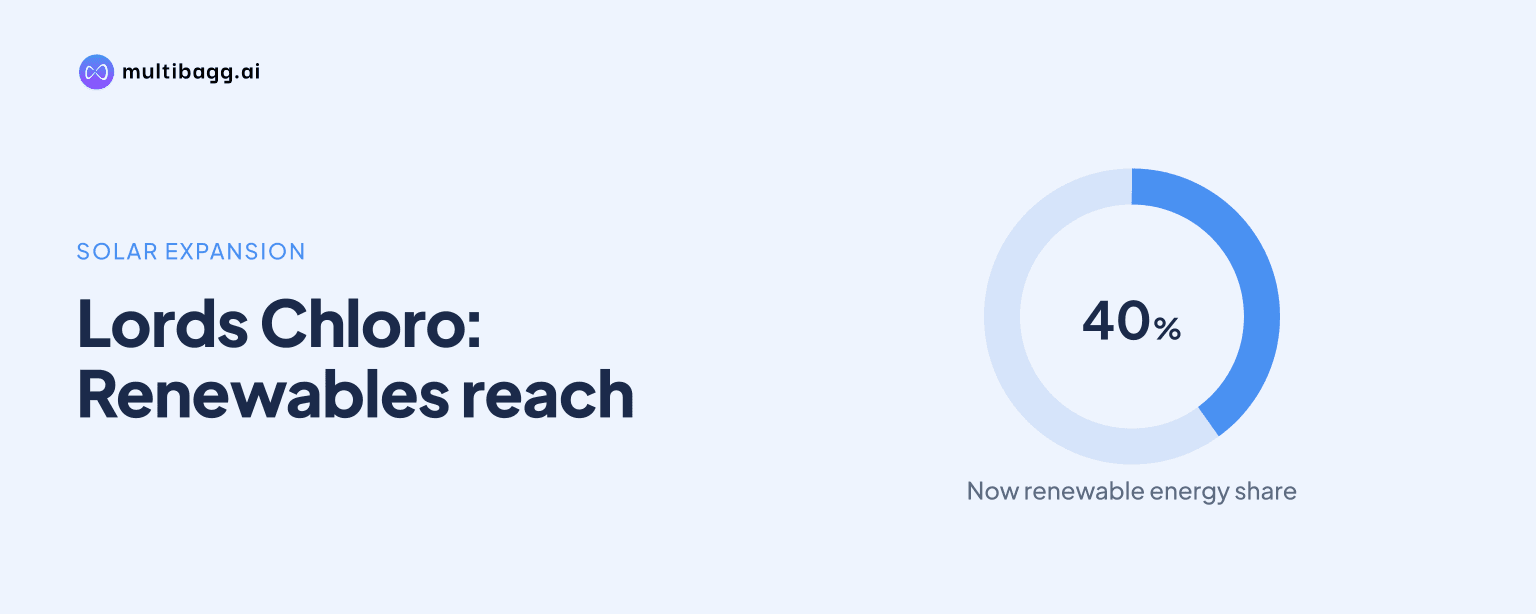
Lords Chloro Alkali Limited now meets about 40% of its total energy consumption through renewable sources after commissioning a 21 MW DC captive solar project with battery energy storage, taking its captive and group-captive renewable capacity to 47 MW DC. The addition is material because power and fuel expenses fell by Rs 5 crore quarter-on-quarter to Rs 37.79 crore.
Know Lords Chloro Alkali inside out
Results, valuation, peers and who's buying, in one view.
How did Lords Chloro Alkali reach 40% renewable power?
Lords Chloro Alkali reached the 40% level after its 21 MW DC captive solar power project at Bikaner, Rajasthan, began operating in late September or early October. The project includes a Battery Energy Storage System, or BESS, and was described by management as a major development during the quarter.
The new project has increased the company's combined captive and group-captive renewable capacity to 47 MW DC. This portfolio includes an earlier 16 MW solar facility at Bikaner and access to 10 MW from a wind-solar hybrid project. The company had entered a power supply and share purchase agreement with CGE II Hybrid Energy Private Limited for the hybrid project in March 2025.
The 16 MW Bikaner solar plant was the first phase of Lords Chloro Alkali's renewable programme. Management had earlier said that the facility met about 10% of its energy needs and generated estimated annual savings of around Rs 12 crore. It also acquired a 26% equity stake in a hybrid energy park that provides 10 MW of wind and solar power for its Alwar plant.
The latest 21 MW DC installation has therefore moved the renewable contribution from the earlier planned 25% range to about 40% of energy consumption. The company said this reduces its dependence on grid electricity and supports its stated effort to improve energy-cost efficiency in chemical manufacturing.
What was the financial impact of the renewable capacity addition?
The immediate financial indicator was a quarter-on-quarter reduction of Rs 5 crore in power and fuel expenses, which stood at Rs 37.79 crore. Lords Chloro Alkali attributed the decline to cost efficiencies from renewable-energy integration, although the commissioning occurred only towards the end of September or in early October.
For the quarter ended September 30, 2026, the company reported standalone net profit of Rs 9.02 crore, compared with Rs 9.04 crore in the corresponding quarter a year earlier. The near-flat profit comparison shows that the company was managing operating costs while the new solar project was being brought into operation.
Electricity is a significant operating input for chlor-alkali producers, which use electrolysis in caustic soda production. A higher share of captive and group-captive renewable supply can reduce exposure to grid tariffs, though the actual saving will depend on generation availability, contractual supply and operating conditions.
The company has also recorded the effects of its renewable supply contracts in its accounts. In FY 2025-26, it recognised a shortfall of 97.50 lakh units under the open-access power purchase agreement with CGE II Hybrid Energy Private Limited. Lords Chloro Alkali credited Rs 2.15 crore to power and fuel expenses, based on compensation of Rs 2.20 per unit under the agreement.
Got a follow-up? Ask IRIS
What is Lords Chloro Alkali's renewable energy target?
Lords Chloro Alkali intends to raise renewable energy's share to 70%-80% of total consumption over the next two to three years. Management said the target is subject to Rajasthan's policy framework, which allows renewable capacity of up to two times contracted demand, an allowance it said is not available in other states.
The stated target builds on earlier milestones. The company had targeted a 40%-45% renewable share in the short term and 80% in the medium term, after combining its Bikaner solar capacity, the hybrid project and the additional solar expansion. The commissioning of the 21 MW DC project indicates that it has reached the lower end of that initial range.
The renewable programme is connected to broader operating and expansion plans. Lords Chloro Alkali has disclosed a 90-tonne-per-day caustic soda capacity addition and a 30-tonne-per-day CPW capacity expansion. It also approved Rs 30 crore for the CPW project, with commissioning targeted by the end of FY27.
Management said it expects about Rs 80 crore of free cash flow, which could support an expansion or acquisition. It also discussed a potential large electrolyser of 120-140 tonnes that could take capacity directly to 500 tonnes, with an indicated investment of Rs 140-150 crore. These were management comments on available options, not announcements of a completed investment.
Why does renewable power matter for the chemical business?
Renewable power matters because energy costs can materially influence margins in caustic soda manufacturing. The Rs 5 crore quarter-on-quarter decline in power and fuel expenses provides a reported measure of the cost benefit associated with Lords Chloro Alkali's increasing renewable usage.
The company has faced grid-power cost pressures in the past, including increased grid electricity rates in October 2025. Its captive solar and group-captive hybrid arrangements are intended to diversify its power sourcing and reduce reliance on conventional grid supply. The BESS attached to the new Bikaner project is part of the latest captive-power installation.
For investors, the 47 MW DC renewable portfolio is relevant both as an operating-cost measure and as support for future production capacity. However, the benefit will continue to depend on the proportion of generation available for plant consumption, open-access arrangements and the regulatory conditions cited by management.
The company's shareholding data for September 30, 2026 showed Indian promoters held 74.96%, while public shareholders held 25.03%. The renewable strategy is being executed alongside the company's reported capacity-expansion programme rather than as a standalone power business.
Conclusion
Lords Chloro Alkali has taken its renewable capacity to 47 MW DC and says the portfolio now supplies about 40% of its total energy consumption. The company linked this change to a Rs 5 crore quarter-on-quarter reduction in power and fuel expenses to Rs 37.79 crore, making the solar commissioning relevant to its cost structure.
The next disclosed milestone is the company's aim to source 70%-80% of energy from renewables within two to three years, subject to Rajasthan's renewable-capacity policy. Investors will also track the planned CPW expansion by the end of FY27 and any formal decision on further caustic soda capacity or electrolyser investment.