










Lords Chloro Alkali Says Alwar Chlorine Losses Narrowed
Key highlights
- Lords Chloro Alkali said Alwar chlorine realisations improved from negative Rs 4,000-Rs 4,500 to negative Rs 1,000 to zero per tonne.
- Q2 FY27 caustic soda lye sales reached 23,300 tonnes, versus about 21,000 tonnes in Q2 FY26.
- Q2 FY27 total income was about Rs 115 crore, up 14% from about Rs 100 crore in Q2 FY26.
- Management said roughly 100 tonnes of chlorine are consumed internally and about 150 tonnes are sold in the open market.
powered by IRIS
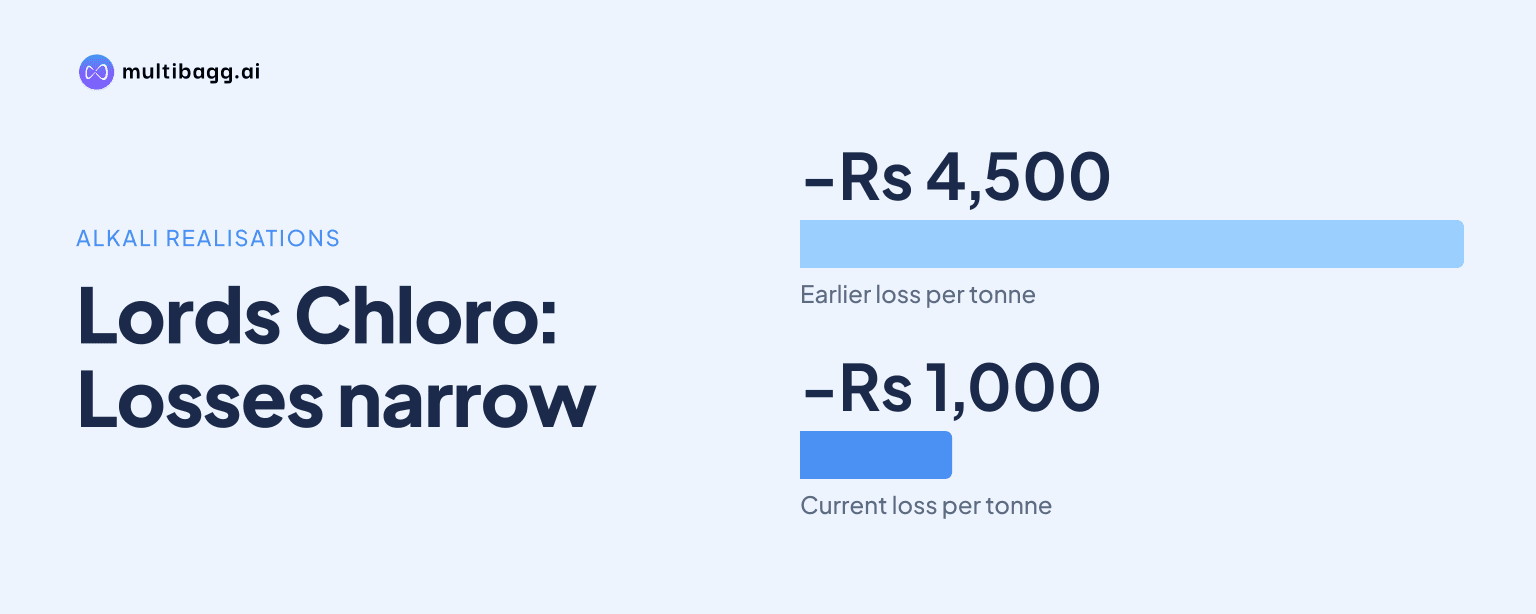
Lords Chloro Alkali Limited said Alwar chlorine realisations improved from negative Rs 4,000-Rs 4,500 per tonne in the past to negative Rs 1,000 to zero in Q2 FY27 commentary, while management expects future polyvinyl chloride capacity to absorb more chlorine. Q2 FY27 caustic soda lye sales reached 23,300 tonnes.
Know Lords Chloro Alkali inside out
Results, valuation, peers and who's buying, in one view.
Why have Lords Chloro Alkali's chlorine losses narrowed?
Lords Chloro Alkali said chlorine realisations in Alwar improved to negative Rs 1,000 to zero per tonne from negative Rs 4,000-Rs 4,500 previously. Management also described the current Alwar range earlier in the discussion as negative Rs 2,000 to zero, indicating variation in local market realisations. Chlorine is co-produced with caustic soda, making its sale or captive use relevant to chlor-alkali economics.
Management attributed Alwar's comparatively better chlorine pricing to fewer competitors than Gujarat. It put Gujarat chlorine realisations at about negative Rs 2,000 per tonne, compared with the negative Rs 1,000-to-zero Alwar level later cited. For caustic soda, management said prices at ports or in Gujarat of Rs 32,000-Rs 33,000 per tonne can become roughly Rs 36,000-Rs 37,000 in northern India because of freight.
The comparison represents management commentary rather than a published market price series. It indicates that Alwar chlorine moved from a larger disposal-related cost to a range that can reach break-even. Management said chlorine realisations improved significantly between the preceding quarter and Q2 FY27, whereas caustic soda realisations decreased significantly over that same quarter-on-quarter comparison.
How could PVC capacity change chlorine demand?
Lords Chloro Alkali expects planned polyvinyl chloride, or PVC, capacity from Reliance and Adani to improve chlorine market balance because their chlorine would be used internally for PVC. Management said Reliance is likely to enter next year and Adani the following year. It presented this as a potential gradual improvement in chlorine demand, not as a quantified forecast for Alwar pricing.
Management contrasted India with the United States, where it said chlorine and caustic soda are equal contributors to sales. In India, it described chlorine as a laggard because the downstream market is still developing. Greater captive conversion into PVC could reduce open-market chlorine availability, but the call did not provide the companies' chlorine requirements, PVC capacities or project commissioning dates.
On caustic soda, management estimated Indian production at about 6 million tonnes, potentially rising to 8 million tonnes with Reliance and around 10 million tonnes after Adani. It said Indian production and consumption each grow about 5% annually. Management also cited European capacity shutdowns and planned European depots by Reliance and Adani as reasons it was not concerned about the additional supply.
Got a follow-up? Ask IRIS
How is Lords Chloro Alkali reducing chlorine exposure?
Lords Chloro Alkali is using chlorinated paraffin wax, or CPW, as a captive outlet for chlorine. Management said roughly 100 tonnes are consumed internally and about 150 tonnes are sold in the open market. CPW was initially planned to avoid selling chlorine at negative realisations, while proximity to New Delhi and northern Indian CPW customers also supported the product choice.
CPW accounted for 20%-25% of income, according to management, and its volume rose more than 40% year on year in H1 FY27. Caustic soda volume rose more than 9% over the same period. Management said CPW earnings before interest, tax, depreciation and amortisation, or EBITDA, margins can range from 0% to 20%, depending on paraffin oil procurement costs and CPW selling prices.
The latest quarter showed the input-cost exposure in that model. Raw-material consumption increased by about Rs 6 crore quarter on quarter, to about Rs 36 crore from about Rs 30 crore, primarily because paraffin oil, sulphuric acid and related chemicals became costlier, management said. That increase outweighed a fall in power and fuel expense to Rs 37.79 crore from Rs 42 crore in the preceding quarter.
Management said CPW prices had increased alongside paraffin oil costs, and that it had contracted substantial paraffin oil volumes at lower prices. It said this procurement position could play more fully in the coming quarter. That outlook remains dependent on future input prices and CPW market pricing, both of which management said can materially affect margins.
What did Q2 FY27 volumes and costs show?
Lords Chloro Alkali recorded 23,300 tonnes of caustic soda lye sales in Q2 FY27, its highest quarterly sales volume, compared with 19,953 tonnes in Q1 FY27 and about 21,000 tonnes in Q2 FY26. Total income was about Rs 115 crore, up 14% from about Rs 100 crore in Q2 FY26. Management attributed the increase chiefly to higher volumes and improved CPW realisations.
For H1 FY27, total income was about Rs 222 crore, compared with Rs 201 crore in H1 FY26, while profit before tax stayed at about Rs 28 crore. Management said H1 EBITDA rose 10.36% year on year despite lower caustic soda realisations. Higher caustic soda volumes and CPW sales therefore partly offset pricing pressure, although the Q2 raw-material increase showed continued cost sensitivity.
Lords Chloro Alkali plans to raise caustic soda production from about 300 tonnes to 360 tonnes between March and July of next year. The 360-tonne level includes about 100 tonnes of flakes capacity, which management said can travel farther than lye because flakes are solid while lye contains 47% caustic soda and 53% water. Management also said 40% of power consumption came from renewable sources after a project started in early October.
Conclusion
Lords Chloro Alkali's central market point is that the Alwar chlorine burden has narrowed, with management citing movement from negative Rs 4,000-Rs 4,500 per tonne to negative Rs 1,000 to zero. CPW provides an internal chlorine outlet for roughly 100 tonnes, while about 150 tonnes remain exposed to the open market. Q2 FY27 volume growth to 23,300 tonnes supported income of about Rs 115 crore despite lower caustic soda realisations.
The next events to watch are completion of the Rs 315 crore capital-expenditure plan by July of next year and the planned increase from 300 tonnes to 360 tonnes of caustic soda capacity between March and July. Management expects at least Rs 15 crore-Rs 20 crore of quarterly EBITDA after the expansion at lower realisations, while any move toward 500 tonnes of caustic soda capacity or specialty chemicals remains undecided.