










Lords Chloro Alkali targets 80% renewable energy medium-term
Key highlights
- Lords Chloro Alkali targets 40% to 45% renewable energy in the short term and 80% in the medium term.
- Power and fuel fell to 36% of production costs in H1 FY27 from 51% in FY25.
- Lords Chloro Alkali’s captive and group-captive renewable capacity reached 47 MW DC in Q2 FY27.
- The Rs. 315 crore FY24-FY28 programme includes Rs. 165 crore of ongoing FY26-FY27 projects.
powered by IRIS
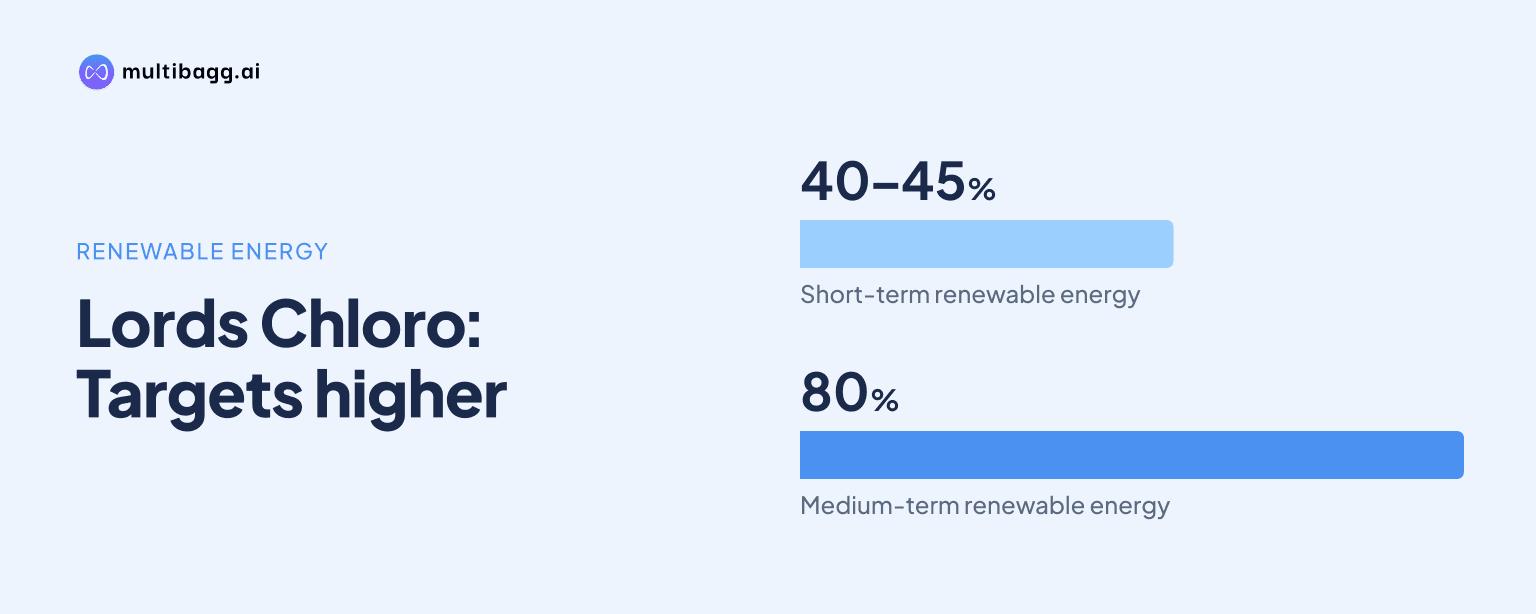
Lords Chloro Alkali Limited is targeting 80% renewable energy in the medium term through a Rs. 315 crore FY24-FY28 capital programme, after power and fuel declined to 36% of production costs in H1 FY27 from 51% in FY25 and renewable capacity reached 47 MW direct current (DC) in Q2 FY27.
Know Lords Chloro Alkali inside out
Results, valuation, peers and who's buying, in one view.
How is Lords Chloro Alkali reducing grid-power dependence?
Lords Chloro Alkali is adding captive solar and group-captive hybrid capacity to reduce its reliance on grid electricity, with management targeting 40% to 45% renewable energy in the short term and 80% in the medium term. The company identifies energy as its largest cost component, and its presentation shows power and fuel accounting for 36% of production costs in H1 FY27, compared with 51% in FY25.
The company attributes the reduction in the power-and-fuel share to renewables, while also disclosing a setback from higher grid electricity rates in October 2025. Lords Chloro Alkali said its solar shift began reducing power costs from Q4 FY25 onwards and entered power-supply and share-purchase agreements with CGE II Hybrid Energy Private Limited for a 10 MW wind-solar hybrid project.
Lords Chloro Alkali commissioned a 16 MW solar facility at Bikaner under its FY24-FY25 projects, which it says meets about 10% of its power requirement. In Q2 FY27, it commissioned a 14.5 MW alternating-current captive solar plant, equivalent to 21 MW DC, with a Battery Energy Storage System at Bikaner; management said total captive and group-captive renewable capacity then reached 47 MW DC.
The planned configuration is 37 MW of captive renewable capacity plus 10 MW of group-captive capacity. That configuration is intended to lower grid exposure and energy costs, but the presentation does not state the current share of electricity consumption supplied by renewables or specify a financial year for the 80% target.
What does the Rs. 315 crore capex programme include?
Lords Chloro Alkali’s Rs. 315 crore FY24-FY28 programme covers caustic soda capacity, renewable power and downstream chlorinated paraffin wax capacity. It comprises Rs. 150 crore of completed projects in FY24-FY25 and Rs. 165 crore of ongoing projects in FY26-FY27, which the presentation describes as revenue-accretive, margin-improving and self-funded.
The completed Rs. 150 crore programme increased caustic soda capacity from 210 tonnes per day (TPD) to 300 TPD, with the expanded capacity already operating at about 80% utilisation. It also included the 16 MW Bikaner solar facility and an increase in chlorinated paraffin wax (CPW) capacity from 20 TPD to 50 TPD to improve captive use of chlorine.
The FY26-FY27 plan includes a 100 TPD caustic soda addition targeted around Q4 FY27. Lords Chloro Alkali says installed caustic soda capacity after the project will be 360 TPD because a 40 TPD UHDE plant will be decommissioned, making the stated net increase 60 TPD rather than the gross 100 TPD addition.
Lords Chloro Alkali also lists a 50 TPD CPW project in the ongoing programme and says it approved a Rs. 30 crore CPW expansion for commissioning by the end of FY27. The presentation does not provide a reconciled final CPW installed-capacity figure after the disclosed projects, but identifies chlorine utilisation as the purpose of this downstream investment.
Got a follow-up? Ask IRIS
Why is Lords Chloro Alkali expanding CPW capacity?
Lords Chloro Alkali is expanding CPW capacity to absorb chlorine generated as a by-product of caustic soda production and support continuity in caustic soda operations. Management says the CPW expansion is intended to protect caustic soda production while increasing CPW’s contribution to revenue over the next two to three years.
The company’s integration mechanism links caustic soda production to separate downstream end markets. Its presentation lists caustic soda applications in aluminium, paper and pulp, textiles, soaps and detergents, and pharmaceuticals, while CPW is used in PVC pipes and cables, rubber, plastics and leather, and paints and coatings; the FY24-FY25 programme raised CPW capacity from 20 TPD to 50 TPD.
Lords Chloro Alkali also states that its Alwar, Rajasthan site has annual capacity of 105,000 tonnes of caustic soda and 18,250 tonnes of CPW. These annual figures should not be directly compared with the daily 300 TPD and 50 TPD operating-project figures because the presentation does not provide the production-day assumptions needed to reconcile the measures.
What do Q2 FY27 operating figures show?
Lords Chloro Alkali reported higher income and caustic soda lye volume in Q2 FY27 than a year earlier, but lower earnings than in Q1 FY27. Total income rose to Rs. 115.51 crore from Rs. 100.77 crore in Q2 FY26, while caustic soda lye volume increased to 23,309 tonnes from 21,337 tonnes.
Management reported year-on-year sales-volume growth of 9.24% in caustic soda lye and 40.38% in CPW during Q2 FY27. It said lower caustic soda realisations affected profitability, partly offset by improved CPW realisations, higher sales volumes and lower power-and-fuel expenses than in the preceding Q1 FY27 quarter.
Earnings before interest, tax, depreciation and amortisation were Rs. 18.82 crore in Q2 FY27, compared with Rs. 22.83 crore in Q1 FY27 and Rs. 21.09 crore in Q2 FY26. Profit after tax was Rs. 9.02 crore, below Rs. 14.95 crore in Q1 FY27 and close to Rs. 9.04 crore a year earlier, showing that higher income did not result in higher quarterly profit amid lower caustic soda realisations.
Management has not quantified an expected rupee saving, earnings benefit or margin target from the 47 MW DC renewable base. Its disclosed operating priorities are plant efficiency, reliability, cost discipline, downstream diversification, capacity expansion and disciplined capital allocation.
Conclusion
Lords Chloro Alkali’s Rs. 315 crore programme combines two disclosed operating aims: reducing energy exposure after power and fuel fell from 51% of production costs in FY25 to 36% in H1 FY27, and extending downstream chlorine utilisation through CPW. The 47 MW DC renewable base, the 100 TPD caustic soda project and the CPW investments are the stated mechanisms supporting those aims.
The next disclosed milestones are the approximately Q4 FY27 completion of the 100 TPD caustic soda addition and commissioning of the approved Rs. 30 crore CPW expansion by the end of FY27. Progress on the 10 MW group-captive hybrid project and the planned 37 MW captive-plus-10 MW group-captive configuration will indicate movement toward management’s short-term 40% to 45% and medium-term 80% renewable-energy targets.