










Lords Chloro Alkali takes renewable capacity to 47 MW DC
Key highlights
- Lords Chloro Alkali commissioned a 21 MW DC captive solar plant with BESS at Bikaner in Q2 FY27.
- Lords Chloro Alkali reported 47 MW DC of installed captive and group-captive renewable capacity after commissioning.
- Lords Chloro Alkali's Q2 FY27 power and fuel expense was Rs 37.79 crore, versus Rs 42.82 crore in Q1 FY27.
- Lords Chloro Alkali's Q2 FY27 revenue from operations rose 17.35% year on year to Rs 115.40 crore.
powered by IRIS
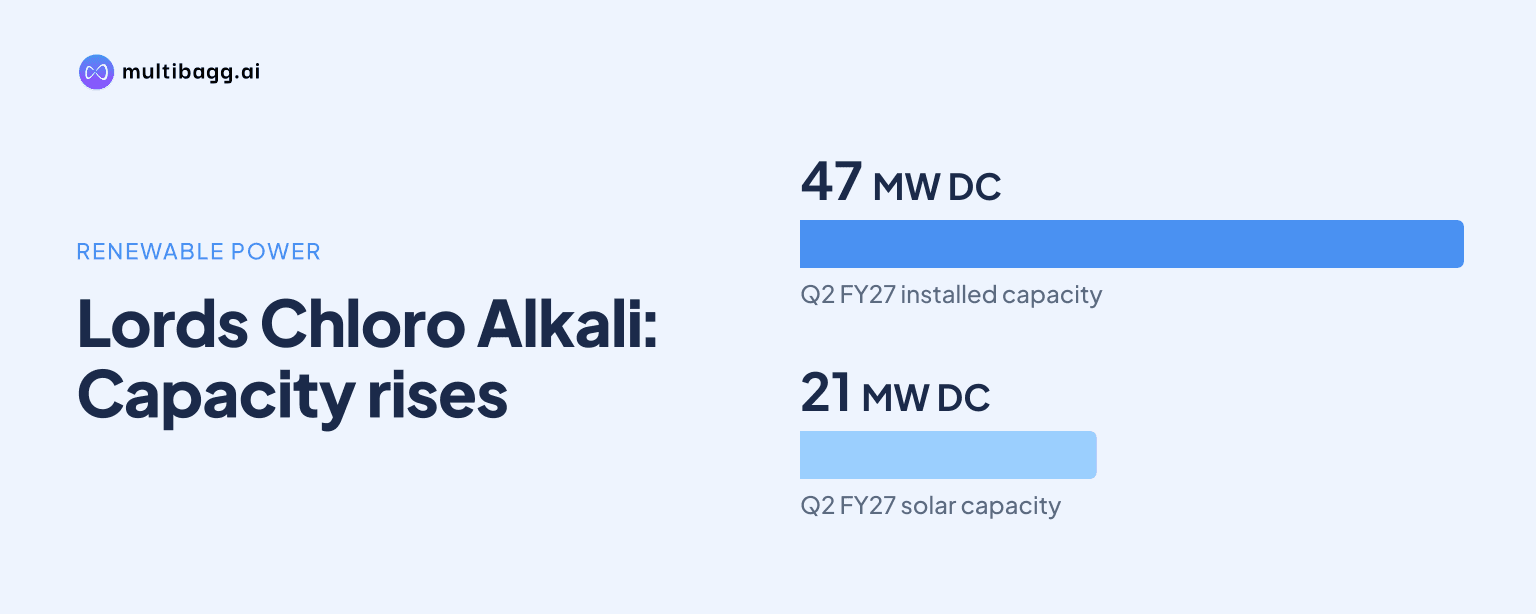
Lords Chloro Alkali Limited commissioned a 21 MW direct-current, or DC, captive solar plant with a battery energy storage system in Bikaner during Q2 FY27, taking installed captive and group-captive renewable capacity to 47 MW DC. Management said the project is intended to reduce reliance on grid electricity and improve energy-cost efficiency.
Know Lords Chloro Alkali inside out
Results, valuation, peers and who's buying, in one view.
What did Lords Chloro Alkali commission in Q2 FY27?
Lords Chloro Alkali commissioned a 14.5 MW alternating-current, or AC, and 21 MW DC captive solar power plant with a Battery Energy Storage System, or BESS, at Bikaner, Rajasthan, during the quarter ended September 30, 2026. The release does not give a commissioning date within Q2 FY27, the BESS capacity in megawatt-hours, project expenditure or expected annual power generation.
Managing Director Ajay Virmani described the solar-and-storage facility as a significant milestone in Q2 FY27, when revenue from operations rose 17.35% year on year to Rs 115.40 crore. He said the project supports lower grid-electricity dependence, improved energy-cost efficiency and the company’s stated objective of becoming a green chemical company, but did not quantify savings or returns from the asset.
The new facility was disclosed alongside Lords Chloro Alkali’s chemical manufacturing base at Alwar, Rajasthan, which has installed capacity of 300 metric tonnes per day of caustic soda and 50 tonnes per day of Chlorinated Paraffin Wax, or CPW. The release identifies the Bikaner project as captive, while its 47 MW DC total includes both captive and group-captive renewable capacity.
How did the Bikaner project change renewable capacity?
Lords Chloro Alkali said commissioning the 21 MW DC Bikaner plant increased its installed captive and group-captive renewable capacity to 47 MW DC. This is the company’s combined portfolio measure after the Q2 FY27 addition, rather than a separately disclosed breakdown of each project on a uniform AC or DC basis.
Lords Chloro Alkali’s company profile separately refers to a 37 MW solar park in Bikaner and a 10 MW hybrid group-captive project in Jaisalmer. Those two stated figures total 47 MW, but the release does not say whether the 21 MW DC plant is part of the 37 MW Bikaner solar park or provide DC ratings for every asset.
The disclosure therefore supports the 47 MW DC reported portfolio total, but it does not support adding each listed capacity as a separate project. It also does not state the share of Lords Chloro Alkali’s electricity consumption supplied by the 47 MW DC portfolio or the amount of grid power displaced during Q2 FY27.
Got a follow-up? Ask IRIS
What evidence is there of an energy-cost effect?
Lords Chloro Alkali reported power and fuel expense of Rs 37.79 crore in Q2 FY27, down Rs 5.03 crore from Rs 42.82 crore in Q1 FY27. Executive Director Madhav Dhir said improved recovery of solar power supported the sequential reduction and that the additional captive solar facility provides an opportunity to improve energy-cost efficiency over coming periods.
The reduction in power and fuel expense occurred while total income rose to Rs 115.51 crore in Q2 FY27 from Rs 106.56 crore in Q1 FY27. The company did not isolate the contribution of the new 21 MW DC facility, battery storage, grid tariffs, fuel use or other operational changes within the expense line.
Management’s stated mechanism is a reduced dependence on grid electricity and more efficient power consumption. The Q2 FY27 release does not disclose the BESS operating schedule, charging source, storage duration, electricity tariff comparison or a forecast for savings, so the reported Rs 5.03 crore sequential movement cannot be treated as a project-level benefit.
How did profitability move as renewable capacity expanded?
Lords Chloro Alkali’s earnings before interest, tax, depreciation and amortisation, or EBITDA, including other income, was Rs 18.82 crore in Q2 FY27, down from Rs 21.09 crore in Q2 FY26 and Rs 22.83 crore in Q1 FY27. Management attributed the year-on-year moderation primarily to lower caustic soda realisations, partly offset by improved CPW realisations and lower power and fuel expense.
The EBITDA margin fell to 16.29% in Q2 FY27 from 20.93% in Q2 FY26, a decline of 464 basis points, despite revenue from operations increasing by Rs 17.06 crore to Rs 115.40 crore. Higher sales volumes drove the revenue increase, with Caustic Soda Liquid volume up 1,972 metric tonnes and CPW volume up 987 metric tonnes year on year.
Profit after tax was Rs 9.02 crore in Q2 FY27, compared with Rs 9.04 crore a year earlier and Rs 14.96 crore in Q1 FY27. For H1 FY27, total income increased 10.36% year on year to Rs 222.08 crore, while profit after tax rose 22.99% to Rs 23.97 crore; management said lower tax expense supported the half-year profit increase while profit before tax remained broadly stable at Rs 28.06 crore.
Conclusion
The Bikaner project gives Lords Chloro Alkali a reported 47 MW DC captive and group-captive renewable portfolio following the commissioning of a 21 MW DC solar plant with BESS in Q2 FY27. Its strategic relevance is clearest in management’s aim to reduce grid dependence, while the disclosed Q2 power and fuel expense of Rs 37.79 crore shows a sequential reduction without establishing the new plant’s direct financial contribution.
Next, investors can watch management’s execution of ongoing capacity-expansion initiatives, its work on plant productivity and power-consumption optimisation, and any future disclosure on BESS capacity or solar-linked cost effects. Management has also identified downstream diversification, manufacturing efficiency and disciplined capital allocation as continuing priorities, but gave no timetable or financial target for these plans.