










Lords Chloro Alkali Limited Q2 revenue rises 17% on volumes
Key highlights
- Lords Chloro Alkali’s Q2 FY27 revenue from operations rose 17.35% to Rs 115.40 crore.
- Q2 FY27 EBITDA including other income declined 10.79% to Rs 18.82 crore, and margin fell to 16.29%.
- Caustic Soda Liquid volume increased 9.24% to 23,309 metric tonnes in Q2 FY27.
- H1 FY27 profit after tax rose 22.99% to Rs 23.97 crore, supported by lower tax expense.
powered by IRIS
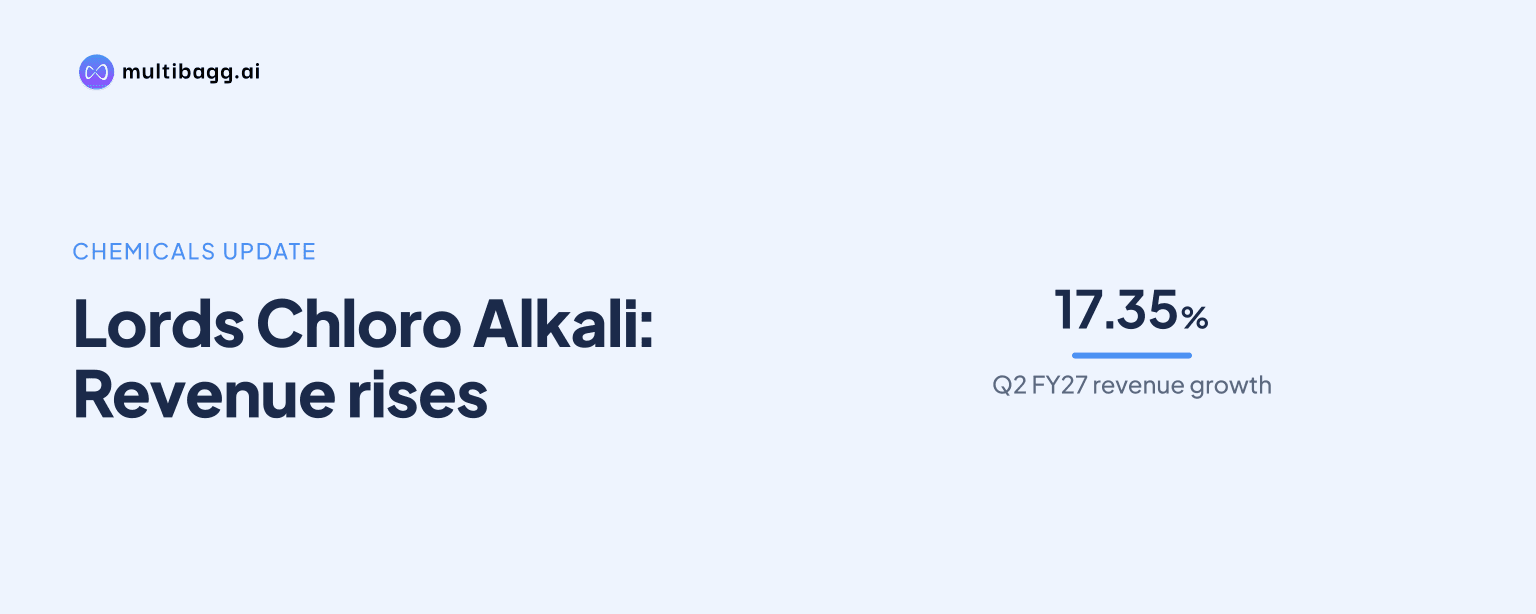
Lords Chloro Alkali increased revenue from operations by 17.35% year on year to Rs 115.40 crore in Q2 FY27, as higher sales volumes of Caustic Soda Liquid and Chlorinated Paraffin Wax outweighed lower caustic soda realisations. However, EBITDA declined 10.79% to Rs 18.82 crore and margin fell to 16.29%.
Know Lords Chloro Alkali inside out
Results, valuation, peers and who's buying, in one view.
How did Lords Chloro Alkali perform in Q2 FY27?
Lords Chloro Alkali reported higher revenue but lower operating profit in the quarter ended September 30, 2026. Revenue from operations reached Rs 115.40 crore, up from Rs 98.34 crore in Q2 FY26, while total income rose 14.62% to Rs 115.51 crore from Rs 100.77 crore.
EBITDA, or earnings before interest, tax, depreciation and amortisation, including other income, declined to Rs 18.82 crore from Rs 21.09 crore. The EBITDA margin contracted by 464 basis points, with 100 basis points equal to one percentage point, to 16.29% from 20.93%. Profit after tax was broadly unchanged at Rs 9.02 crore, compared with Rs 9.04 crore a year earlier, as lower tax expense offset lower profitability before tax.
The sequential comparison also shows that income increased while profitability reduced. Total income was Rs 106.56 crore in Q1 FY27, so Q2 income was 8.39% higher. EBITDA fell from Rs 22.83 crore in Q1 FY27, and margin declined from 21.42%, indicating that the quarter’s sales growth did not translate into comparable operating earnings growth.
What drove Lords Chloro Alkali’s revenue growth?
Lords Chloro Alkali’s Q2 revenue growth was driven primarily by higher volumes of Caustic Soda Liquid and Chlorinated Paraffin Wax, or CPW. Caustic Soda Liquid sales volume rose by 1,972 metric tonnes year on year to 23,309 metric tonnes, a 9.24% increase from 21,337 metric tonnes. The company reported that CPW sales volume increased by 987 metric tonnes, or 40.38%, during the same comparison.
The product-level pricing picture was mixed. Caustic soda realisations moderated in Q2 FY27, which restricted operating profitability despite the 9.24% growth in Caustic Soda Liquid volume. In contrast, improved CPW realisations, together with the 40.38% increase in CPW volume, supported revenue. This means the company’s 17.35% revenue increase resulted from both greater product movement and higher CPW pricing, rather than a broad increase in caustic soda prices.
Quarter on quarter, Caustic Soda Liquid volume rose 16.82% from 19,953 metric tonnes in Q1 FY27 to 23,309 metric tonnes in Q2 FY27. For the first half, volume was 43,262 metric tonnes, only 1.08% above 42,799 metric tonnes in H1 FY26. The contrast indicates that Q2 carried a larger part of the half-year volume increase than the aggregate H1 comparison suggests.
Got a follow-up? Ask IRIS
Why did Lords Chloro Alkali’s EBITDA margin decline?
Lords Chloro Alkali’s EBITDA margin declined because lower caustic soda realisations had a greater effect on operating profitability than the benefits from stronger CPW realisations and lower energy costs. EBITDA fell 10.79% year on year to Rs 18.82 crore even as total income grew 14.62% to Rs 115.51 crore. The resulting margin of 16.29% was below both 20.93% in Q2 FY26 and 21.42% in Q1 FY27.
Management said lower caustic soda realisations were partly offset by improved CPW realisations and lower power and fuel expenses compared with the previous quarter. Power and fuel expense declined to Rs 37.79 crore in Q2 FY27 from Rs 42.82 crore in Q1 FY27, according to management. The release does not provide a Q2 FY26 power-and-fuel figure, so it does not quantify the year-on-year effect of energy costs.
The half-year figures show a less pronounced decline in absolute operating profit than in the Q2 comparison. H1 FY27 EBITDA was Rs 41.65 crore, against Rs 41.78 crore in H1 FY26, a decrease of 0.31%, while the EBITDA margin fell by 201 basis points to 18.75% from 20.76%. Thus, the H1 income increase of 10.36% to Rs 222.08 crore was accompanied by a lower operating margin across the six-month period.
What did Lords Chloro Alkali report for H1 FY27?
Lords Chloro Alkali reported H1 FY27 total income of Rs 222.08 crore and profit after tax of Rs 23.97 crore for the half year ended September 30, 2026. Total income increased from Rs 201.24 crore in H1 FY26, while profit after tax grew 22.99% from Rs 19.49 crore. The company attributed the profit-after-tax improvement primarily to lower tax expense rather than an expansion in profit before tax.
Profit before tax for H1 FY27 was Rs 28.06 crore and was described as broadly stable by the company. That distinction matters because EBITDA was nearly flat at Rs 41.65 crore versus Rs 41.78 crore a year earlier, whereas profit after tax rose by Rs 4.48 crore. The reported tax outcome therefore helped create a different trend at the net-profit level from the operating-profit trend.
Management disclosed the commissioning during Q2 FY27 of a 14.5 megawatt alternating-current, or 21 megawatt direct-current, captive solar power plant and battery energy storage system in Bikaner, Rajasthan. The addition increased Lords Chloro Alkali’s installed captive and group-captive renewable capacity to 47 megawatts direct current. Management said it remains focused on plant efficiency, operational reliability, downstream diversification, capacity expansion and disciplined capital allocation.
Conclusion
Lords Chloro Alkali delivered a 17.35% year-on-year increase in Q2 FY27 revenue from operations to Rs 115.40 crore, backed by higher Caustic Soda Liquid and CPW volumes and improved CPW realisations. Lower caustic soda realisations nevertheless reduced EBITDA to Rs 18.82 crore and narrowed the margin to 16.29%, while lower tax expense kept profit after tax near the prior-year level at Rs 9.02 crore.
The next results will show whether caustic soda realisations, CPW pricing and power-and-fuel costs change after Q2 FY27. Management said the newly commissioned 14.5 megawatt alternating-current solar plant, which lifted renewable capacity to 47 megawatts direct current, provides an opportunity to improve energy-cost efficiency, while its capacity-expansion initiatives have no disclosed timetable or financial target.