










Lords Chloro Alkali Q2 Revenue Rises YoY While PBT Declines
Key highlights
- Lords Chloro Alkali reported year-on-year Q2 FY27 revenue growth on higher caustic soda lye and CPW volumes.
- Lower caustic soda realisations reduced EBITDA and margins, while profit before tax declined year on year.
- Lords Chloro Alkali reported quarterly profit of 903.79, with the unit not specified in the supplied material.
- A solar-plus-storage project lifted Lords Chloro Alkali's renewable capacity to 47 MW DC.
powered by IRIS
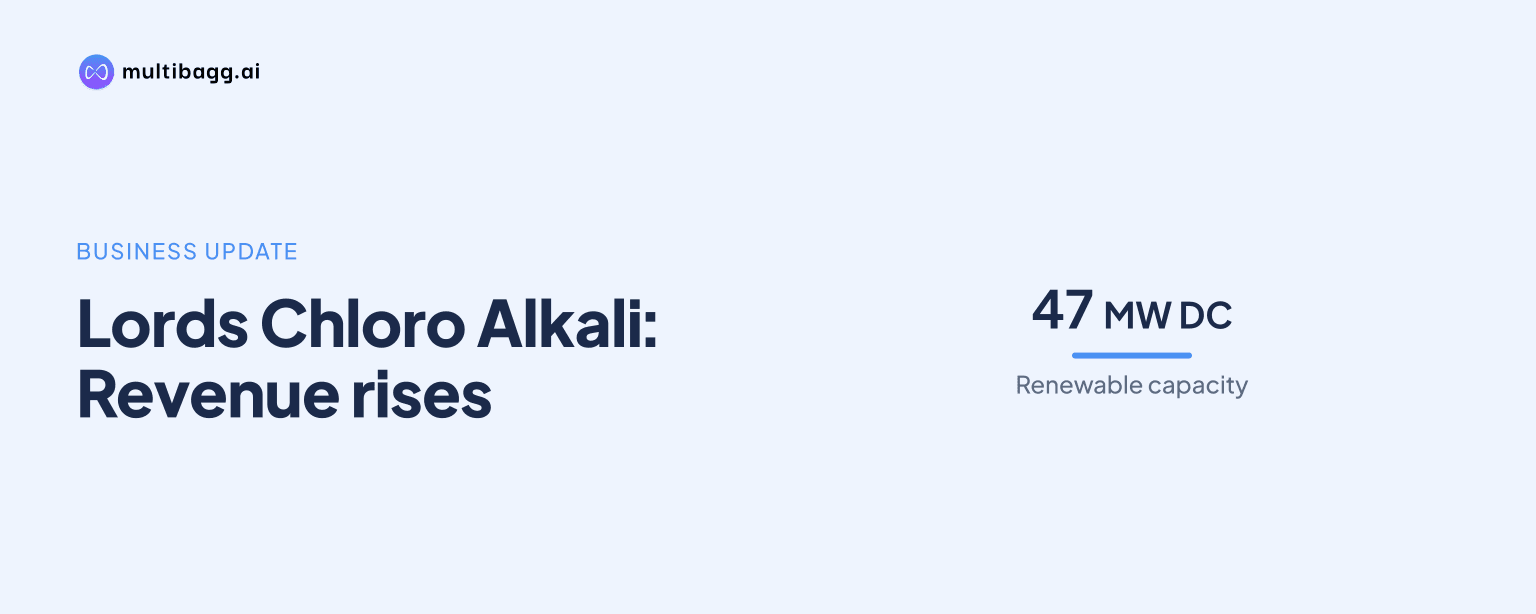
Lords Chloro Alkali Limited reported year-on-year revenue growth in Q2 FY27, supported by higher caustic soda lye and CPW volumes, but profit before tax declined as lower caustic soda realisations compressed margins. The company reported quarterly profit of 903.79 and renewable capacity of 47 MW DC after commissioning a solar-plus-storage plant.
Know Lords Chloro Alkali inside out
Results, valuation, peers and who's buying, in one view.
Why did Lords Chloro Alkali's Q2 FY27 revenue increase?
Lords Chloro Alkali Limited said Q2 FY27 revenue increased from a year earlier because sales volumes of caustic soda lye and CPW were higher. The company identified volume growth as the principal support for its top line during the quarter ended September 30, 2026.
Caustic soda lye is a core product for chlor-alkali producers and is used across industries including textiles, pulp and paper, alumina, chemicals and water treatment. CPW, or chlorinated paraffin wax, is used in applications such as PVC processing, paints, coatings and rubber. Higher dispatch volumes in these products can raise revenue even when selling prices are lower.
The available disclosure does not provide the absolute Q2 FY27 revenue figure, its year-on-year percentage change, or product-wise revenue. It therefore establishes the direction of revenue movement rather than the size of the increase. No revenue amount has been inferred or converted because no such figure was disclosed in the supplied material.
The company’s results are relevant to investors because they show the differing influence of volume and pricing in a commodity chemical business. Revenue expansion based on volumes can coexist with weaker profitability when the price realised for a key product declines.
Why did profitability decline despite higher sales volumes?
Profitability declined because lower caustic soda realisations reduced EBITDA and margin, despite the improvement in volumes. The supplied information also states that profit before tax declined year on year, showing that the pricing pressure was material enough to outweigh the benefit from higher sales.
Lords Chloro Alkali reported quarterly profit of 903.79. The source material does not specify the reporting unit for this figure, so it is presented without assigning a currency or scale. It also does not provide the comparable prior-year profit or the precise profit-before-tax amount.
Caustic soda is a cyclical product whose realisations can change with demand from consuming industries, domestic supply, imports and broader chemical-market conditions. For a producer, lower selling prices can reduce operating profit per tonne even when production and sales volumes rise.
The company linked the margin movement specifically to caustic soda pricing, rather than to an announced change in volumes. This distinction matters because the quarter did not indicate a demand-led contraction in the company’s reported sales activity. Instead, it reflected weaker price realisation in a key product category.
What do cash flow and capital spending show about operations?
Lords Chloro Alkali generated operating cash flow of 4,907.20 during the reported period, while investment outflows included capital spending of 5,704.81. The disclosed figures indicate that the company continued to allocate substantial funds towards its operating and capacity-related plans.
Capital expenditure exceeding operating cash flow in the supplied figures points to a period of active investment. However, the document does not state the funding mix, total investing cash flow, financing cash flow, closing cash balance or debt movement. Those details would be needed to assess the balance-sheet effect of the spending.
The company also commissioned a solar-plus-storage plant, lifting renewable capacity to 47 MW DC. Management described this as part of its cost and capacity expansion strategy. For an electrochemical producer, power is an important operating input, making renewable power additions relevant to the cost structure.
The disclosure does not quantify the solar plant’s generation, storage capacity, capital cost, expected savings or commissioning date. It consequently supports the conclusion that renewable capacity has expanded, but not a calculation of the financial return from the project.
Got a follow-up? Ask IRIS
What did the company disclose about Q2 and H1 FY27 results?
Lords Chloro Alkali said its board meeting on November 3, 2026 was scheduled to consider and approve unaudited financial results for Q2 and the first half of FY27 ended September 30, 2026. The company also announced an earnings call for November 4, 2026 at 12:00 noon IST to discuss the Q2 and H1 FY27 results.
The call was intended for shareholders, investors and analysts to hear management’s discussion of financial performance and possible updates on operations or outlook. The supplied material does not include a management transcript, guidance, production target, price outlook or a direct statement on future profitability.
For market participants, the call is important because the headline result combines higher revenue with lower margins. Investors may seek clarity on the pace of caustic soda volume growth, the duration of pricing pressure, utilisation of the expanded renewable capacity and the company’s capital-spending priorities.
The board and earnings-call disclosures are regulatory and investor-communication events. They do not themselves establish a change in strategy beyond the company’s stated cost and capacity expansion efforts.
How does the quarter affect investors and the chlor-alkali sector?
The Q2 FY27 outcome shows that Lords Chloro Alkali’s sales volumes remained supportive while pricing limited the conversion of revenue into operating profit and profit before tax. This is a key consideration for investors because chemical producers can experience materially different earnings trends from revenue trends when product prices move.
The addition of renewable capacity to 47 MW DC provides an operational development alongside the financial result. Its potential relevance lies in electricity cost management, but the available material gives no quantified saving or payback period. Investors should therefore separate the confirmed capacity addition from any unconfirmed estimate of its effect on margins.
Operating cash flow of 4,907.20 and capital spending of 5,704.81 indicate continuing investment activity. Without disclosed debt, liquidity and project-cost information, it is not possible to determine whether the spending changes the company’s financial risk profile.
The wider chlor-alkali sector remains sensitive to caustic soda realisations and demand from end-user industries. Lords Chloro Alkali’s quarter provides company-specific evidence of price pressure, but the supplied disclosure does not establish an industry-wide price trend or forecast.
Conclusion
Lords Chloro Alkali delivered year-on-year Q2 FY27 revenue growth through higher caustic soda lye and CPW volumes, while lower caustic soda realisations reduced EBITDA, margins and profit before tax. Quarterly profit was reported at 903.79, and the company continued to invest, with operating cash flow of 4,907.20 and capital spending of 5,704.81.
The next disclosed event is the November 4, 2026 earnings call on Q2 and H1 FY27 performance. Investors will watch for management’s comments on caustic soda pricing, volume trends, capital expenditure and the operational contribution of renewable capacity now standing at 47 MW DC.