










Lords Chloro Alkali weighs Rs 140 crore allocation choice
Key highlights
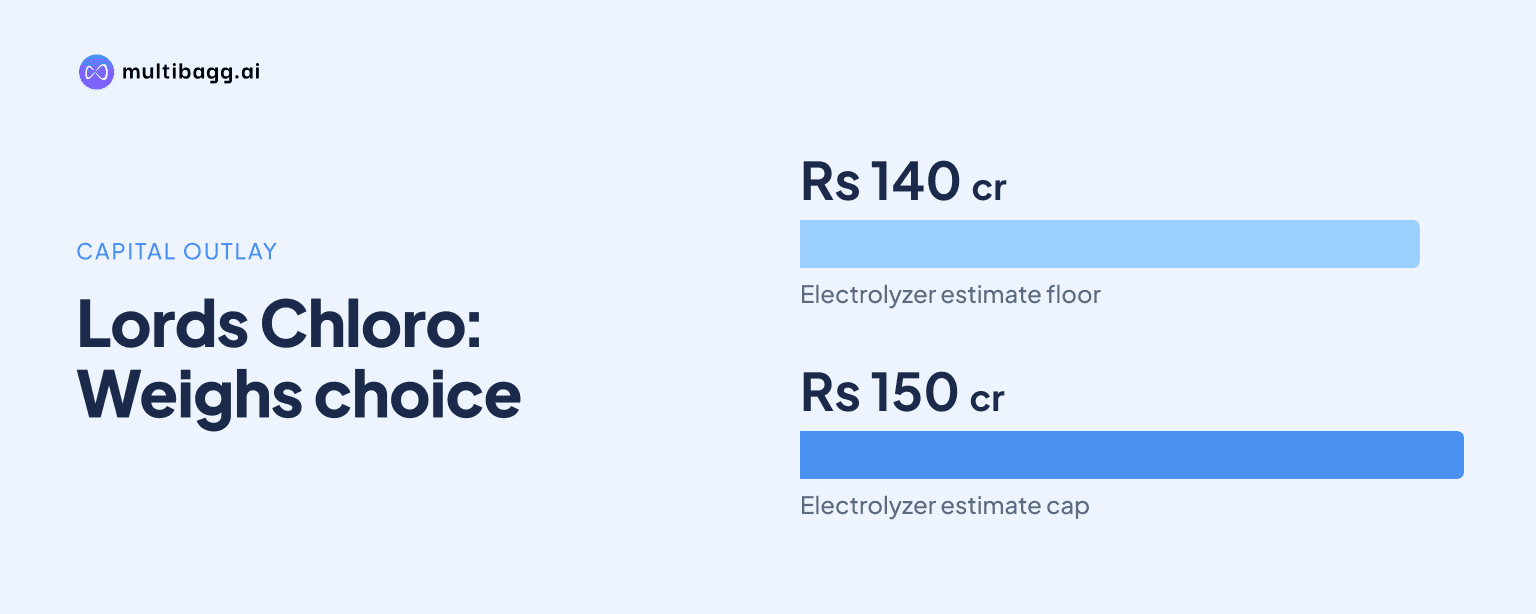
- Lords Chloro Alkali estimates Rs 140 crore to Rs 150 crore for a 120-tonne to 140-tonne caustic-soda electrolyzer.
- Management expects at least about Rs 80 crore of annual free cash flow from July onwards after current capital expenditure is completed.
- Lords Chloro Alkali plans to raise capacity from 300 tonnes to 360 tonnes between March and July of next year.
- The planned 360-tonne capacity includes about 100 tonnes of caustic-soda flakes.
powered by IRIS
Lords Chloro Alkali Limited has not decided whether to commit Rs 140 crore to Rs 150 crore to a caustic-soda expansion that could lift capacity to 500 tonnes or deploy capital in specialty chemicals. Management said the decision remains under analysis, while at least about Rs 80 crore of annual free cash flow may be available from July onwards after current capital expenditure is completed.
Know Lords Chloro Alkali inside out
Results, valuation, peers and who's buying, in one view.
Will Lords Chloro Alkali expand caustic soda or enter specialty chemicals?
Lords Chloro Alkali has not chosen between a further caustic-soda expansion and a specialty-chemicals investment. Management said it was comparing different companies and products, and that whichever option comes first, the other would follow later. It did not name an acquisition target, specialty product, transaction value or timetable for a specialty-chemicals entry.
The disclosed caustic-soda alternative is one large electrolyzer adding about 120 tonnes to 140 tonnes of capacity after the company reaches 360 tonnes. Management put the investment required for another 140 tonnes at Rs 140 crore to Rs 150 crore and said this step would take capacity directly to 500 tonnes. That cost is the only stated capital benchmark for the decision; no comparable cost or expected return was provided for specialty chemicals.
Management said specialty chemicals are under consideration to diversify away from commodity chemical cycles. It also said earnings before interest, taxes, depreciation and amortisation, or EBITDA, on the caustic-soda line were “quite strong”, so the review does not indicate a plan to leave that business. The choice is instead between expanding the existing caustic-soda operation and allocating capital to a different chemicals segment.
Management did not commit to when Lords Chloro Alkali would reach 500 tonnes because the analysis is unfinished. The 500-tonne objective therefore remains an intention rather than an approved project schedule. The company’s nearer capacity step, from 300 tonnes to 360 tonnes between March and July of next year, is separate from the undecided Rs 140 crore to Rs 150 crore electrolyzer investment.
How will Lords Chloro Alkali fund its next investment?
Lords Chloro Alkali said it can use internal accruals, debt and equity for either specialty chemicals or further caustic-soda capacity. Management expects at least about Rs 80 crore of annual free cash flow to become investable from July onwards, when its current capital-expenditure programme is completed. It did not say how much of that cash flow would be retained, spent, or directed to either option.
At Rs 140 crore to Rs 150 crore, the potential electrolyzer would exceed the at-least-Rs 80 crore annual free-cash-flow figure cited by management. This comparison does not establish a funding need because the company gave no project-spending schedule. However, it explains why management identified debt and equity alongside internal accruals rather than presenting internal cash flow as the sole source.
Management said banks were supportive and that Lords Chloro Alkali could obtain more debt, while adding that it may not choose to be overleveraged. It did not disclose a debt balance, interest rate, borrowing limit, repayment schedule or debt-to-EBITDA multiple. Its comments on borrowing capacity are therefore a financing option, not a confirmed debt-raising plan.
Equity is the third option. Management said promoters hold around 74% of Lords Chloro Alkali and that this shareholding allows scope to use equity for a significant investment in a new company or another acquisition. No equity issue, dilution level, amount or timing was announced, and management did not link an equity raise specifically to the 140-tonne electrolyzer.
Got a follow-up? Ask IRIS
What is Lords Chloro Alkali's route to 500 tonnes?
Lords Chloro Alkali plans first to raise capacity from 300 tonnes to 360 tonnes between March and July of next year. Management said the 360-tonne level would include about 100 tonnes of caustic-soda flakes. It described the remaining move to 500 tonnes as dependent on one 120-tonne to 140-tonne electrolyzer whose timing cannot yet be committed.
The 100 tonnes of flakes could widen Lords Chloro Alkali’s distribution reach, according to management. Flakes can be transported on trucks rather than tankers and have lower freight costs over longer distances. Management described flakes as 100% caustic soda, compared with liquid lye at 47%, where 53% of tanker volume is water.
Management said the flakes format could support sales across India and potentially exports, which Lords Chloro Alkali does not currently undertake for this product. Its comments identify a commercial mechanism for the 360-tonne capacity stage, but they do not include projected flakes volumes, export sales, pricing or margins. The company also did not disclose how much of the 100-tonne flakes capacity is expected to be sold domestically.
What operating factors shape Lords Chloro Alkali's decision?
Lords Chloro Alkali said caustic-soda sales volume reached 23,300 tonnes in the quarter, compared with 19,953 tonnes in the first quarter. Management described the later period as its highest sales volume for caustic-soda lye. This increase in volume provides the operating backdrop to the company’s stated ambition to move from 300 tonnes to 360 tonnes and ultimately to 500 tonnes.
Management said caustic-soda realisations improved after the quarter, while calling the preceding quarter one of the worst for realisations in a long time. It described northern Indian pricing as generally reflecting the Gujarat or port price plus roughly Rs 4,000 to Rs 5,000 for freight. In its example, caustic soda priced at Rs 32,000 to Rs 33,000 at a port or in Gujarat would be roughly Rs 36,000 to Rs 37,000 in Alwar or northern India.
Power costs are also part of management’s case for improved operating efficiency. After an early-October start-up, management said renewable sources supplied about 40% of all energy consumed. It targets 70% to 80% renewable power within two to three years, conditional on Rajasthan retaining rules that currently permit renewable contracts at twice contracted demand.
Management said the 10-megawatt wind-solar hybrid project had been online and supplying power since last year. By contrast, its battery energy storage system, or BESS, is about 1.45 megawatts and was described as too small to make a consequential difference to results or renewable-power consumption. Management said it would not invest heavily in BESS unless it identifies a significant use case, keeping the immediate allocation focus on chemical expansion or diversification.
Conclusion
Lords Chloro Alkali’s capital-allocation decision remains open. The company can pursue a Rs 140 crore to Rs 150 crore electrolyzer to support a move from 360 tonnes to 500 tonnes, or use its available financial options to enter specialty chemicals. Management has identified at least about Rs 80 crore of annual free cash flow from July onwards, alongside debt and equity, but has not set a funding mix or approved either larger investment.
The next disclosed operating milestone is the move from 300 tonnes to 360 tonnes between March and July of next year, including about 100 tonnes of flakes. Investors should also watch for management’s eventual choice between the two investment routes, details of any specialty-chemicals target or product, and progress toward its conditional target of 70% to 80% renewable energy consumption within two to three years.