










Lords Chloro reaches 40% renewable power share in H1 FY27
Key highlights
- Lords Chloro said 47 MW DC of renewable capacity supplied about 40% of total power needs in H1 FY27.
- Lords Chloro commissioned 21 MW DC of captive solar capacity with BESS in September 2026.
- Lords Chloro's Q2 FY27 power and fuel expense fell to Rs 37.79 crore from Rs 42 crore in the preceding quarter.
- Lords Chloro reported H1 FY27 total income of about Rs 222 crore, versus about Rs 201 crore in H1 FY26.
powered by IRIS
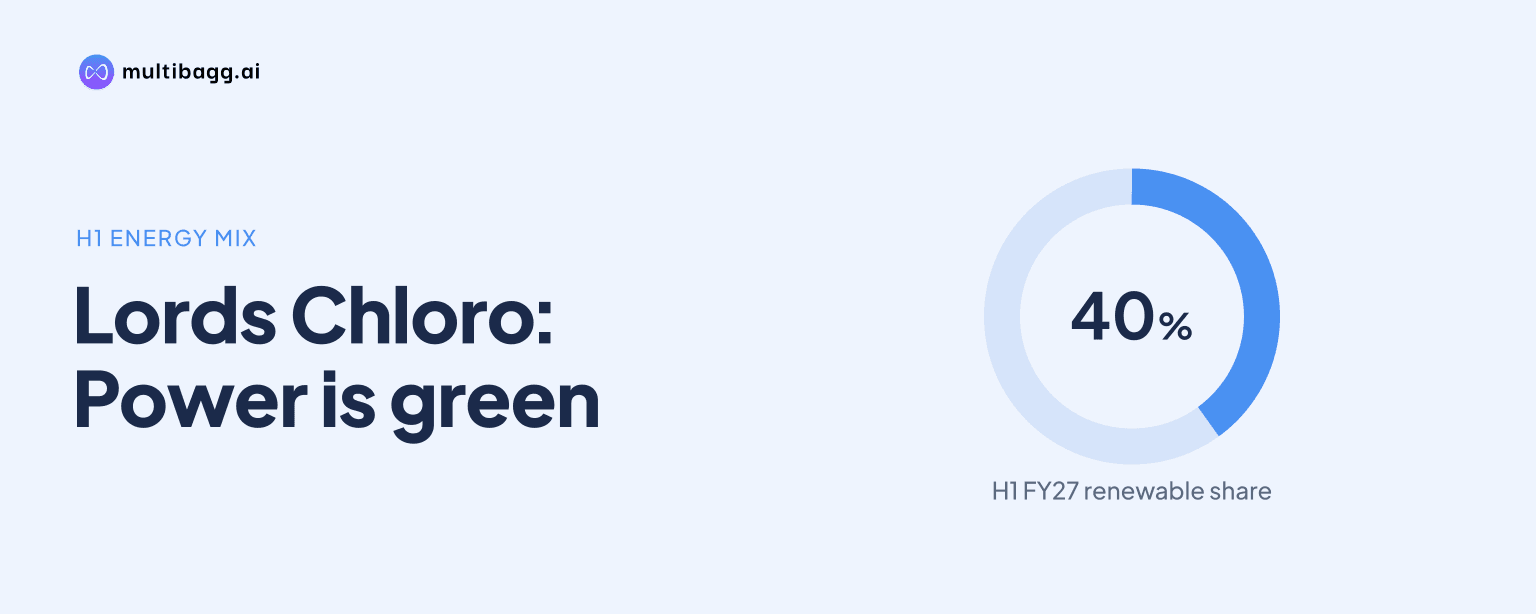
In H1 FY27, Lords Chloro Alkali Limited said 47 MW DC of captive and group-captive renewable capacity met about 40% of its total power needs after commissioning 21 MW DC of captive solar capacity with battery energy storage in September 2026. Management linked the larger renewable mix to lower electricity costs despite pressure on caustic-soda lye realisations.
Know Lords Chloro Alkali inside out
Results, valuation, peers and who's buying, in one view.
What renewable-power share has Lords Chloro reached?
Lords Chloro said renewable sources now provide around 40% of its total power requirements. The position followed the sanctioning and commissioning of 21 MW DC of captive solar capacity with a battery energy storage system, or BESS, in Q2 FY27. That addition increased total captive and group-captive renewable capacity to 47 MW DC.
The disclosed 47 MW DC portfolio includes both captive and group-captive power arrangements. Lords Chloro did not provide the capacity split between those structures, their electricity generation in H1 FY27, or its total electricity consumption. The 40% figure is therefore management's stated share of power needs rather than a calculation that can be independently derived from generation data in the call.
Management called the September commissioning an important step in reducing power costs and raising renewable sourcing to about 40%. It also said the share was likely among the highest at a caustic-soda manufacturing plant in India, and possibly globally. That comparison was management's assessment; the call included no industry capacity or sourcing data to substantiate it.
How has renewable sourcing affected Lords Chloro's power costs?
Lords Chloro said lower-cost captive and group-captive electricity has reduced its exposure to grid power. Management cited a grid rate of about Rs 8.3, a captive-power rate of about Rs 2, and a group-captive rate of about Rs 4.50. The call did not specify the unit for these rates, but management used the differences to explain the cost-efficiency effect.
A significant part of Lords Chloro's solar assets is held on its own books, management said. It contrasted the cited captive-power cost of about Rs 2 with the roughly Rs 4.50 it cited for group-captive power. However, Lords Chloro did not disclose how much of the 40% renewable share comes from captive assets versus group-captive supply, preventing a calculation of its blended renewable-power cost.
Power and fuel expense fell to Rs 37.79 crore in Q2 FY27 from Rs 42 crore in the preceding quarter, a sequential reduction of about Rs 5 crore. Management said the decline occurred despite higher caustic-soda sales and production. It also cautioned that power cost could increase in the next quarter, without quantifying the potential change.
Management said its objective is to reduce swings in earnings before interest, tax, depreciation and amortisation, or EBITDA, caused by caustic-soda realisations. The earnings call did not disclose a separate EBITDA contribution from renewable assets, the solar plant's capital cost, or a payback period for the 21 MW DC project.
Got a follow-up? Ask IRIS
What do Lords Chloro's H1 FY27 results show?
Lords Chloro reported total income of about Rs 222 crore in H1 FY27, compared with about Rs 201 crore in H1 FY26, while profit before tax, or PBT, remained about Rs 28 crore in both periods. Management attributed the broadly unchanged PBT despite lower caustic-soda lye realisations to cost efficiencies and higher sales volumes.
In Q2 FY27, total income was about Rs 115 crore, versus about Rs 100 crore in Q2 FY26, representing management's stated year-on-year growth of about 14%. Caustic-soda lye volume rose to about 23,000 tonnes from about 21,000 tonnes. Management attributed the revenue increase to higher caustic-soda volumes and improved chlorinated paraffin wax realisations.
For H1 FY27, management said caustic-soda volumes increased by more than 9% year on year, while chlorinated paraffin wax, or CPW, volume increased by more than 40%. Lords Chloro began producing CPW only about one to one-and-a-half years earlier, according to management, and said the product now contributes 20% to 25% of income. The call did not disclose CPW revenue or profitability in rupees.
Has Lords Chloro set a 70%-80% renewable-power target?
No, Lords Chloro did not disclose a 70%-80% renewable-power target or a three-year timetable in the supplied Q2 and H1 FY27 transcript. Its stated renewable position was about 40% of total power needs, supported by 47 MW DC of captive and group-captive capacity after the September 2026 solar commissioning.
The call did disclose a Rs 315 crore capital-expenditure plan, of which management said approximately Rs 150 crore had been completed in the prior year. Another Rs 165 crore was expected to be completed by July at the latest. Management linked this programme to caustic-soda and CPW expansion rather than to an identified further solar project or renewable-capacity target.
Management expects at least Rs 550 crore of realisation in the following year, primarily from the soda expansion. It also said the completed capex plan could generate annual free cash flow of about Rs 80 crore based on its stated assumptions, supporting future specialty-chemical expansion or acquisitions. Those are management expectations, not disclosed commitments to increase renewable sourcing beyond 40%.
Conclusion
Lords Chloro's disclosed renewable-energy position is 47 MW DC of captive and group-captive capacity meeting about 40% of its power needs in H1 FY27. The economic relevance is reflected in Q2 FY27 power and fuel expense of Rs 37.79 crore, down from Rs 42 crore in the preceding quarter, even as caustic-soda production and sales increased.
The next disclosed milestone is completion of the remaining approximately Rs 165 crore of the Rs 315 crore capital-expenditure programme by July at the latest. Investors can watch for the power-cost outcome after a fuller operating period for the September solar plant, capacity additions in soda and CPW, and any future management disclosure of a renewable-power target or further solar capacity.