










Lords Chloro expects ₹550-600 crore revenue after expansion
Key highlights
- Lords Chloro expects ₹550 crore to ₹600 crore of revenue after its ₹315 crore expansion is completed by July.
- Management estimates about ₹80 crore of annual free cash flow after completion, based on quarterly EBITDA of ₹15 crore to ₹20 crore.
- H1 FY27 total income was ₹222 crore, compared with ₹201 crore in H1 FY26.
- Renewable capacity reached 47 MW DC, while power and fuel expense fell to ₹37.79 crore in Q2 FY27 from ₹42 crore in Q1 FY27.
powered by IRIS
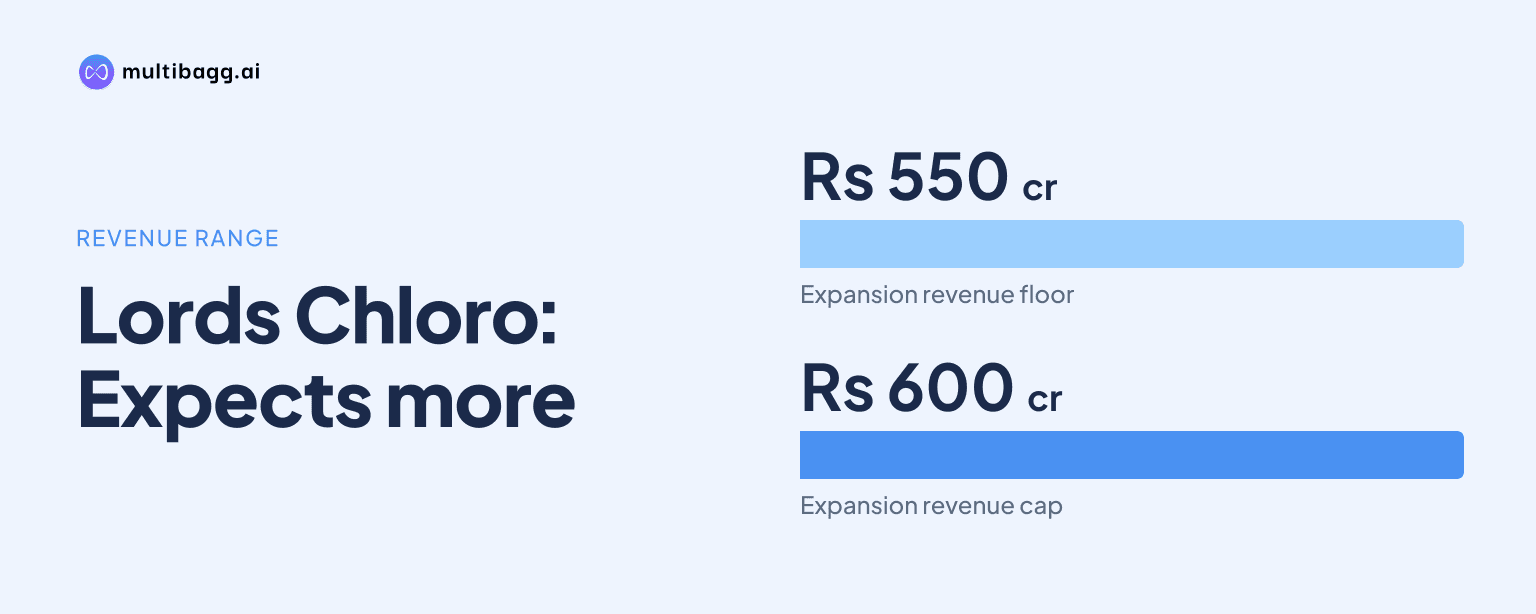
Lords Chloro Alkali Limited, referred to as Lords Chloro, expects ₹550 crore to ₹600 crore of revenue after its ₹315 crore expansion is completed by July at the latest, management said on November 4, 2026. Management also estimated that the expanded business could produce about ₹80 crore of annual free cash flow for subsequent investments.
Know Lords Chloro Alkali inside out
Results, valuation, peers and who's buying, in one view.
What revenue does Lords Chloro expect after its expansion?
Lords Chloro expects at least ₹550 crore of revenue in the next year and sees ₹550 crore to ₹600 crore as the potential from its current capital-expenditure plan. Management said the increase would primarily come from the caustic-soda expansion. Because the new plant is expected to be operational by July at the latest, management said the next year would include only nine months of sales from the new capacity.
The projection is above income reported so far in FY27. Total income was ₹222 crore in H1 FY27, compared with ₹201 crore in H1 FY26, while Q2 FY27 income reached about ₹115 crore against about ₹100 crore a year earlier. Management attributed the 14% Q2 increase, despite lower product realisations, to higher caustic-soda volumes and improved chlorinated paraffin wax, or CPW, realisations.
The ₹315 crore programme is being completed in stages. Lords Chloro had completed about ₹150 crore of spending in the prior year, leaving about ₹165 crore to be completed by July at the latest. Management said commissioning would occur primarily in March and no later than July, while reaffirming the original timetable.
How could the expansion change Lords Chloro’s cash generation?
Management expects Lords Chloro to generate at least ₹15 crore to ₹20 crore of earnings before interest, tax, depreciation and amortisation, or EBITDA, each quarter after the capex is complete. It translated that operating expectation into roughly ₹80 crore of annual free cash flow, describing the estimate as achievable even at lower caustic-soda realisations.
Management said the expected cash flow would be available for further chemical investments after the ₹315 crore programme is finished. It described the immediate priority as completing the current expansion, while using external research to assess potential products and companies. Its stated longer-term preference is to diversify further into specialty chemicals.
Lords Chloro also outlined management’s potential funding approach for an acquisition. Management said about ₹80 crore of annual free cash flow could support a ₹200 crore loan on a 30% equity basis, potentially allowing an acquisition valued at about ₹250 crore to ₹300 crore. It said strategic expansions and acquisitions are under consideration, but it did not identify a target or announce a transaction.
Which operating trends support Lords Chloro’s outlook?
Lords Chloro’s Q2 FY27 total income rose to about ₹115 crore from about ₹100 crore in Q2 FY26 as caustic-soda lye sales volumes increased. Management initially cited volume of about 23,000 tonnes against 21,000 tonnes a year earlier, and later specified Q2 sales at 23,300 tonnes. That was also above 19,953 tonnes in Q1 FY27.
CPW is another part of the operating mix. Management said CPW volume grew by more than 40% year on year in H1 FY27 and contributed 20% to 25% of income. Lords Chloro has produced CPW for about one to one-and-a-half years and initially developed the product mainly to consume chlorine internally rather than sell it into the open market.
Management said Lords Chloro sells roughly 150 tonnes of chlorine in the open market and uses about 100 tonnes internally, without specifying a period for those figures. In the Alwar region, it put chlorine realisations at between negative Rs 2,000 and zero, versus negative Rs 4,000 to negative Rs 4,500 in the past. Management said Gujarat was still at about negative Rs 2,000.
Got a follow-up? Ask IRIS
How do renewable-power assets affect Lords Chloro’s costs?
Lords Chloro commissioned 21 megawatts direct current, or MW DC, of captive solar power with a battery energy storage system during the quarter. The addition took captive and group-captive renewable capacity to 47 MW DC. Management said renewable sources now supply around 40% of total power needs following the additional captive solar plant’s September commissioning.
Management cited grid power at about Rs 8.30, compared with about Rs 2 for captive power and Rs 4.50 for group-captive power. It said this cost difference supports lower energy expenses and its effort to reduce the effect of caustic-soda price movements on profitability. The Alwar manufacturing site covers 84 acres, which management said provides room for further expansion.
Power and fuel expense fell quarter on quarter to ₹37.79 crore in Q2 FY27 from ₹42 crore in Q1 FY27, despite higher caustic-soda production and sales. However, management said raw-material cost rose by about ₹6 crore, to ₹36 crore from ₹30 crore, mainly because paraffin oil, sulphuric acid and other CPW inputs had become more expensive. Employee benefits also included ₹1.20 crore of half-yearly, EBITDA-linked incentives.
What could affect Lords Chloro’s post-expansion results?
Caustic-soda and raw-material pricing are the main variables management identified. It said caustic-soda realisations declined significantly between Q1 FY27 and Q2 FY27 after a previous commodity-price increase associated with the US-Iran war. H1 FY27 profit before tax was about ₹28 crore and broadly unchanged from H1 FY26 despite lower caustic-soda realisations.
Management expects power and fuel expense to decline further, but also said material costs should ease from Q2 FY27 levels. For CPW, it said Lords Chloro had contracted for large quantities of paraffin oil at lower prices and that current paraffin-oil pricing was below levels when the conflict began. It did not provide a numerical outlook for caustic-soda or CPW realisations.
Management also discussed prospective industry supply additions. It said India’s caustic-soda production was about 6 million tonnes and could increase to 8 million tonnes when Reliance begins operations next year, then to about 10 million tonnes after Adani’s planned addition. Management said Indian and global consumption were growing by about 5% annually, while European capacity closures and export depots could affect market balances.
Conclusion
Lords Chloro’s ₹315 crore expansion is intended to lift revenue to ₹550 crore to ₹600 crore and, in management’s estimate, create about ₹80 crore of annual free cash flow for reinvestment. The plan follows H1 FY27 income of ₹222 crore, up from ₹201 crore in H1 FY26, with higher caustic-soda and CPW volumes offsetting lower caustic-soda realisations and higher CPW input costs.
The next development to watch is commissioning, which management expects primarily in March and no later than July. After completion, management plans to evaluate specialty-chemical expansion or acquisitions using expected cash generation, but it has not disclosed a target, chosen product category or announced transaction.