










Lords Chloro Alkali Reports 17% Q2 Revenue Growth
Key highlights
- Lords Chloro Alkali reported Q2 FY27 income from operations of INR 115.40 crore, up 17.34% year-on-year.
- Q2 FY27 EBITDA was INR 18.82 crore, down 10.78% from INR 21.09 crore a year earlier.
- Management said H1 FY27 total income rose to INR 222 crore from INR 201 crore.
- Renewable sources account for around 40% of Lords Chloro Alkali's total power requirement, according to management.
powered by IRIS
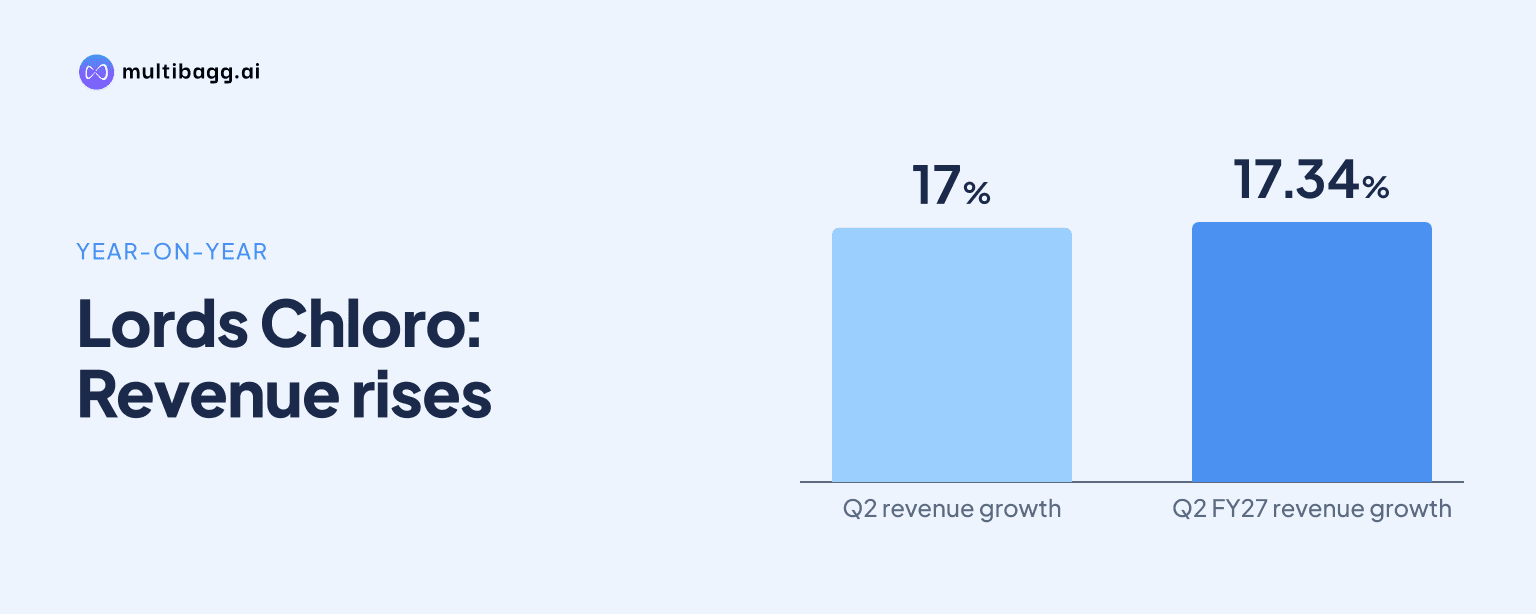
Lords Chloro Alkali Limited reported Q2 FY27 income from operations of INR 115.40 crore, up 17.34% year-on-year from INR 98.34 crore, as higher sales volumes and improved chlorinated paraffin wax realizations offset pressure on caustic soda prices. The quarterly update also showed EBITDA declining 10.78% to INR 18.82 crore.
Know Lords Chloro Alkali inside out
Results, valuation, peers and who's buying, in one view.
What did Lords Chloro Alkali report for Q2 FY27?
Lords Chloro Alkali reported higher revenue in Q2 FY27, but lower EBITDA than in the comparable quarter a year earlier. Income from operations was INR 115.40 crore, compared with INR 98.34 crore in Q2 FY26. Management separately described total income as about INR 115 crore, against about INR 100 crore a year earlier.
The company reported quarterly EBITDA of INR 18.82 crore, down from INR 21.09 crore in Q2 FY26. This means revenue growth did not translate into a higher EBITDA figure for the quarter. The supplied presentation-based figures do not provide a net profit number, EBITDA margin, or a detailed cost breakdown.
For the first half of FY27, management said total income increased to INR 222 crore from INR 201 crore in the year-earlier period. The half-year comparison indicates that the company maintained revenue growth despite weaker realisations in a key product line.
Why did Lords Chloro Alkali's revenue increase?
Lords Chloro Alkali attributed the revenue increase primarily to higher caustic soda volumes and better realisations for chlorinated paraffin wax, or CPW. Management said the company produced and sold substantially more caustic soda in volume terms, helping compensate for lower caustic soda lye prices.
CPW realisations also improved during the period, according to the earnings-call remarks. The company identified New Delhi and North India as important CPW markets and said its location provides proximity to those demand centres. Its products serve paper, pulp, textiles, soaps, detergents, pharmaceuticals, plastics, water treatment and other industrial end markets, mainly across North India.
The Q2 performance therefore reflected a mix of volume growth and product-level pricing improvement rather than broad-based price strength. Management did not disclose product-wise sales volumes, pricing data, capacity utilisation, or the precise contribution of CPW to quarterly revenue.
What caused pressure on Lords Chloro Alkali's earnings?
Lords Chloro Alkali said caustic soda lye realisations had been under pressure during the last quarter. That pricing weakness is important because caustic soda is a core product for chlor-alkali producers, and lower selling prices can restrict profitability even when volumes rise.
The company nevertheless said its H1 FY27 performance was similar to the prior year despite significantly lower product realisations. Management linked this resilience to improved cost efficiency. The available material does not disclose whether lower power costs, operating efficiencies, raw-material changes, or other factors accounted for the improvement.
The fall in quarterly EBITDA to INR 18.82 crore from INR 21.09 crore shows that margin pressure remained visible in reported earnings. Revenue rose by 17.34% year-on-year, while EBITDA fell by 10.78%, underscoring the effect of pricing and cost conditions on the quarter's operating performance.
Got a follow-up? Ask IRIS
How is renewable power relevant to Lords Chloro Alkali?
Lords Chloro Alkali said renewable sources now account for around 40% of its total power requirement. The company presented this as a key part of its effort to improve cost efficiency while operating in a power-intensive chlor-alkali business.
Electricity is a significant operating input in caustic soda manufacturing. A greater renewable-power share can therefore be relevant to the company's cost structure, particularly when product realisations are weak. However, the company did not provide a quantified savings figure, renewable capacity figure, or a timeline for increasing the 40% share.
Management described the renewable contribution as likely among the highest for a caustic soda manufacturing plant in India. That statement was made during the earnings call and was not accompanied in the supplied material by an industry-wide comparison or independent benchmark.
What did the Q2 FY27 update mean for investors and operations?
The Q2 FY27 update showed that Lords Chloro Alkali grew revenue through volumes and CPW realisations while facing lower caustic soda pricing and a decline in EBITDA. For investors, the most relevant reported contrast is between the 17.34% increase in income from operations and the 10.78% decrease in EBITDA.
The company held its Q2 and H1 FY27 earnings call on November 4, 2026, following the board-meeting outcome and financial-results disclosure on November 3, 2026. It subsequently disclosed an audio recording link under SEBI Listing Obligations and Disclosure Requirements regulations. The supplied material says no earnings-call transcript was published for the quarter.
The provided information does not include management guidance, a production target, a caustic soda price outlook, or a direct forecast for profitability. It also does not quantify any share-price movement referenced in external coverage. As a result, the reported figures offer a view of the completed quarter but not a confirmed financial outlook.
Conclusion
Lords Chloro Alkali delivered higher Q2 FY27 revenue, with income from operations rising to INR 115.40 crore, supported by higher caustic soda volumes and improved CPW realisations. But EBITDA fell to INR 18.82 crore as pressure on caustic soda lye realisations continued, making cost efficiency and product mix central to the quarter's performance.
Investors will watch whether caustic soda pricing changes, whether CPW realisations remain supportive, and how the company's 40% renewable-power share contributes to costs. The supplied disclosures contain no management target or profitability guidance, leaving subsequent financial filings and investor communications as the next confirmed sources of operational detail.