










Motherson targets Rs 9,18,000 crore gross revenue by FY30
Key highlights
- Motherson targets Rs 9,18,000 crore of gross revenue in 2029-30 at a stated Rs 85 per US dollar conversion.
- Motherson’s Vision 2030 sets a 40% group ROCE target.
- Motherson’s 3CX10 framework limits any country, customer or component to 10% of revenue.
- Motherson reported Rs 1,26,104 crore of revenue from operations and Rs 12,033 crore of EBITDA in FY26.
powered by IRIS
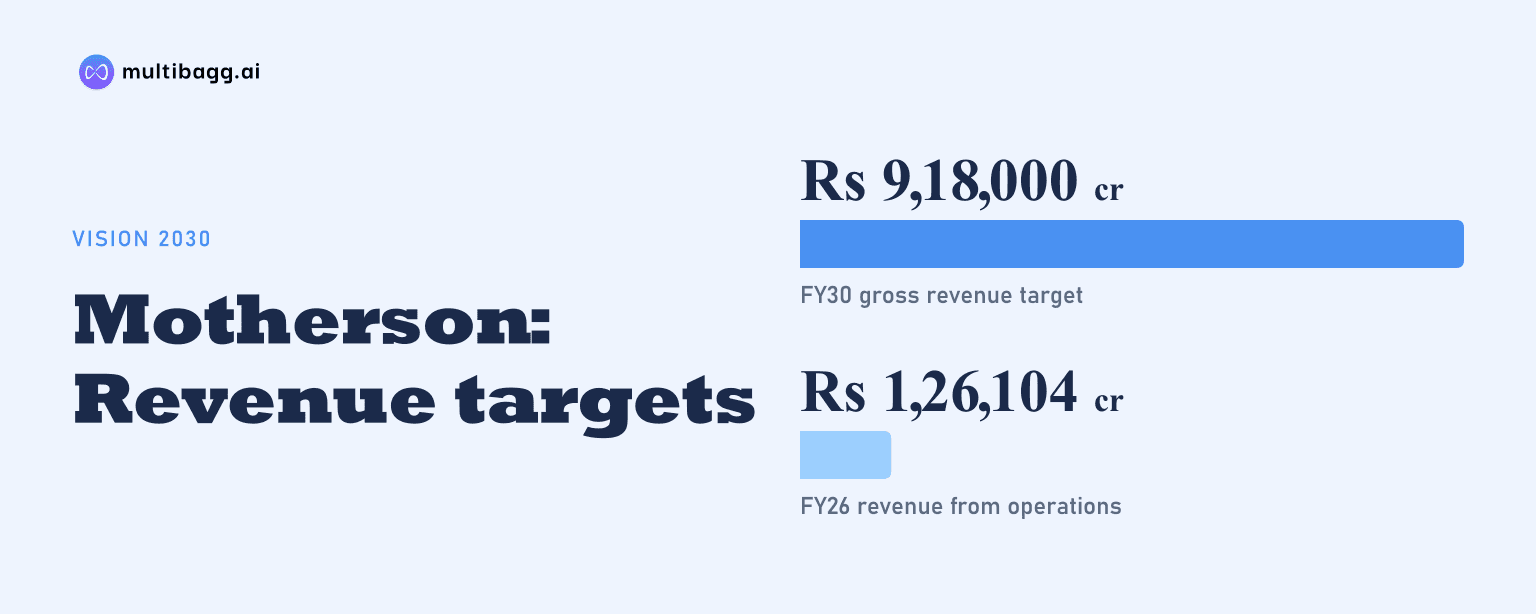
Motherson’s Vision 2030 targets Rs 9,18,000 crore of gross revenue in 2029-30, based on a stated Rs 85 per US dollar constant-currency conversion, while setting a 40% group return on capital employed target and limiting any country, customer or component to 10% of revenue.
Know Samvardhana Motherson International inside out
Results, valuation, peers and who's buying, in one view.
What does Motherson’s Vision 2030 target?
Motherson’s seventh five-year plan targets gross revenue of Rs 9,18,000 crore in 2029-30. The presentation expresses the objective as a constant-currency measure using the average exchange rate for FY2025, and identifies the 2025 plan starting point as Rs 1,80,200 crore at the stated Rs 85 per US dollar conversion.
The plan has four stated outcomes: the gross-revenue target, 40% group return on capital employed, or ROCE, the 3CX10 diversification framework, and dividends of up to 40% of consolidated profit. The dividend wording sets an upper limit, rather than a stated annual payout or minimum distribution commitment.
Motherson’s FY2025 plan history page gives a slightly different conversion rate of Rs 84.55 per US dollar, while the current-plan footnote uses Rs 85 per US dollar. Management says Vision 2030 should be tracked at constant currency, but the two plan pages disclose different FY2025 average exchange-rate assumptions.
How are Motherson’s FY30 revenue and return measures calculated?
Motherson defines gross revenues as gross consideration, including throughput revenue arising from principal-versus-agent accounting under Indian Accounting Standard 115, added to revenue from operations and 100% of revenue from equity-accounted joint ventures and associates. The Rs 9,18,000 crore target is therefore broader than the company’s reported revenue-from-operations series.
Motherson defines group ROCE as earnings before interest and tax, or EBIT, divided by average capital employed. Both EBIT and capital employed include 100% of the corresponding amounts of equity-accounted joint ventures and associates, rather than only Motherson’s reported accounting share.
For year five of the plan, Motherson says capital employed is adjusted for valuation and acquisition effects from certain acquisitions made after March 31, 2022, as well as capital work in progress and intangible assets under development. These adjustments matter because the 40% target uses an average capital-employed denominator rather than reported operating profit alone.
How does Motherson’s current scale compare with its FY30 plan?
Motherson reported revenue from operations of Rs 1,26,104 crore in FY26, up from Rs 57,370 crore in FY21, with the presentation stating a five-year compound annual growth rate, or CAGR, of 17%. The FY30 target uses gross revenue instead, so it cannot be read as a like-for-like target against the reported revenue-from-operations line.
Earnings before interest, tax, depreciation and amortisation, or EBITDA, rose to Rs 12,033 crore in FY26 from Rs 4,516 crore in FY21, a stated five-year CAGR of 22%. Profit after tax attributable to the concern share increased to Rs 3,860 crore from Rs 712 crore over the same period, for a stated 40% CAGR.
The presentation’s five-year-plan record also shows varied outcomes across earlier cycles. The 1995 plan recorded Rs 153 crore against a Rs 100 crore target, and the 2000 plan recorded Rs 1,029 crore against a Rs 1,000 crore target; the later 2015 and 2020 plans are shown below their respective targets.
Got a follow-up? Ask IRIS
How does Motherson’s 3CX10 framework limit concentration?
Motherson’s 3CX10 framework says no country, customer or component should contribute more than 10% of revenue. The three limits apply separately, making geographic, customer and component exposure an explicit constraint within the 2029-30 growth plan.
For 3CX10, Motherson uses economic revenue, including 100% of revenue of joint ventures and associate companies accounted for under the equity method. This differs from the gross-revenue definition through its stated focus on the relevant economic revenue base used for concentration measurement.
Geographic segmentation is based on manufacturing locations, except in certain job-work cases such as Mexico and India. Motherson does not disclose current percentages for its largest country, customer or component exposure, so the presentation sets out the 10% objective and methodology rather than a current compliance scorecard.
Motherson reports 28 existing joint-venture partners from 13 countries of origin, with its oldest partnership spanning 43 years. It also lists 54 customer-requested acquisitions since 2002, including Shushan Autocraft Technology in China and Motherson Controls in India in 2026.
What balance-sheet information accompanies Motherson’s plan?
Motherson reported effective net debt of Rs 9,811 crore at March 2026, compared with Rs 9,791 crore at March 2025. Over the same period, its leverage ratio fell to 0.8 times from 0.9 times, against a stated financial-policy level of 2.5 times.
The leverage ratio had been 1.9 times at March 2022 and 1.4 times in both March 2023 and March 2024 before declining in the following two years. Motherson excludes compulsorily convertible debenture-related debt because it is mandatorily convertible, with no actual repayment other than the contracted coupon rate.
Motherson also notes that, for acquired assets less than one year old, it uses last-twelve-month EBITDA for like-for-like comparison in FY24 and FY25. This measurement treatment is relevant to interpreting leverage during a period in which the presentation lists acquisitions through 2026.
Conclusion
Motherson’s Vision 2030 combines a Rs 9,18,000 crore gross-revenue objective for 2029-30 with a 40% group ROCE target and separate 10% limits on country, customer and component concentration. The plan’s scale measure includes throughput revenue and specified joint-venture and associate revenue, while its diversification test uses economic revenue and manufacturing-location geography.
The next disclosures to watch are Motherson’s progress toward the 2029-30 target, any reported 3CX10 concentration data, and movement toward the 40% ROCE objective. Management’s treatment of constant currency, including whether it uses Rs 84.55 or Rs 85 per US dollar, and any dividend declared within the up-to-40% ceiling will also shape how the plan is tracked.