










MRO-TEK Networks Product Revenue Rises 79.5% to ₹32.67 Crore
Key highlights
- MRO-TEK's FY26 product revenue rose 79.5% to ₹32.67 crore from ₹18.20 crore in FY25.
- The product segment added ₹14.47 crore of revenue year on year in FY26.
- MRO-TEK reports over 65% local content in its networking products.
- The planned Bangalore Rural manufacturing facility has an estimated capital outlay of over ₹26 crore.
powered by IRIS
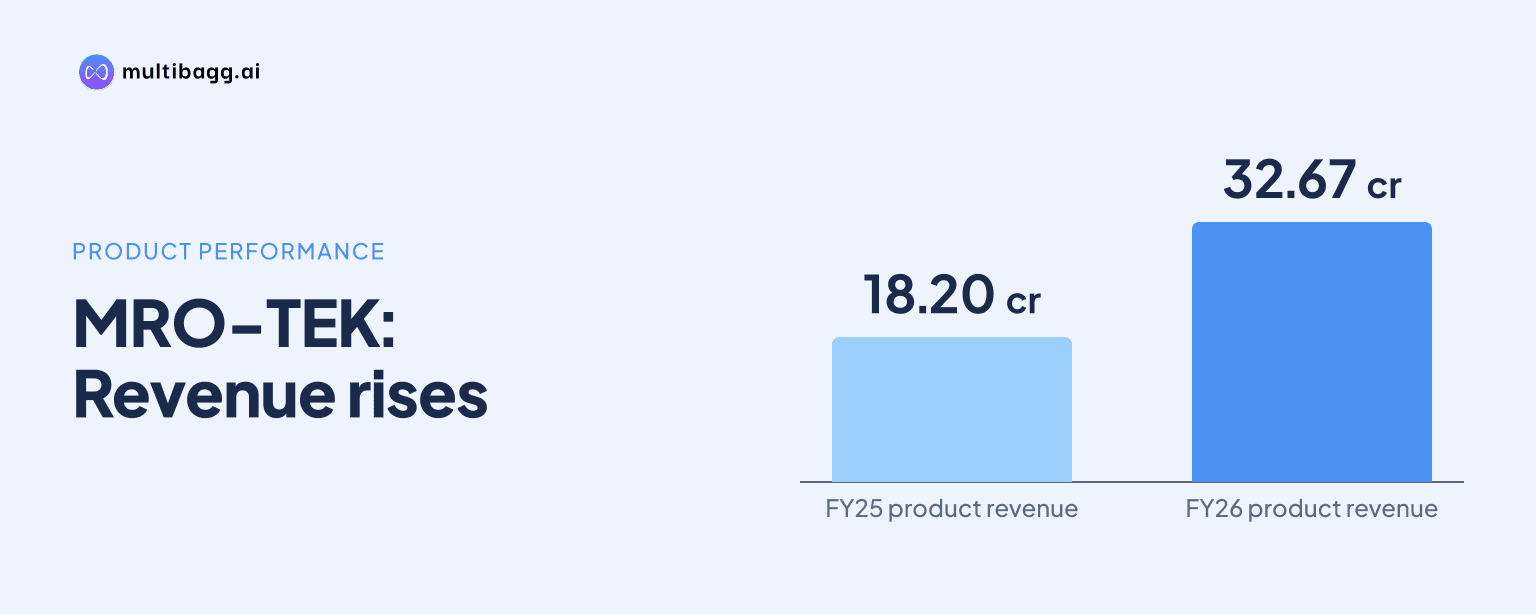
MRO-TEK Networks Ltd reported product-segment revenue of ₹32.67 crore in FY26, a 79.5% increase from ₹18.20 crore in FY25, supported by new switch and router models, higher local content and government-compliance certifications. The performance is significant as the company shifts from telecom infrastructure services towards telecom equipment and network solutions.
Know Umiya Buildcon inside out
Results, valuation, peers and who's buying, in one view.
Why did MRO-TEK's product revenue rise in FY26?
MRO-TEK's product revenue rose because it expanded its product portfolio through new switch and router models, continued research and development, and increased local content in its equipment. The director's report said these steps helped the company use the Make in India policy and the National Security Directive on the Telecommunication Sector.
Product-segment revenue increased by ₹14.47 crore year on year, reaching ₹32.67 crore in FY26 from ₹18.20 crore in FY25. The company described demand for high-capacity switches and data-centre networking solutions sold under its MRO-TEK brand as a key support for this growth. It has also said it has a healthy order pipeline in the products business.
The reported revenue increase applies specifically to the product segment, rather than to consolidated company revenue. This distinction matters because MRO-TEK also operates networking-solutions and system-integration activities, including operations-and-maintenance work for government-linked networks.
What products and customers support MRO-TEK's networking business?
MRO-TEK designs and manufactures routers, switches and security products for telecom operators, enterprises and critical-infrastructure users in India. Its networking products are supplied under annual contracts to Tier-1 internet service providers and telecom service providers including Airtel, Tata Tele-Services and Vodafone Idea, providing a recurring commercial relationship rather than solely one-time equipment sales.
The company has positioned its product range for sensitive public-sector and infrastructure deployments. It is listed as a Department of Telecommunications Trusted Source, while its flagship products are TEC-certified. Its switches and routers have also cleared RDSO inspection for railway signalling and surveillance deployment, according to the supplied information.
These certifications and approvals are relevant because they determine eligibility for certain government and critical-network procurement opportunities. MRO-TEK has stated that its focus on indigenous research and development, scalable architectures and high-performance switching is intended to align its offerings with India's digital-infrastructure requirements.
Got a follow-up? Ask IRIS
How is MRO-TEK building its indigenous technology and factory capacity?
MRO-TEK is developing an indigenous 1G Ethernet switch, with in-house engineers having successfully tested the firmware and made progress on hardware development. The company said it had procured the required hardware bill of materials during the year under review, indicating that development work has moved beyond software testing.
The company is also relocating manufacturing capacity. The Government of Karnataka has allotted one acre in Bangalore Rural District for an advanced manufacturing facility with an estimated capital outlay of more than ₹26 crore. The site is close to the Foxconn iPhone plant, and the move follows the sale of MRO-TEK's Electronics City property to shift to a more cost-effective location.
Separately, the company has indicated an eventual target of approximately 100,000 square feet with multiple surface-mount technology lines. That target describes a longer-term manufacturing direction, while the one-acre Karnataka allotment and the planned capital outlay are the specific disclosed steps towards a larger facility.
What does the shift mean for MRO-TEK's services and investors?
MRO-TEK's shift means that product growth is being developed alongside recurring network-services contracts rather than replacing them immediately. Its networking-solutions and system-integration arm holds operations-and-maintenance contracts involving BSNL-WCL, BSNL-BCCL, RailTel-WCL and APEPDCL.
During FY25, the company executed the Pondicherry State Wide Area Network project and subsequently received an additional order covering 50 more sites. Such operations-and-maintenance work can provide an ongoing base of activity independent of product-sales cycles, although the supplied information does not disclose contract values or segment-wise profitability.
For investors, the FY26 product-revenue increase provides a measurable indicator of demand for the company's equipment portfolio. At the same time, the planned facility involves capital spending of over ₹26 crore, and the source does not provide a commissioning date, funding details, total order-book value or guidance for future revenue. These disclosures remain important for assessing execution and financial effects.
MRO-TEK has said it expects its growth momentum to continue into FY27, supported by the product-business order pipeline and continued progress in other segments. That statement is the company's outlook, not a reported FY27 financial result.
Conclusion
MRO-TEK's FY26 product revenue of ₹32.67 crore, up 79.5% from ₹18.20 crore, reflects the contribution of an expanded networking portfolio, higher local content and compliance certifications. The result also supports the company's stated transition from telecom infrastructure services to a more focused telecom equipment and network-solutions business.
The next points to watch are progress on the indigenous 1G Ethernet switch, development of the Karnataka manufacturing facility with planned spending above ₹26 crore, and conversion of the disclosed product order pipeline into FY27 revenue. The company has not disclosed facility commissioning timelines, order-book value or FY27 financial guidance.