










MSL reports Rs 2,203 crore order book as tenders improve
Key highlights
- MSL reported a Rs 2,203 crore order book as of 10 November 2026.
- Other customers represented Rs 1,466 crore, or 67%, of MSL's order book.
- MSL's Telangana orders included Rs 144 crore of cylinder-pipe orders.
- MSL said crude-oil output declined 2.5% in both 2024-25 and 2025-26.
powered by IRIS
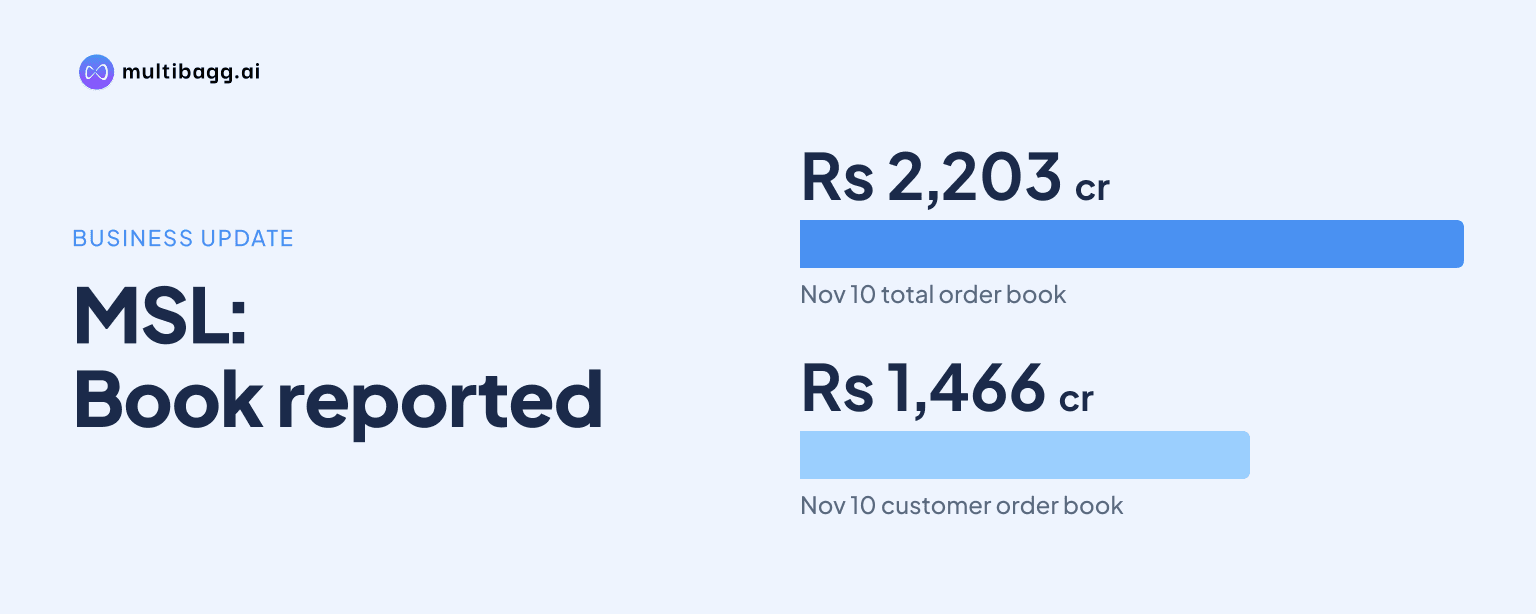
Maharashtra Seamless Limited reported a Rs 2,203 crore order book on 10 November 2026, of which Rs 1,466 crore, or 67%, came from customers other than ONGC and OIL. MSL said oil-and-gas tender issuance had improved after a prolonged slowdown and that back-to-back raw-material bookings were intended to lock margins on each confirmed order.
Know Maharashtra Seamless inside out
Results, valuation, peers and who's buying, in one view.
What is MSL's order-book mix as of 10 November 2026?
MSL's Rs 2,203 crore order book comprised Rs 737 crore, or 33%, from ONGC and OIL and Rs 1,466 crore, or 67%, from other customers. The other-customers segment was Rs 729 crore larger than the ONGC and OIL segment, showing that the disclosed backlog was weighted towards buyers outside the two separately named oil-sector customers.
Maharashtra accounted for Rs 1,687 crore of the order book, Telangana for Rs 196 crore and electric resistance welded, or ERW, pipes for Rs 320 crore. The ONGC and OIL allocation included Rs 736 crore in Maharashtra and Rs 1 crore in ERW, while the other-customers allocation included Rs 951 crore in Maharashtra, Rs 196 crore in Telangana and Rs 319 crore in ERW.
The Telangana orders under other customers included Rs 144 crore of cylinder-pipe orders, according to the presentation. That component represented Rs 144 crore out of the Rs 196 crore Telangana allocation, while the ONGC and OIL line also included drill-pipe orders valued at Rs 27 lakh.
How does MSL manage order-book margin exposure?
MSL says it books raw materials back-to-back against each order, a process it says locks margins and minimises the effect of fluctuating raw-material prices. The presentation does not quantify the raw-material price exposure or margins on the Rs 2,203 crore order book, but identifies procurement matching as the mechanism used for booked work.
MSL also cites a minimum-import-price anti-dumping measure on various seamless pipes from China. The Ministry of Finance implemented the measure from 28 October 2021 following a recommendation by the Directorate General of Trade Remedies, and MSL says its interim extension runs until 27 January 2027.
The company further points to the Ministry of Steel's revised DMI and SP policy, effective from 1 April 2025 for five years. Under the policy, seamless and ERW pipes are classified as Melt and Pour, meaning supplies for public-sector undertaking projects must use domestic steel; MSL says requirements up to Rs 200 crore are tendered domestically, excluding foreign players.
Got a follow-up? Ask IRIS
What oil-and-gas demand signals does MSL identify?
MSL says tender issuance by oil companies has improved after a long slowdown, although it says further improvement is needed. It links the demand need to domestic production trends: crude-oil output fell 2.5% in both 2024-25 and 2025-26, while natural-gas production fell 1.0% in 2024-25 and 3.7% in 2025-26.
The presentation says India imports 88% of its crude-oil needs and 51% of its natural-gas needs. It also identifies ONGC discoveries at Suryamani and Vajramani in offshore Mumbai blocks, discoveries in the Mahanadi basin's MN-DWHP-2018/1 block, and offshore Mumbai oil blocks named Amrit and Moonga, without attaching an MSL order value to those developments.
MSL cites the Ind-Ra 2QFY26 Project Tracker, under which project awards declined 27% year on year in H1 FY26 and 13% year on year in Q2 FY26. While tender announcements had reached record highs, MSL says it is now seeing actual contract awards and purchase orders, distinguishing the current observation from the slower award conversion in those earlier periods.
Based on earlier market-source indications of about 500 new onshore and offshore wells a year, MSL estimates a fresh seamless-pipe requirement of 100,000 metric tonnes annually. That estimate applies a conservative 200 metric tonnes per well and excludes regular requirements for development and workover wells, so it is an MSL demand estimate rather than a reported market outcome.
Which products could add to MSL's demand?
MSL says its cylinder pipes have been approved by all major compressed natural gas cylinder manufacturers and that it receives consistent demand from buyers. The Rs 144 crore cylinder-pipe component of the Telangana order book provides a disclosed order-value indicator for this import-substitution product.
MSL says it has dispatched subsea sour-service seamless-pipe orders and estimates the domestic market for that product at 35,000 metric tonnes. It has also dispatched drill-pipe orders, estimates the domestic drill-pipe market at 10,000 metric tonnes and says fresh drill-pipe orders are awaited.
MSL says it is making active efforts to enter export markets for drill pipes, but provides no export order value, sales target or timetable. At the wider market level, it cites OPEC guidance for global oil demand of 106 million barrels a day in calendar 2026 and 108 million barrels a day in calendar 2027.
The presentation also cites a projection that Indian oil demand will rise 30% to 7.2 million barrels a day in 2030 from 5.6 million barrels a day in 2024, compared with 7% global growth. It says India plans to expand refining capacity to 450 million tonnes over the next 10 years, while ONGC, ONGC Petro additions Ltd and Mangalore Refinery and Petrochemicals Ltd plan to double production to 8 million metric tonnes annually by 2030 with Rs 1 lakh crore of spending.
Conclusion
MSL's Rs 2,203 crore order book as of 10 November 2026 was led by Rs 1,466 crore of other-customer orders and included Rs 144 crore of cylinder-pipe orders. The company connects the backlog and product opportunity to improving tender activity, domestic-steel procurement rules and import-substitution products, while using matched raw-material bookings to address price movements on confirmed orders.
The next disclosed milestones are whether recent tendering converts into additional awards, whether fresh drill-pipe orders follow completed dispatches and whether export-market efforts produce orders. MSL also identifies 27 January 2027 as the interim end date for the minimum-import-price measure, while the revised DMI and SP policy is stated to run for five years from 1 April 2025.