










STIL links 75 product passports to export-market access
Key highlights
- STIL had 75 product LCAs and Digital Product Passports live in FY26.
- STIL reports Green Fibre capacity of 120 metric tonnes per day and renewable capacity of 18.12 megawatts.
- STIL plans a full Scope 3 inventory in FY27 and states a Scope 3 reduction target of at least 15% by FY31.
- STIL states a target to cut Scope 1 and Scope 2 emissions intensity by at least 30% by FY30.
powered by IRIS
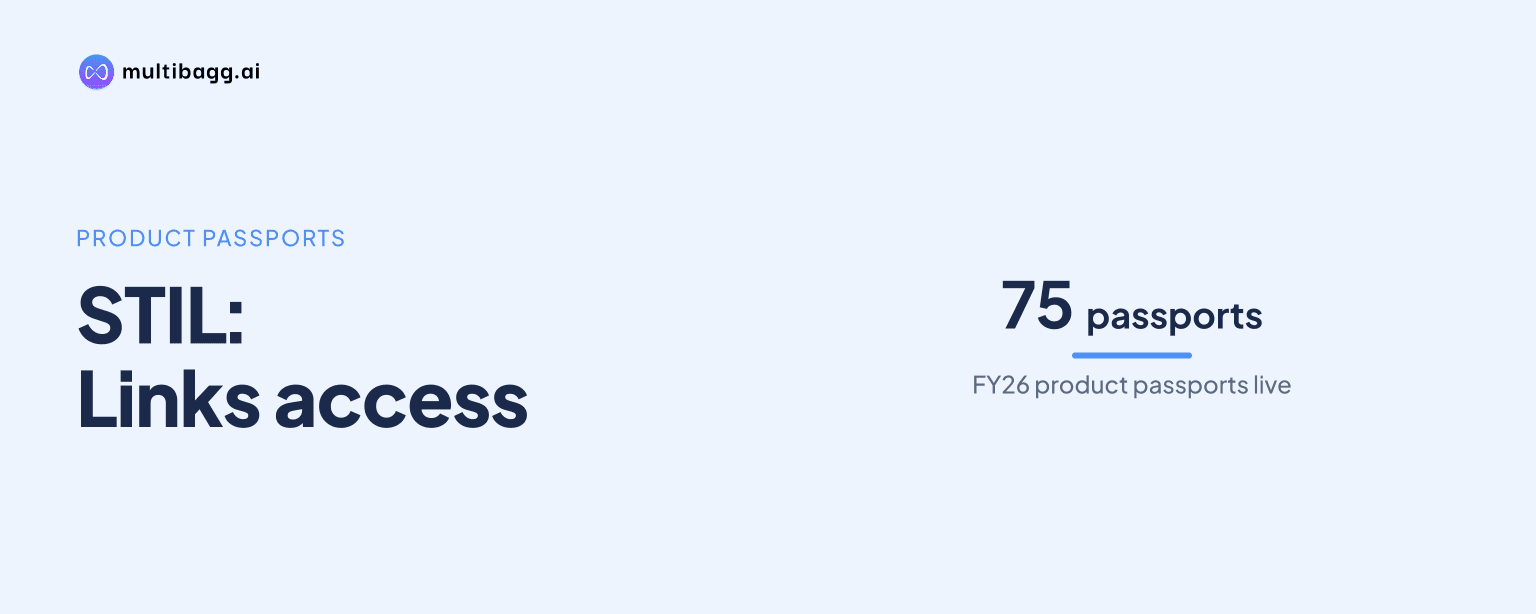
Sutlej Textiles and Industries Limited made life-cycle assessments and Digital Product Passports live for 75 products in FY26, using product-specific environmental and traceability data to support access to brand programmes across more than 60 export countries. STIL links this programme to its certified recycled-fibre chain, 18.12 megawatts of renewable capacity and emissions-reduction roadmap.
Know Sutlej Textiles and Industries inside out
Results, valuation, peers and who's buying, in one view.
How does STIL use product data for export-market access?
STIL uses live Digital Product Passports, or DPPs, for 75 products to provide specifications, process traceability, environmental metrics and certificates at product level. The company says these DPPs are already used in buyer audits and for claim substantiation, and that certified, data-backed supply can qualify it for brand programmes across more than 60 export countries.
The information is based on gate-to-gate life-cycle assessments, or LCAs, completed for the same 75 products in FY26. STIL says the LCAs measure energy, water, waste and carbon dioxide equivalent, or CO₂e, at every process stage. Its next planned step is cradle-to-gate LCAs for priority stock-keeping units, including Green Fibre yarns.
STIL plans to extend its DPP records with supplier data from fibre inward and integrate them with brand platforms. Management presents this as preparation for European Union Ecodesign for Sustainable Products Regulation, or ESPR, and textile DPP requirements. The presentation does not disclose orders, export revenue or pricing gains attributable to the 75 live DPPs.
What production systems support STIL’s product data?
STIL reports Green Fibre capacity of 120 metric tonnes per day for recycled polyester staple fibre, or recycled PSF. It describes an in-house chain from post-consumer polyethylene terephthalate, or PET, bottles to fibre and yarn, operating within one legal entity and therefore one audit trail.
STIL says its fibre chain is certified to Global Recycled Standard, Recycled Claim Standard, Global Organic Textile Standard, Organic Content Standard and Forest Stewardship Council standards. The company presents the certifications alongside DPPs, which carry product-specific certificates, process information and environmental metrics. It does not disclose how many of the 75 assessed products use recycled PSF.
STIL also reports Zero Liquid Discharge, or ZLD, and process-water recycling. Its spun-dyed yarn process removes the yarn-dyeing stage and its related water and effluent load. These operating methods sit alongside the 75 LCAs, which provide product-level measurement of water, energy, waste and emissions.
Got a follow-up? Ask IRIS
What climate milestones and targets has STIL set?
STIL says it will commit to the Science Based Targets initiative, or SBTi, in FY27 and seek validation of 1.5°C-aligned near-term targets by FY30. Its roadmap states a target to reduce Scope 1 and Scope 2 emissions intensity by at least 30% by FY30, while the milestone table lists near-term target validation in FY29.
For Scope 3, STIL plans a full inventory in FY27 and states a reduction target of at least 15% by FY31. Management says verified CO₂e per kilogram from product LCAs can help brands account for low-carbon yarn within their own Scope 3 work. The presentation identifies product data as the base for the planned climate-target process.
The supplied presentation contains two renewable-energy thresholds. One sustainability page states a target of at least 40% renewable share by FY30, while the roadmap milestone table states at least 50% renewable energy in FY30–31. It also gives FY29 in the milestone table and FY30 in the commitment statement for SBTi target validation, without reconciling the timing.
What commercial benefits does STIL expect from the programme?
STIL frames the programme around market access, premium product mix and future-proofed growth. Management says Green Fibre, certified yarns and spun-dyed yarns can shift the mix toward higher-value products, while DPP-ready suppliers can be nominated by brands before EU textile DPP rules apply. These are management’s stated commercial outcomes rather than reported financial results.
The company’s delivered infrastructure includes 75 live LCAs and DPPs, 120 metric tonnes per day of Green Fibre capacity, 18.12 megawatts of renewable capacity and ZLD. Its planned elements include fibre-inward supplier data, brand-platform integration, cradle-to-gate LCAs for priority products and a Scope 3 inventory in FY27.
STIL also lists renewable expansion, DPPs, Green Fibre and protective textiles among its strategic priorities. Its Gujarat home-furnishings facility has capacity of 8.97 million metres per year, with 126 shuttleless looms and 42 single-width Dobby Shedding looms. The presentation does not link that home-furnishings capacity to the 75-product DPP count, export sales or customer nominations.
Conclusion
STIL has established a product-data framework around 75 live LCAs and DPPs, supported by a 120-metric-tonne-per-day recycled-PSF operation, 18.12 megawatts of renewable capacity and ZLD. The combined framework gives STIL product-level records for traceability, certificates and environmental metrics, while management positions those records as tools for export-market and brand-programme access.
The next disclosed events are the FY27 SBTi commitment, Scope 3 inventory and at least 30% renewable-energy milestone, followed by planned target validation in FY29 or FY30 and stated emissions reductions through FY30–31. STIL will need to clarify the differing validation dates and renewable-energy thresholds, and future disclosures could show whether the 75-product programme produces orders, revenue or margin outcomes.