










Sutlej Textiles posts Rs 9 crore H1 profit as EBITDA rises
Key highlights
- STIL reported H1 FY27 standalone PAT of Rs 9 crore, versus a Rs 44 crore loss in H1 FY26.
- H1 FY27 standalone EBITDA rose 346.6% to Rs 101 crore and margin expanded 473 basis points to 6.5%.
- Q2 FY27 standalone total income was Rs 833 crore, up 29.8% year on year and 18.3% quarter on quarter.
- Q2 FY27 standalone PAT was Rs 7 crore, compared with a Rs 18 crore loss in Q2 FY26.
powered by IRIS
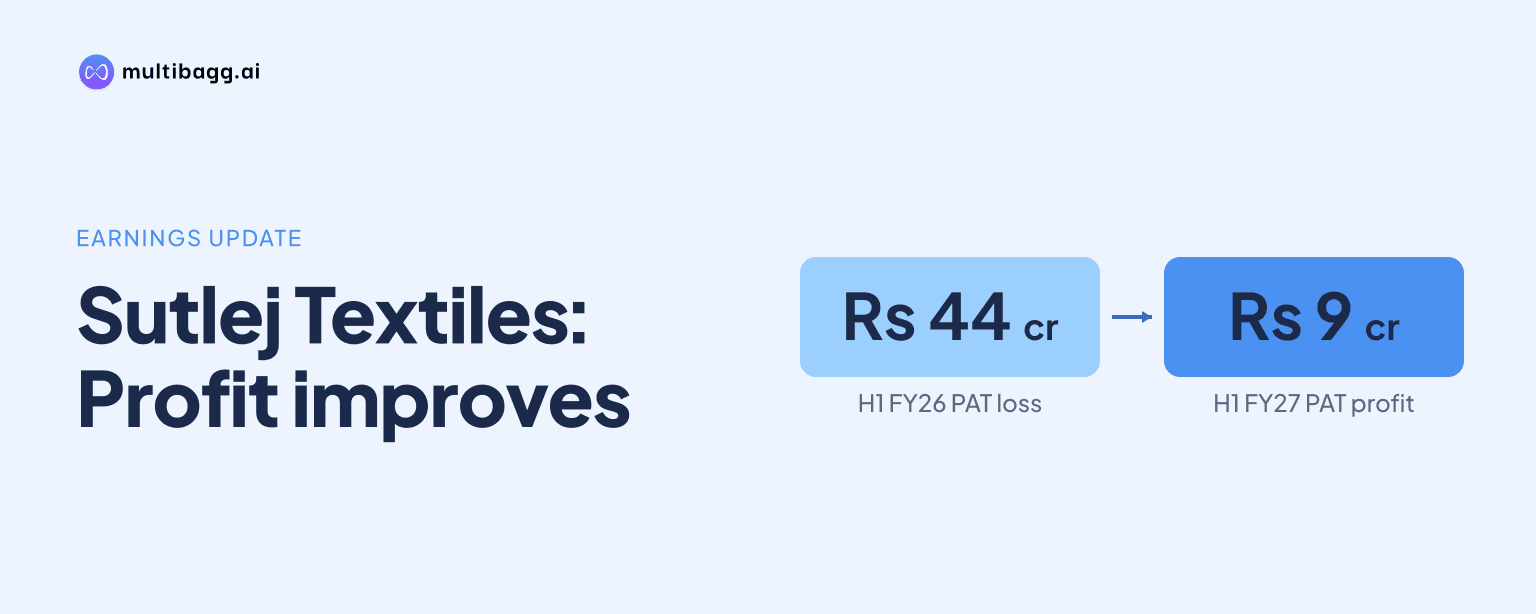
Sutlej Textiles and Industries Limited returned to a standalone profit of Rs 9 crore in the first half of financial year 2027 (H1 FY27), against a Rs 44 crore loss in H1 FY26, as earnings before interest, tax, depreciation and amortisation (EBITDA) rose to Rs 101 crore from Rs 23 crore and margin expanded 473 basis points to 6.5%.
Know Sutlej Textiles and Industries inside out
Results, valuation, peers and who's buying, in one view.
How did STIL return to profit in H1 FY27?
STIL returned to profit because its standalone H1 FY27 profit after tax (PAT) was Rs 9 crore against a Rs 44 crore loss a year earlier. The Rs 53 crore swing followed a rise in operating earnings, with EBITDA increasing Rs 78 crore to Rs 101 crore in the half year ended September 30, 2026.
The improvement extended below the operating line. Profit before tax after exceptional items was Rs 15 crore in H1 FY27, compared with a Rs 64 crore loss in H1 FY26. Depreciation fell to Rs 48 crore from Rs 54 crore, while interest rose to Rs 38 crore from Rs 33 crore, meaning the operating improvement outweighed the higher financing cost disclosed for the period.
STIL reported H1 FY27 total income of Rs 1,537 crore, up 23.4% from Rs 1,246 crore in H1 FY26. EBITDA grew faster than income, rising 346.6%, or about 4.4 times, from the prior-year half. This difference between revenue growth and EBITDA growth was reflected in the margin increase from 1.8% to 6.5%.
What drove STIL's EBITDA margin expansion?
STIL said a richer mix of value-added yarns, home textiles and sustainable fibres lifted realisations and helped convert revenue growth into higher profitability. Its H1 FY27 EBITDA margin rose 473 basis points to 6.5%, from 1.8% in H1 FY26, alongside the Rs 78 crore increase in EBITDA to Rs 101 crore.
The company also attributed the operating gain to manufacturing productivity, energy efficiency and operating-cost control. These mechanisms accompanied a 23.4% increase in H1 FY27 total income to Rs 1,537 crore, while EBITDA rose by 346.6%. The release describes this as improved operating leverage, without providing separate figures for energy savings, productivity or product-level pricing.
In the second quarter of financial year 2027 (Q2 FY27), the same pattern was visible on a smaller sequential comparison. Q2 FY27 EBITDA margin was 6.4%, up from 2.7% in Q2 FY26, a 399-basis-point year-on-year expansion. However, the Q2 margin was 28 basis points below Q1 FY27's 6.7%, despite EBITDA increasing 13.4% sequentially to Rs 53 crore.
The H1 result therefore combined a significant year-on-year margin recovery with a modest quarter-on-quarter margin reduction. Q2 FY27 total income rose 18.3% from Rs 704 crore in Q1 FY27 to Rs 833 crore, but the Q2 EBITDA margin of 6.4% did not match the preceding quarter's 6.7%. STIL's disclosed drivers were mix improvement and cost discipline rather than a stated margin target.
Got a follow-up? Ask IRIS
How did STIL perform in Q2 FY27?
STIL reported standalone Q2 FY27 PAT of Rs 7 crore, compared with a Rs 18 crore loss in Q2 FY26. Total income increased 29.8% year on year to Rs 833 crore from Rs 642 crore, while EBITDA more than tripled to Rs 53 crore from Rs 17 crore, a reported increase of 205.6%.
The quarter's profit before tax after exceptional items was Rs 10 crore, reversing a Rs 26 crore loss in Q2 FY26. Depreciation declined 14.8% to Rs 23 crore from Rs 27 crore, whereas interest rose 25.4% to Rs 20 crore from Rs 16 crore. The Rs 36 crore year-on-year improvement in pre-tax result matched the Rs 36 crore increase in EBITDA on the reported figures.
Sequentially, Q2 FY27 PAT rose from Rs 3 crore in Q1 FY27 to Rs 7 crore, while profit before tax after exceptional items increased from Rs 4 crore to Rs 10 crore. EBITDA rose from Rs 47 crore to Rs 53 crore and total income from Rs 704 crore to Rs 833 crore. The release described this as intact sequential momentum, while also recording the 28-basis-point sequential EBITDA-margin decline.
On a consolidated basis, Q2 FY27 total income was Rs 836 crore and EBITDA was Rs 55 crore, compared with Rs 705 crore and Rs 46 crore respectively in Q1 FY27. Consolidated Q2 PAT was Rs 8 crore, compared with Rs 1 crore in Q1 FY27. The announcement provides consolidated Q2 and Q1 figures, but does not provide consolidated H1 FY27 figures in its financial-summary table.
Which businesses and markets does STIL say support its plan?
STIL said its portfolio is anchored in three growth verticals: value-added yarns, home textiles and green fibre. It also said it is exploring a foray into technical textiles. The company has more than 400,000 spindles of spinning capacity and identifies dyed yarn and cotton mélange yarn as established segments within its value-added yarn operations.
The company linked its reported H1 FY27 margin improvement to this broader move toward differentiated products. In the release, management said its focus includes specialised yarns, home textiles, sustainable fibres and technical textiles, with the stated aim of building a more diversified business. The disclosed financial evidence for the period is the 6.5% H1 FY27 EBITDA margin, compared with 1.8% in H1 FY26.
STIL exports to more than 60 countries and cited deeper penetration in the United Kingdom, European Union and emerging markets as part of its market-diversification strategy. The release says this wider reach broadens the customer base and reduces concentration risk, but does not disclose export revenue, the share of sales by geography or growth rates for individual markets in H1 FY27.
Management also cited sustained investment in product development and innovation as a way to meet evolving customer requirements. Executive Chairman C. S. Nopany said changing trade patterns, supply-chain realignments and sustainability trends create opportunities for India in the textile value chain. These comments concern specialised yarns, home textiles, sustainable fibres and technical textiles, while the release cautions that actual results may differ because of regulatory, political and economic risks.
Conclusion
STIL's H1 FY27 numbers show a reported turnaround from a Rs 44 crore standalone loss to Rs 9 crore PAT, supported by Rs 101 crore of EBITDA versus Rs 23 crore a year earlier. Revenue rose 23.4% to Rs 1,537 crore, while the 473-basis-point expansion in EBITDA margin to 6.5% indicates that the disclosed mix and cost measures had a greater effect on earnings than on sales alone.
What remains unresolved is whether the Q2 EBITDA margin of 6.4% can stay near the H1 level after declining 28 basis points from Q1's 6.7%. STIL's disclosed plan centres on value-added yarns, home textiles and green fibre, alongside an exploration of technical textiles, but the release gives no investment amount, launch schedule or segment-level financial targets for those initiatives.