










MSTC to decide coal exchange role within months as rules evolve
Key highlights
- MSTC expects to decide its coal-exchange approach within 2 to 3 months.
- Management sees a 3-to-5-year period in which coal spot-auction and linkage volumes could move fully or partly to exchanges.
- MSTC reported H1 FY '27 standalone profit after tax of Rs 132.72 crore, versus Rs 93.47 crore in the earlier H1.
- Gross merchandise value through MSTC's portal was Rs 54,580 crore in H1 FY '27, excluding exited trading activity.
powered by IRIS
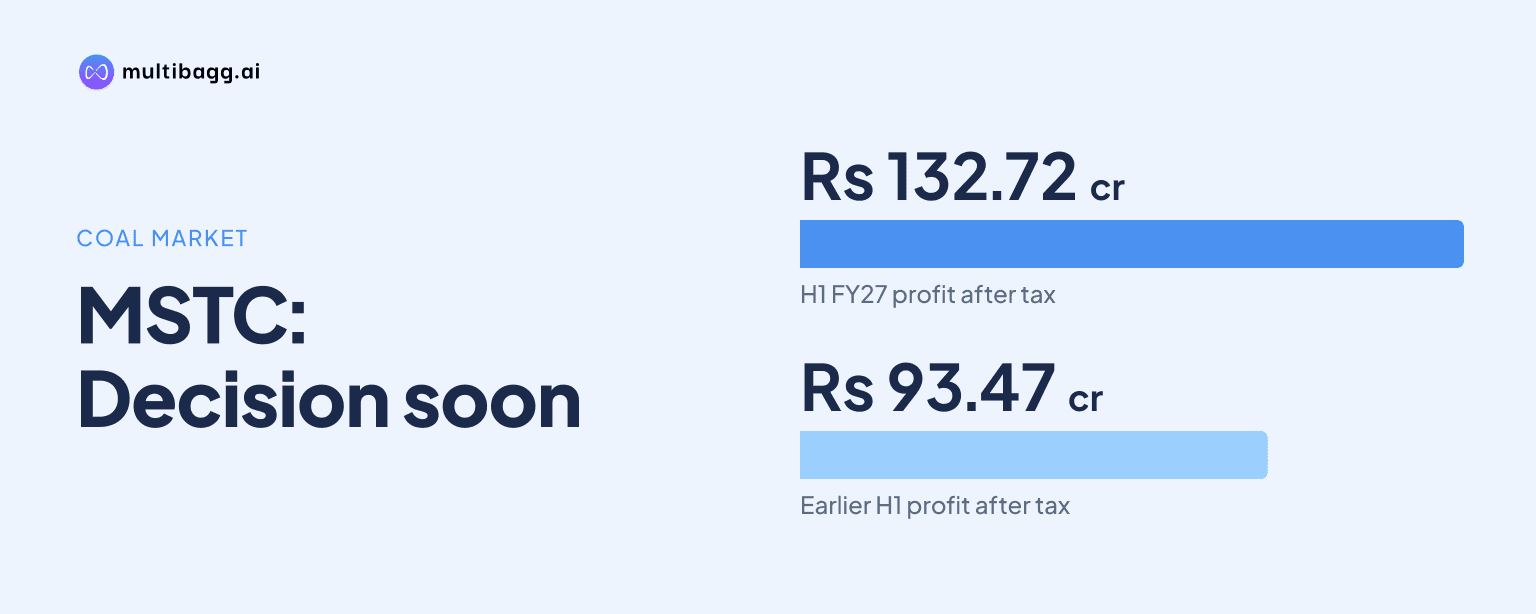
MSTC Limited expects to decide within two to three months how to participate in coal exchanges, as management said future regulation could shift some or all spot-auction and coal-linkage volumes to exchanges over a three-to-five-year period. The company has not disclosed coal-specific revenue or committed to an exchange launch.
Know MSTC inside out
Results, valuation, peers and who's buying, in one view.
What is MSTC deciding about coal exchanges?
MSTC is assessing whether and how to enter the coal-exchange market, with management saying on its Q2 FY '27 call that it expects to make up its mind within the next two to three months. The review covers the viability of an exchange, total market volume, expected market shares among participants and the revenue streams that could result.
MSTC had earlier cited a three-to-four-month period for a firm conclusion, before restating the shorter two-to-three-month window after repeating its answer because of call-audio problems. Neither timeline is a commercial-operating target, because management said the company must first establish what volumes exchanges may handle and how those volumes may be divided.
The decision follows notifications by the Ministries of Coal and Mines concerning coal and mineral exchanges. Management said coal, coal linkages and minerals including iron ore, graphite and manganese are among commodities currently transacted through spot auctions on its platforms, making the proposed market structure relevant to its existing e-sale operations.
Could coal exchanges move MSTC's current auction volumes?
Yes, management said an exchange could ultimately route some or all current coal spot-auction and linkage volume away from the present platform model. MSTC said it currently handles a large part, but not all, of such spot and linkage auctions, and that regulation could make exchanges the route for the entire trading volume in three, four or five years.
The key unresolved issue is whether regulation requires both spot auctions and linkages to move to exchanges, or creates a hybrid model in which only spot auctions migrate. Management said this distinction would determine the addressable volume and revenue opportunity, rather than assuming that all current activity would automatically transfer.
MSTC does not separately report coal-auction revenue for Q2 FY '27 or H1 FY '27. Its finance director said coal sales, coal linkages and mineral auctions are commingled within the minerals segment because clients and fee structures differ, while scrap remains the principal revenue contributor and minerals generally account for about 20% to 25% of that part of the business.
During Q2 FY '27, MSTC sold nearly 4 lakh metric tonnes of chromite and 1.54 million metric tonnes of iron ore or coal through its platform. Management also said the company conducted its first coal-gasification event for the Ministry of Coal, but it did not provide either the associated transaction value or a fee earned from that event.
Got a follow-up? Ask IRIS
What will determine MSTC's coal-exchange revenue?
MSTC said potential exchange revenue will depend on total traded volume, the number of players, the share secured by each player and the regulations defining eligible transactions. Management is assessing those factors across a three-to-five-year market-development period and declined to state an exchange-revenue estimate before completing that work.
Competition is part of the analysis. An analyst said National Stock Exchange of India had received Securities and Exchange Board of India approval to invest in and establish the National Coal Exchange in India, while MSTC management said it expects more than one player and is evaluating how the available volume could be split.
Management identified its legacy and domain expertise in coal auctions as an advantage it intends to leverage if it proceeds. That is a management view rather than a disclosed market-share forecast: MSTC has not identified an exchange partner, investment amount, planned ownership structure or expected commercial start date.
The company’s approach resembles its Extended Producer Responsibility, or EPR, certificate platform, where five categories have been notified but regulatory approval and stakeholder consultations remain unfinished. MSTC said it would need six to eight months of operations after the EPR platform starts to assess revenue flows, reflecting its stated preference not to project transaction-based income before the operating model is clear.
How does the coal-exchange review fit MSTC's H1 FY '27 results?
Coal and mineral activity contributed to higher e-sale activity in H1 FY '27, although MSTC cannot isolate coal income from its reported numbers. Management attributed growth during the quarter and half year to firmer scrap rates, significantly higher iron-ore volumes, mineral-block transactions and sales of smaller assets such as land parcels.
MSTC's standalone total revenue rose 31.25% to Rs 257.20 crore in H1 FY '27 from Rs 195.96 crore in the earlier H1. Standalone profit after tax rose 41.99% to Rs 132.72 crore from Rs 93.47 crore, while management said marketing contribution was zero for the first time following the exit from trading activity.
MSTC reported gross merchandise value of Rs 54,580 crore through its portal in H1 FY '27, excluding the exited trading business. The figure measures transaction value rather than MSTC revenue, but it illustrates the scale of platform activity against which any eventual shift in coal and linkage trading methods would be assessed.
Conclusion
MSTC's coal-exchange evaluation is a response to the possibility that regulation changes the route through which coal spot auctions and linkages are transacted. Its existing presence in these auctions and stated coal expertise provide a reason to assess participation, but the company has not committed to entry because the compulsory transaction scope, market volume, competition and revenue model remain unsettled.
The next item to watch is management's stated two-to-three-month decision window. An update could indicate whether MSTC expects spot auctions alone or both spot auctions and linkages to migrate to exchanges over the three-to-five-year period, and whether it has settled on a specific role in that market.