










Mukka Proteins targets revenue above Rs 3,000 crore by FY30
Key highlights
- Mukka Proteins targets revenue above Rs 3,000 crore in FY30 versus Rs 1,449 crore in FY26.
- Export revenue accounted for 81.3% of Mukka Proteins’ revenue in Q2 FY27.
- Mukka Proteins’ Oman facility began operations in Q2 FY27 and spans 21,249 square metres.
- Mukka Proteins lists 18 owned facilities and 25 manufacturing units including third-party and job-work units.
powered by IRIS
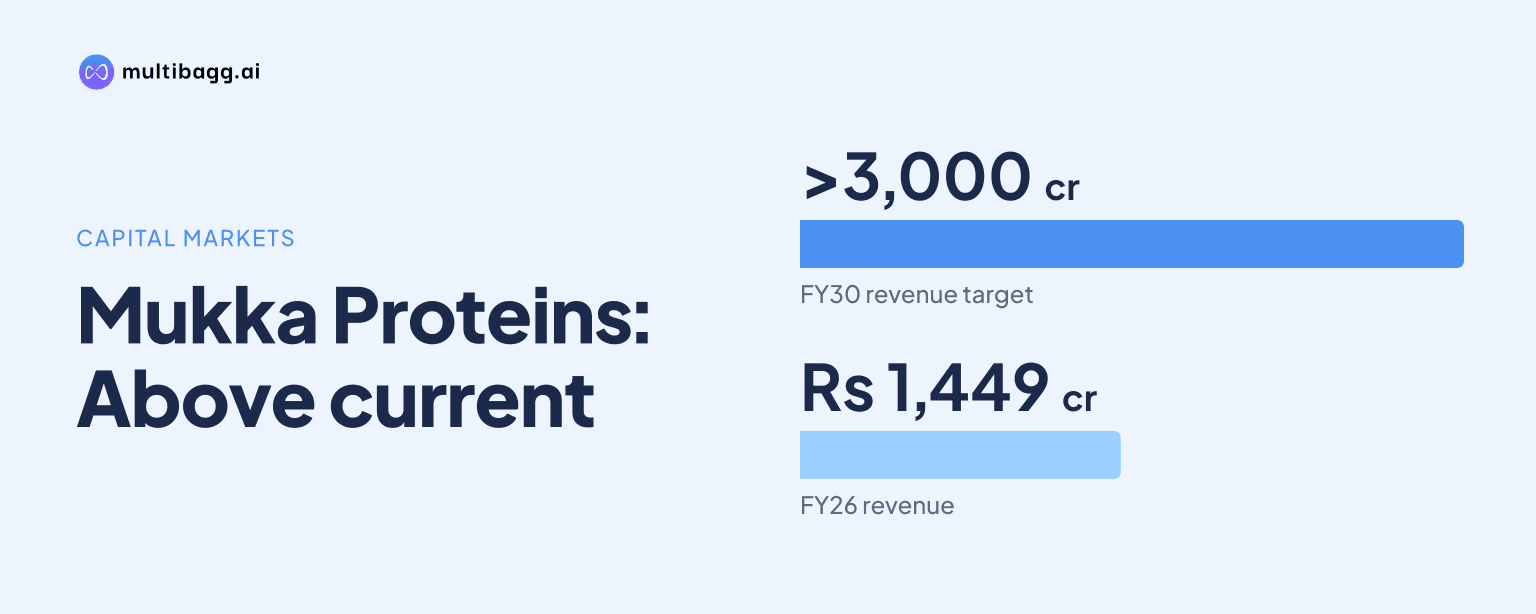
Mukka Proteins Limited is targeting revenue above Rs 3,000 crore in FY30, compared with Rs 1,449 crore in FY26, implying more than twofold growth in about four years. Mukka Proteins identifies four business verticals, Oman operations, organic and inorganic expansion, backward integration and an export-led supply chain as the mechanisms intended to deliver the target.
Know Mukka Proteins inside out
Results, valuation, peers and who's buying, in one view.
What is Mukka Proteins’ FY30 revenue target?
Mukka Proteins’ stated target is revenue above Rs 3,000 crore in FY30, against Rs 1,449 crore in FY26. The FY30 objective therefore represents a minimum increase of more than Rs 1,551 crore over the FY26 base, and management describes the objective as more than 2x growth in about four years.
Mukka Proteins attributes the planned expansion to integration, diversification and global growth rather than to a single product line. The presentation describes an integrated protein, waste-management and biotechnology platform operating across four verticals, with diversification intended to reduce cyclicality.
How will Oman and exports support Mukka Proteins’ growth plan?
Mukka Proteins says its Oman operations are intended to provide direct access to raw material and proximity to Gulf Cooperation Council and other export markets. Its Al Joubah Industrial Area facility in Oman covers 21,249 square metres and commenced operations in Q2 FY27; the facility also secured United States Food and Drug Administration facility registration for markets requiring FDA-registered manufacturing sites.
Exports are central to the operating model, with export revenue accounting for 81.3% of revenue in Q2 FY27. Mukka Proteins reported access to more than 25 international markets, 25 manufacturing units including third-party and job-work units, and 18 owned in-house production facilities across India and Oman, serving Asia, the Middle East, the Far East, Europe and the United States.
The coastal-asset strategy is designed to place plants near raw-material sources while connecting sourcing, processing and export logistics. Mukka Proteins says it is among India’s largest exporters of fish meal and fish oil, and its listed certifications include MarinTrust Improver Programme acceptance, FDA registration, Hazard Analysis and Critical Control Points certification, Good Manufacturing Practice Plus feed certification and a China-registered licence.
Which businesses make up Mukka Proteins’ four-vertical platform?
Mukka Proteins’ four verticals are fish protein, alternative proteins, waste management, and frozen and value-added marine products. Fish protein includes fish meal, fish oil and fish soluble paste, while alternative proteins include insect meal, insect oil, insect compost, humic acid and briquettes.
The other two verticals extend the platform beyond fish-derived ingredients. Waste management includes leachate management, while frozen and value-added products include surimi, crustaceans, cephalopods, and scombroid and non-scombroid products; the presentation links these categories to a shift from raw marine exports towards processed offerings.
Mukka Proteins positions fish protein as its core market, citing a global fishmeal and fish oil market of about 5 million to 6 million metric tonnes annually and demand growth of about 5% compound annual growth rate from 2024 to 2030. For alternative proteins, the presentation cites Rabobank’s expectation of a fishmeal shortage from 2028 and describes insect-based ingredients as a potential substitute as aquaculture-feed requirements evolve.
Got a follow-up? Ask IRIS
How does Mukka Proteins plan to build capacity through expansion?
Mukka Proteins says it is pursuing organic and inorganic opportunities across India and Oman, supported by investment in fishing assets, research and development, and manufacturing. Its corporate structure chart shows 15 entities with dates ranging from 2018 to 2026, covering Jafarabad, Mangalore, Porbandar, Veraval, Kerala, Bengaluru, Gujarat and Oman.
The listed ownership interests range from 31.34% in Pacific Marine Products Pvt Ltd to 100% in Haris Marine Products Pvt Ltd and Ento Proteins Pvt Ltd. The entities dated 2025 include Mukka Frozen Impex, GSM Marine Export, United Gulf Fishery Products LLC and MPL HRC Jathin Ecosolutions LLP, while Delta Marine Products Pvt Ltd is dated 2026.
Backward integration is intended to secure raw-material access and improve cost control, according to the presentation. Mukka Proteins identifies strategic plans to strengthen fishing assets and capabilities, while its 18 owned facilities and 25-unit manufacturing network are presented as the base for sourcing, processing and export logistics.
What market conditions does Mukka Proteins cite for the FY30 plan?
Mukka Proteins cites expanding fish demand and Indian fisheries policy as support for its growth plan. Its presentation puts global fish demand at 22 million tonnes in 2024 and 44 million tonnes in 2033, with a stated 7.4% compound annual growth rate, alongside rising domestic consumption and aquaculture capacity.
The policy backdrop cited includes a Rs 2,761.8 crore fisheries allocation, Rs 2,500 crore under the PM Matsya Sampada Yojana, and development plans for 500 reservoirs and Amrit Sarovars. The presentation also notes a 3% duty-free import limit for seafood-processing inputs and duty-free fish catch in the exclusive economic zone and high seas as measures expected to support exports.
For waste management, Mukka Proteins identifies municipal wet waste as potential feedstock and cites India’s annual municipal solid-waste generation at 1.7 lakh tonnes, with wet waste accounting for about 50% to 60% of municipal solid waste. In frozen products, Mukka Proteins links its strategy to India being the world’s second-largest fish-producing nation and to processed categories including individually quick frozen products and surimi.
Conclusion
Mukka Proteins’ FY30 revenue target depends on combining fish-protein operations with new growth sources in alternative proteins, waste management and processed marine products. The plan is supported by an export-heavy sales base, coastal manufacturing assets, the Oman facility and entities across India and Oman.
The key item to watch is execution against the stated FY30 target above Rs 3,000 crore, as the presentation provides the FY26 base and FY30 objective but no annual revenue milestones between them. Management’s disclosed plan calls for continued organic and inorganic expansion, stronger fishing capabilities, research and development investment, and further development of the India-Oman operating network.