










Music Broadcast Limited FY26 Revenue Falls, Margin Reaches 18%
Key highlights
- Music Broadcast’s FY26 revenue fell to INR174 crore from INR234 crore in FY25 as advertising spending remained subdued.
- Operating EBITDA margin improved to 18% in FY26 from 17% in FY25, with operating EBITDA at INR31.3 crore.
- Q4 FY26 operating EBITDA turned positive at INR6.1 crore, compared with negative EBITDA of INR3.5 crore in Q4 FY25.
- Management expects annual savings of around INR30 crore from expenses and NCRPS interest to support profitability.
powered by IRIS
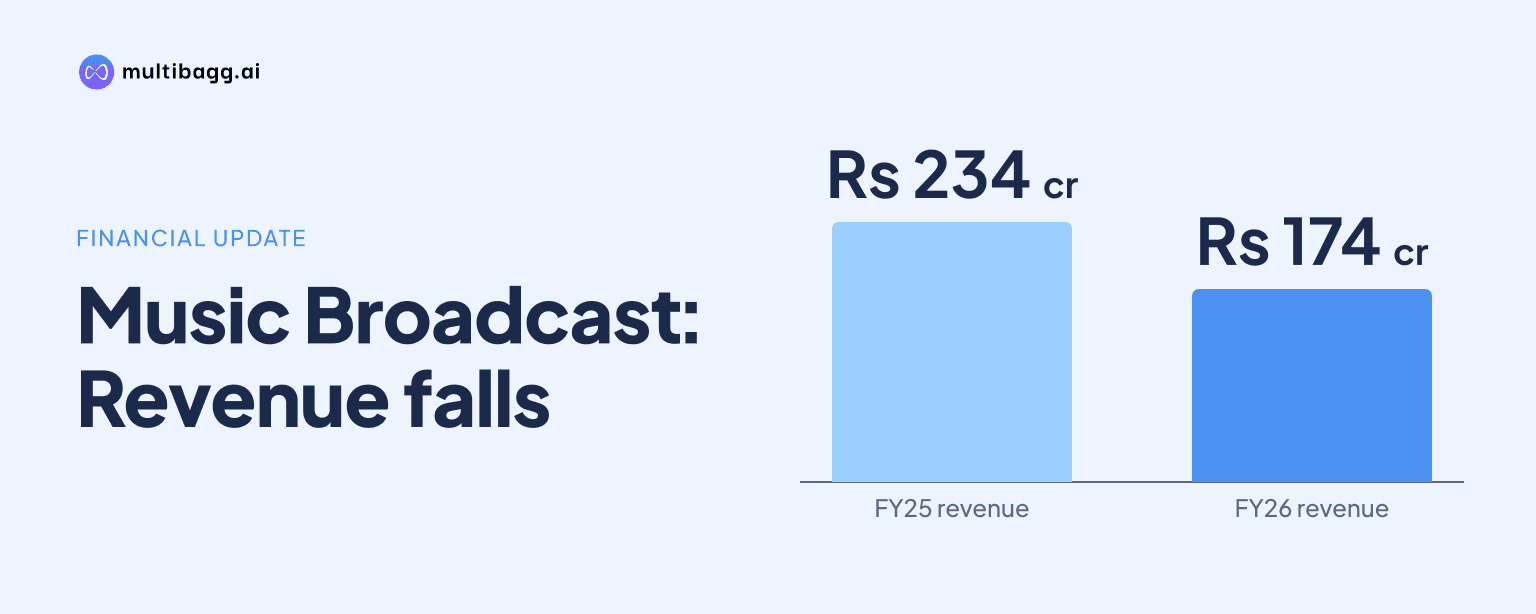
Music Broadcast Limited reported FY26 revenue of INR174 crore against INR234 crore in FY25 as advertising spending remained subdued in some categories, while operating EBITDA margin improved to 18% from 17%. The company attributed the margin improvement to cost optimisation and operational efficiency despite weaker revenue.
Know Music Broadcast inside out
Results, valuation, peers and who's buying, in one view.
What did Music Broadcast report for FY26 revenue and profitability?
Music Broadcast reported revenue of INR174 crore for FY26, compared with INR234 crore in FY25. Total income for the year stood at INR201.2 crore, while operating EBITDA was INR31.3 crore. Its operating EBITDA margin improved to 18%, from 17% in FY25.
The annual outcome followed a weak fourth quarter for revenue. Q4 FY26 revenue was INR40.8 crore, compared with INR54 crore in Q4 FY25, while total income was INR45.4 crore. Management said subdued advertising expenditure across certain categories affected quarterly revenue.
Even with the revenue decline, Q4 operating EBITDA turned positive at INR6.1 crore, against negative EBITDA of INR3.5 crore in Q4 FY25. The Q4 EBITDA margin was 15%, which the company linked to continued cost optimisation and more efficient operations.
The figures show that the improvement in operating profitability did not depend on revenue growth during FY26. Instead, lower costs and operational measures helped Music Broadcast protect margins while the advertising environment remained soft.
Why did Music Broadcast revenue remain under pressure?
Music Broadcast said advertising spending was subdued across certain categories, affecting its revenue during the year and in the fourth quarter. In its Q3 FY26 call commentary, management said quarterly volume had declined by around 4%, while year-to-date volume was lower by about 1%.
Advertising rates were stable, but remained at roughly 75% of pre-COVID levels. This indicates that pricing had not returned to earlier levels even as the company sought to stabilise its business. Management linked the pace of revenue recovery to wider industry conditions and advertiser sentiment.
The company nevertheless identified Tier 2 and Tier 3 markets as possible sources of growth, citing increased client spending in those markets. This was presented as a business opportunity rather than a reported financial outcome.
Music Broadcast also said its volumes were broadly flattish by the end of FY26 and that its market share had risen quarter on quarter to about 17.5%. The company described this as an indication of market-share gains despite the broader slowdown in advertising expenditure.
How is Music Broadcast improving its margins?
Music Broadcast said its cost-rationalisation and operational-efficiency measures had been completed, creating a base for sustainable profitability. Management expects annual savings of around INR30 crore from expenses and NCRPS interest to directly support profitability.
The margin movement in FY26 supports that emphasis. Operating EBITDA margin rose by one percentage point to 18% even though annual revenue declined by INR60 crore from the preceding year. In the fourth quarter, the company reported positive operating EBITDA after recording a negative operating EBITDA in the comparable FY25 quarter.
Management characterised FY26 as a transition year focused on operational strengthening and disciplined cost management. Its commentary indicated that stable to improving profitability would depend on maintaining these measures alongside a recovery in revenue.
The improvement in margins is therefore significant for investors because it shows the effect of the company’s internal cost actions. But management also made clear that top-line growth remains linked to advertising demand and the recovery of the wider radio and media market.
Got a follow-up? Ask IRIS
Which revenue streams is Music Broadcast prioritising?
Music Broadcast is placing greater emphasis on digital solutions, branded content, sponsorships and integrated marketing to diversify its income base. These businesses are intended to supplement conventional radio advertising and support future revenue growth.
Digital revenue currently contributes about 8% of total revenue, according to management’s FY26 commentary. Non-FCT revenue, which includes events and activations, contributes around 22% and has been increasing. FCT refers to free commercial time, the standard advertising inventory sold by radio broadcasters.
The mix is relevant because it reduces the company’s dependence on a single format of advertising revenue. However, the transcript does not provide separate FY26 revenue values for digital solutions, branded content, sponsorships or events.
Management’s stated focus on integrated marketing also aligns with its effort to capture advertiser spending across more than radio spots. The company did not provide a quantified target for the contribution of these alternate revenue streams.
What does the FY26 performance mean for Music Broadcast investors?
Music Broadcast’s FY26 results show two contrasting trends: revenue declined as advertising demand remained weak, while profitability improved through cost controls. The company ended the year with an 18% operating EBITDA margin and a market share of about 17.5%.
For investors, the key operating issue remains whether advertising demand improves enough to restore revenue growth. Management said it was cautiously optimistic about a stable advertising environment and expects Tier 2 and Tier 3 markets to provide growth potential, but it did not give a numerical revenue forecast in the FY26 commentary provided.
The company had earlier targeted close to double-digit revenue growth for FY26 after moderate 3% growth in FY25. Its reported FY26 revenue of INR174 crore, compared with INR234 crore in FY25, shows that the year developed differently amid the reported industry-wide softness in advertising spending.
The financial position described in the call also highlights the importance of cost discipline. Continued savings, stable pricing and expansion of non-FCT and digital activities would be relevant operating markers alongside changes in advertiser sentiment.
Conclusion
Music Broadcast closed FY26 with lower revenue but stronger operating profitability. Revenue fell to INR174 crore from INR234 crore, while operating EBITDA margin improved to 18% from 17%, reflecting the effect of cost rationalisation and operating efficiencies during a period of subdued advertising expenditure.
The next factors to watch are the stability of the advertising environment, spending trends in Tier 2 and Tier 3 markets, and the contribution from digital and non-FCT revenue streams. Management has indicated that annual savings of about INR30 crore and its completed efficiency measures are expected to support profitability going forward.