










Nanta Targets 1,000 FY27 Robots After Deploying 200 in H1
Key highlights
- Nanta deployed about 200 robots in H1 FY27 and is targeting more than 800 deployments in H2.
- Nanta reported an order book of around Rs 60 crore at the end of H1 FY27.
- H1 FY27 revenue rose 97.7% year on year to Rs 42.6 crore, while EBITDA margin reached 23.3%.
- Management said fleet negotiations now cover 50 to 200 robots, compared with one to five units previously.
powered by IRIS
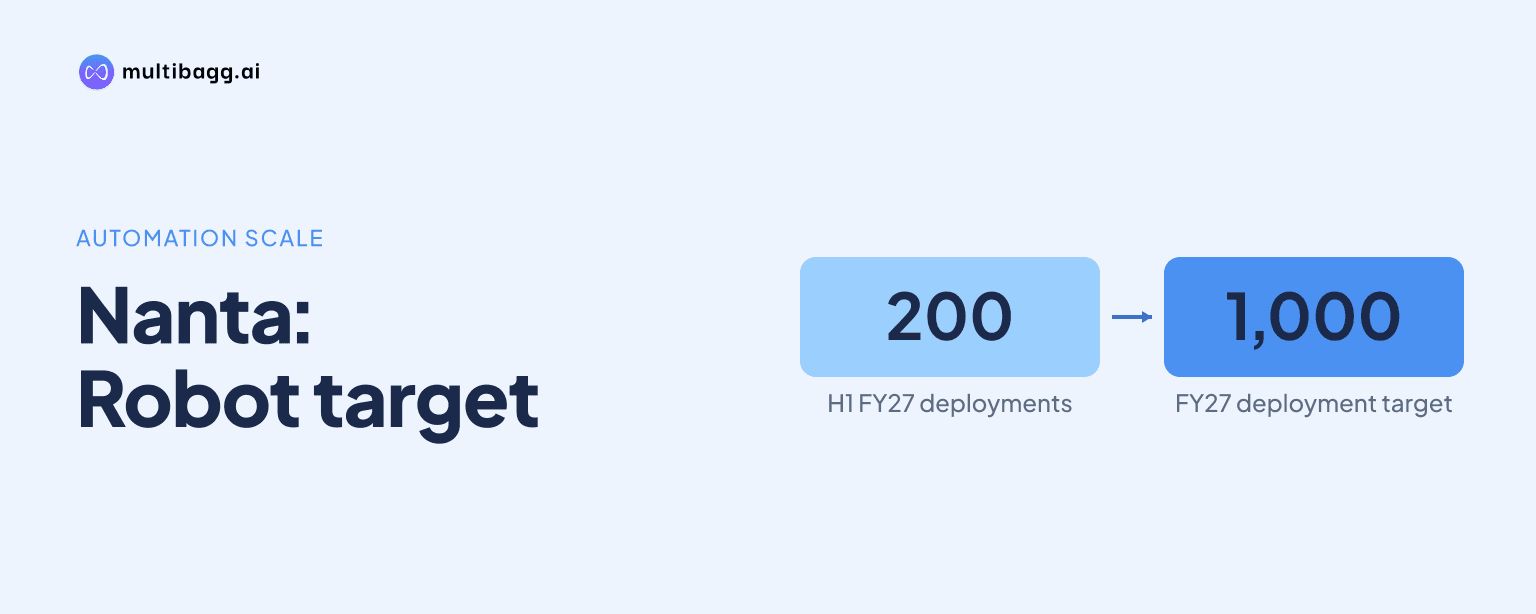
Nanta is targeting at least 1,000 robot deployments in FY27 after deploying about 200 in the first half, with management citing a Rs 60 crore order book and negotiations for customer fleets of 50, 100 and 200 robots. Management said cleaning robots for factories and corporate offices account for most current demand.
Know Nanta Tech inside out
Results, valuation, peers and who's buying, in one view.
Can Nanta deploy 1,000 robots in FY27?
Nanta is targeting a minimum of 1,000 robot deployments in FY27, including more than 800 in H2 after about 200 deployments in H1. Management said autonomous cleaning robots have generated most of the current traction, particularly for factory floors and corporate offices. An analyst said Nanta had previously discussed a 700-robot target, before management stated the 1,000-unit objective on this call.
Management said the target reflects a transition from proof-of-concept, or POC, activity to implementation by large customers. It said POCs at many clients served over the previous 1.5 to two years have been completed. Discussions that previously involved one or five robots are now covering potential fleets of 50, 100 or 200 robots at multiple customer sites.
These fleet discussions are negotiations rather than a disclosed list of binding orders. Nanta said its current order-to-deployment cycle is about 60 to 90 days, including hardware and software customisation, and it aims to shorten that period for some clients. Its arrangement with Aimtron is intended to support an asset-light manufacturing model for larger fleet delivery, though management did not disclose Aimtron's capacity.
What supports Nanta's FY27 deployment target?
Nanta said it had an order book of about Rs 60 crore at the end of H1 FY27, which management cited alongside expected H2 orders as support for the 1,000-robot target. The company did not provide a split of the order book among robotics, artificial intelligence, or AI, software, and audio-visual, or AV, projects. It also did not disclose how many robots are covered by the backlog.
The financial performance in the half year ended September 30, 2026 provides the wider operating context. Revenue from operations rose 97.7% year on year to Rs 42.6 crore in H1 FY27 from Rs 21.5 crore in H1 FY26. Earnings before interest, tax, depreciation and amortisation, or EBITDA, increased 221.2% to Rs 9.9 crore from Rs 3.1 crore over the same periods.
EBITDA margin expanded by 900 basis points to 23.3% in H1 FY27 from 14.3% in H1 FY26, while profit-after-tax margin rose by 170 basis points to 11.9% from 10.2%. Management attributed the change to a greater contribution from robotics and AI, which it said deliver higher margins than AV. For FY27, management expects 45% to 50% growth and EBITDA margin of 20% to 22%, rather than reporting those outcomes.
Got a follow-up? Ask IRIS
How is Nanta balancing outright sales and RaaS?
Nanta said its robotics business was split about 50% between outright sales and service-model arrangements at the time of the call, but management expects more outright sales in H2. Customers are also discussing robotics-as-a-service, or RaaS, under which Nanta deploys robots instead of the customer funding the full capital expenditure at the outset. Nanta said it has already implemented RaaS for one large client.
Management expects RaaS to account for about 25% to 30% of FY27 business unless it develops a concrete approach to the higher capital requirement. It said direct customer capital-expenditure deployments generate EBITDA of about 30% to 35% on average. Its limited RaaS transactions have had investment realisation periods of about 15 to 16 months within contracts generally lasting 24 to 48 months.
Nanta also identified annual maintenance contracts, or AMC, as a recurring-revenue mechanism. Management said it has sold about 400 robots and expects all of them to enter the AMC base before the end of FY27. First-year pricing includes hardware and software maintenance, while large customers typically take additional AMC coverage for three or five years.
From the second year, management said Nanta normally charges about 12%, 15%, 18% or 20% for hardware and software AMC, depending on customer size and terms. The company also said it has more than 10 active software-as-a-service, or SaaS, clients. That software can be provided for customers' own cameras or infrastructure even where it is not used with a robot.
What technology and production does Nanta control?
Nanta said it has developed about 17 robot models in-house and controls their physical design as well as Robot Operating System 2, or ROS 2, software models. Management also named MeetIQ, VisitIQ and NTra as internally owned software used for vision analysis, two-way communication, visitor management, client management and canteen management.
The company said it charges separately for robot hardware and software in first-year agreements, and charges extra when customer-specific customisation is required. Nanta said its source code is held on in-house servers and that it provides software on a SaaS model. Management described integration with customer systems, including SAP and customer relationship management systems, as a key part of a robotics deployment.
Nanta does not currently have in-house robot manufacturing capability. Management said Aimtron will manufacture robots for existing orders, while Nanta plans to prepare an internal assembly line before the end of FY27. If that line is ready early enough, some FY27 units could be assembled internally; otherwise, the planned units will come from outside manufacturers.
Management said motors and actuators are among three or four component categories for which the industry remains dependent on suppliers outside India, including China and Taiwan. It said Indian suppliers can provide those parts where defence or government projects require domestic sourcing, though the company did not quantify the related cost difference or expected local content.
Conclusion
Nanta's H1 FY27 commentary points to a shift from small robot trials toward proposed fleet installations of 50 to 200 units, alongside a minimum 1,000-robot deployment target and a Rs 60 crore order book. Revenue rose to Rs 42.6 crore and EBITDA margin reached 23.3% in H1 FY27, with management linking both the operating mix and margin direction to greater robotics and AI activity.
The next disclosed milestones are delivery of more than 800 robots in H2 FY27, continued conversion of fleet negotiations into orders, and the planned establishment of an assembly line before FY27 ends. Management's stated FY27 RaaS expectation of 25% to 30%, the conversion of about 400 sold robots into AMC coverage, and the 60-to-90-day implementation cycle will also indicate how the service and deployment model develops.