










Nanta Tech expects AMC from 400 robots, caps RaaS at 30%
Key highlights
- Nanta Tech expects around 400 sold robots to enter its AMC base before this year ends.
- Nanta Tech plans for RaaS to represent 25% to 30% of this year’s business because deployment requires capital.
- Nanta Tech targets at least 1,000 robot deployments in FY27 after around 200 in H1.
- Nanta Tech reported an order book of around Rs 60 crore at the end of H1.
powered by IRIS
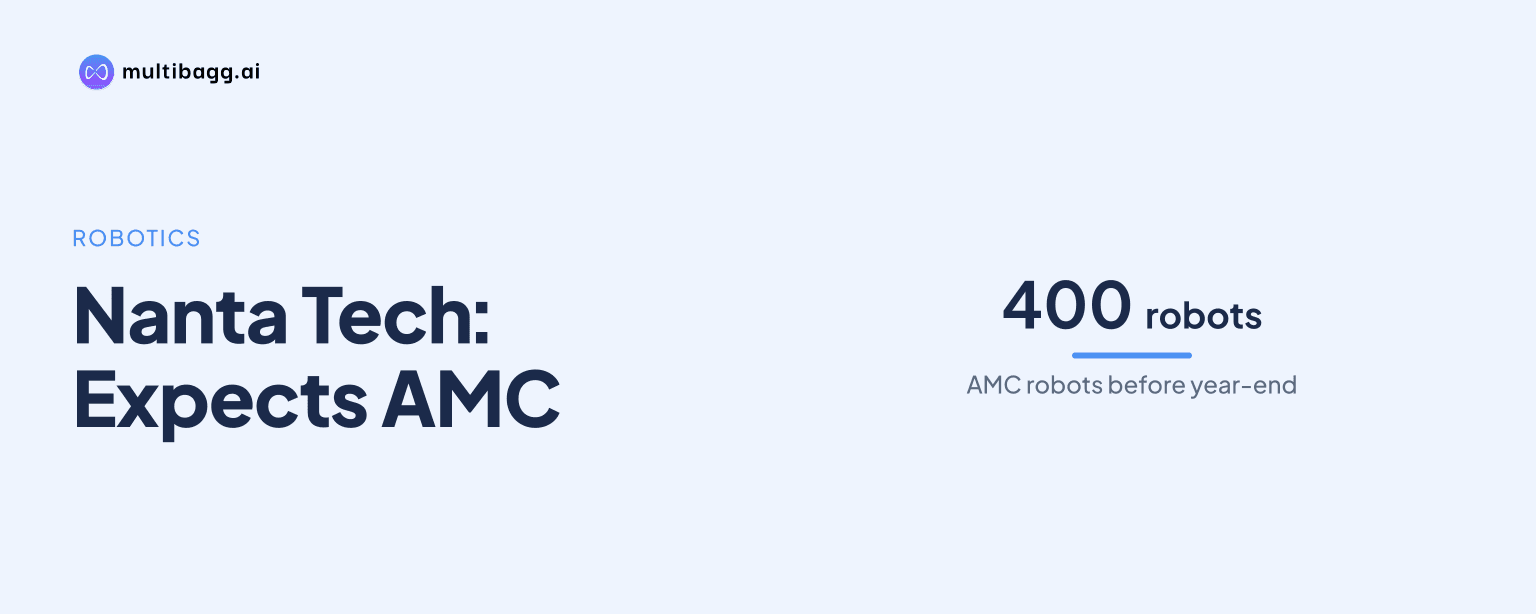
Nanta Tech Limited expects about 400 sold robots to enter annual maintenance contract revenue next year, but management plans to limit robot-as-a-service, or RaaS, to 25% to 30% of this year’s business because deploying company-owned robots requires high capital expenditure. The company has recovered investment in its limited RaaS deals in about 15 to 16 months.
Know Nanta Tech inside out
Results, valuation, peers and who's buying, in one view.
How will Nanta Tech generate recurring revenue from robots?
Nanta Tech expects around 400 robots already sold to move into annual maintenance contract, or AMC, coverage before the end of this year, creating recurring hardware and software revenue next year. Management said the first-year agreement generally charges customers separately for robot hardware and software and usually runs for about one year.
From the second year, Nanta Tech can charge AMC for both hardware and software where customers renew. Management said large clients typically take additional service coverage for three or five years, and said AMC charges can be around 12%, 15%, 18% or 20%, varying by client size. It illustrated the software mechanism with Rs 100 of software being charged at Rs 112 in the second year.
Nanta Tech also has more than 10 active software-as-a-service, or SaaS, clients. Management said these one-year software arrangements can use its tools in a customer’s own cameras or other infrastructure rather than solely on a robot, extending the potential recurring base beyond deployed hardware.
The company identified its ROS 2 robotics operating system, MeetIQ, VisitIQ and NTra as internally developed products. These software products support functions including vision analysis, two-way communication, visitor management, client management and canteen management; management said the core source code remains on Nanta Tech’s in-house servers and is provided to customers on a SaaS basis.
Why is Nanta Tech restricting RaaS to 30%?
Nanta Tech plans for RaaS to account for only 25% to 30% of this year’s business because the model requires substantial capital expenditure to place robots at client sites. Management said it is working internally on how to handle that funding requirement and will not pursue RaaS aggressively until it has a concrete solution.
The company said its present split is roughly 50% outright sales and 50% service-model business, but expects more outright sales than RaaS deployments in the second half, or H2. The service category is therefore broader than RaaS, encompassing other arrangements such as maintenance and software services, while the stated 25% to 30% limit specifically applies to RaaS this year.
Management said Nanta Tech has completed only a couple of RaaS deals and has not yet undertaken large transactions under that model. In those deals, investment recovery took about 15 to 16 months, while RaaS contracts typically run for at least 24 to 48 months. Nanta Tech did not disclose RaaS revenue, contract values or a RaaS earnings before interest, tax, depreciation and amortisation, or EBITDA, margin.
For direct deployment under the capital expenditure, or capex, model, management put average EBITDA at about 30% to 35%. It did not give a comparable margin for RaaS, saying instead that the model could grow at a much larger level if the deployment-capital issue is resolved.
Can Nanta Tech meet its 1,000-robot target this year?
Nanta Tech is targeting at least 1,000 robot deployments at client sites this year after deploying around 200 in H1 and planning more than 800 in H2. Management said autonomous cleaning robots for factory floors and corporate offices are currently producing most of the demand.
The company reported an order book of around Rs 60 crore at the end of H1 and said it expects further orders in H2. Management cited that pipeline in expressing confidence about the 1,000-robot objective. An analyst noted that management had earlier discussed 700 robots, making the current deployment target 300 robots higher.
Management expects 45% to 50% growth this year and said, even on a conservative basis, similar growth could continue in the following year. It expects EBITDA to improve as robotics and artificial intelligence form a larger share of the product mix than the audiovisual, or AV, business, although Nanta Tech did not provide separate H1 revenue for robotics and AI.
Warehouse projects are another stated source of demand. Management said material-movement and pick-and-place robots can offer immediate return on investment for customers, but integrating a new installation into an existing ecosystem takes time. It expects to secure a good number of warehouse automation clients by year-end, with these solution projects also carrying AMC contracts.
Got a follow-up? Ask IRIS
What production and technology model supports Nanta Tech?
Nanta Tech says it has developed around 17 robot models in-house, including physical designs and associated software, but it does not currently manufacture robots in-house. It has signed Aimtron to manufacture existing orders, and management said all 1,000 robots could be externally made unless its own assembly line starts in time.
Management aims to have an in-house assembly line ready before the end of this year, but said the capex has not been finalised. The line is planned to assemble both new H2 models and best-selling models. Nanta Tech did not disclose the proposed capacity, investment amount or a fixed commissioning date.
The company said three or four components, including motors and actuators, remain dependent on suppliers outside India, notably China and Taiwan. Management said other parts are available in India on a cost-effective basis, while Indian vendors could also supply the remaining components for defence or government work requiring complete domestic sourcing, albeit at higher cost due to minimum-order quantities and technical complexity.
Management said the deployment challenge includes integration with a client’s existing enterprise resource planning, or ERP, and customer relationship management, or CRM, systems. It described end-to-end hotel installations as potentially combining cleaning, delivery and reception work, requiring mechanical, design, artificial intelligence and software capabilities.
What milestones could change Nanta Tech’s recurring-revenue mix?
Nanta Tech’s immediate milestones are deploying more than 800 robots in H2, deciding the assembly-line capex and converting current implementation work into contracts lasting roughly 14, 16 or 24 months. Management said a Malaysia initiative has reached a live virtual proof of concept after a robot shipment, while work is also under way in Dubai, with Aimtron and with Connplex across multiple Indian sites.
Management did not say that every memorandum of understanding, or MOU, and letter of intent, or LOI, was a firm order. The Rs 60 crore H1-end order book is the company’s disclosed order measure, while the wider MOU and LOI activity remains at implementation, deployment or proof-of-concept stages.
Nanta Tech is also executing a Phase 1 defence pilot involving artificial intelligence infrastructure at a defence customer’s premises. Management said the present order is not large enough to require compulsory exchange disclosure, expects to complete the Phase 1 model and handover formalities by the end of December, and anticipates a potential larger order in the last quarter of H2.
Management has not set an FY28 robot-deployment target. It said its focus is to complete the FY27 deployment objective first, then assess how much it can expand next year. That sequencing leaves the proportion of future RaaS growth dependent on the company’s unresolved approach to deployment funding.
Conclusion
Nanta Tech’s stated recurring-revenue plan combines AMC from around 400 sold robots with SaaS revenue from more than 10 active clients. However, the company is preserving a sales-led approach this year: direct capex deployments have a disclosed average EBITDA range of 30% to 35%, while RaaS remains capped at 25% to 30% because it places the funding burden for robots on Nanta Tech.
The next measures to watch are whether Nanta Tech deploys more than 800 robots in H2 to reach its 1,000-robot target, finalises assembly-line capex before year-end and retains the announced RaaS mix limit. Management also expects to complete the Phase 1 defence handover by the end of December, while it has not yet announced an FY28 deployment target or a solution for larger RaaS funding needs.