










Nanta Tech sets Dubai base, Southeast Asia robotics pact
Key highlights
- Nanta Tech established a wholly owned Dubai subsidiary for the UAE, Saudi Arabia, Qatar and Kuwait.
- Nanta Tech's GM Biovalley memorandum covers robotics and automation promotion in Malaysia, Brunei and Singapore.
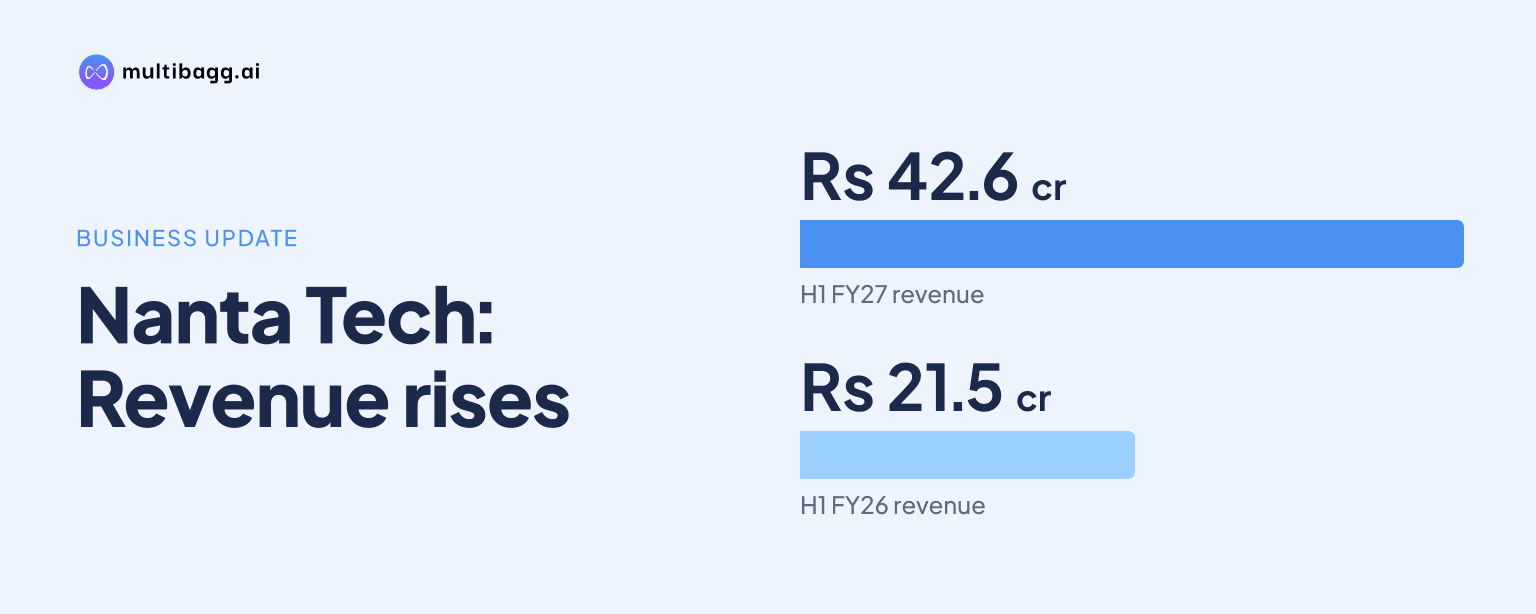
- Nanta Tech reported H1 FY27 revenue of Rs 42.6 crore, up 97.7% from Rs 21.5 crore in H1 FY26.
- Nanta Tech's Connplex letter of intent covers 100 robots and an indicative Rs 14.4 crore over 36 months.
powered by IRIS
In H1 FY27, Nanta Tech Limited established a wholly owned Dubai subsidiary for the UAE, Saudi Arabia, Qatar and Kuwait, and signed a GM Biovalley memorandum of understanding covering Malaysia, Brunei and Singapore. The moves create separate company-led and partner-led routes to develop robotics and automation opportunities outside India.
Know Nanta Tech inside out
Results, valuation, peers and who's buying, in one view.
Why did Nanta Tech establish a Dubai subsidiary?
Nanta Tech established Nanta Technology FZ-LLC as a fully owned subsidiary in Dubai to serve as a gateway to four Gulf Cooperation Council, or GCC, markets: the UAE, Saudi Arabia, Qatar and Kuwait. Management said the entity is intended to deepen engagement with regional customers, channel partners and system integrators for robotics and automation solutions.
Nanta Tech said the Dubai operation will target commercial, hospitality, retail and institutional customers. Its robotics and artificial intelligence, or AI, offering operates under the Allbotix brand and includes service robots for hospitality, healthcare, logistics, warehousing, customer engagement, cleaning and delivery. The transcript did not disclose a revenue target, customer order or investment amount for the Dubai subsidiary.
The overseas plan comes as Nanta Tech expands its AI software capabilities. Management said the acquisition of RSVP strengthened products including MeetIQ, NTalk, Ntra, VisitIQ, conversational AI, intelligent automation and predictive analysis. The stated aim is to use the UAE presence to develop opportunities for combined robotics, automation and physical-AI solutions across the four GCC countries.
How will Nanta Tech develop Southeast Asian markets?
Nanta Tech will use its memorandum of understanding with GM Biovalley to promote and deploy robotics and automation solutions in Malaysia, Brunei and Singapore. Management said GM Biovalley’s regional network and market understanding will help identify customer requirements, develop business opportunities and facilitate adoption of Allbotix robotics.
The Southeast Asian arrangement differs from the Dubai expansion because it is a partner collaboration rather than a wholly owned local subsidiary. Nanta Tech did not disclose a contract value, robot quantity, exclusivity period, order commitment or revenue forecast for the GM Biovalley memorandum. It described the agreement as a platform for market development in the three countries.
For the remainder of FY27, management said it intends to leverage the UAE subsidiary across the GCC and pursue Southeast Asian opportunities through GM Biovalley. This plan sits alongside a wider dealer and distribution network for Allbotix and an asset-light manufacturing approach, rather than a disclosed timetable for country-level launches or overseas revenue recognition.
What operating model supports Nanta Tech's overseas plan?
Nanta Tech is pairing its overseas market-development effort with an exclusive memorandum of understanding with Aimtron Technology Private Limited for joint robot design, development and contract manufacturing. The parties anticipate manufacturing orders with an indicative aggregate value of Rs 10 crore over 15 months, while Nanta Tech retains ownership of the designs, firmware and software intellectual property.
Management said the Aimtron arrangement is intended to support an asset-light manufacturing model and larger robot-fleet deployments. During the call, it said the current implementation cycle is about 60 to 90 days from order to deployment, including the hardware and software customisation required for a customer project. That timeline was discussed in relation to customer deployments, not specifically to GCC or Southeast Asian orders.
Nanta Tech is also seeking a combination of project and recurring revenue. In H1 FY27, it signed a letter of intent with Connplex Cinemas for 100 AT10 marketing and delivery robots under a robot-as-a-service, or RaaS, model, with an indicative value of Rs 14.4 crore over 36 months. Under the proposed model, Nanta Tech said it would retain ownership of hardware, software, AI models and intellectual property.
A separate AI automation assignment shows the solutions Nanta Tech is offering to enterprise customers. The company secured a Rs 6.6 crore project for Pointer Insurance, scheduled for execution over six months, covering power automation, a customer-service chatbot, predictive analysis and intelligent workflows. Management said the project marked Nanta Tech’s entry into the banking, financial services and insurance segment.
Got a follow-up? Ask IRIS
What financial progress accompanied Nanta Tech's expansion?
Nanta Tech reported revenue from operations of Rs 42.6 crore in H1 FY27 ended September 30, 2026, up 97.7% from Rs 21.5 crore in H1 FY26. Earnings before interest, tax, depreciation and amortisation, or EBITDA, increased faster than revenue, rising 221.2% to Rs 9.9 crore from Rs 3.1 crore as management said the robotics and AI mix increased relative to audio-visual integration.
Nanta Tech’s EBITDA margin rose by 900 basis points to 23.3% in H1 FY27 from 14.3% a year earlier. Profit after tax, or PAT, rose 131.4% to Rs 5.1 crore from Rs 2.2 crore, while the PAT margin increased to 11.9% from 10.2%. The transcript does not provide separate revenue, profit, order-book or margin figures for Dubai, the GCC, Malaysia, Brunei or Singapore.
Management also established an experience centre in Ahmedabad and inaugurated a second centre in Andheri East, Mumbai, during H1 FY27. It said the two centres bring together audio-visual, robotics and AI solutions for live demonstrations, dealer training, solution validation and proof-of-concept presentations, supporting enterprise and government customers’ evaluation of products.
What is Nanta Tech targeting for the rest of FY27?
Nanta Tech management said it expects FY27 growth of 45% to 50%, after reporting Rs 42.6 crore of revenue in the first half. It also said it expects EBITDA margin of 20% to 22% for the full year, while noting its confidence was based on H1 execution, the order book and expected business from international markets.
Management said customers that had completed proof-of-concept work over the past 1.5 to two years are now discussing larger deployments of 50, 100 or 200 robots. It added that some customers are considering RaaS arrangements rather than capital-expenditure purchases in the first phase. These comments concern pipeline and negotiations, not announced international orders.
Nanta Tech said TRN, The Robotics Nexus, will continue to support product innovation, prototyping, technology development and industry collaboration. Together with the Aimtron manufacturing agreement, the UAE subsidiary, the GM Biovalley collaboration and the two experience centres, these mechanisms form management’s stated plan to extend Allbotix distribution and convert customer demonstrations into projects.
Conclusion
Nanta Tech’s international initiative uses two distinct channels: a wholly owned Dubai subsidiary for four GCC markets and a GM Biovalley collaboration for Malaysia, Brunei and Singapore. The expansion is supported by H1 FY27 revenue of Rs 42.6 crore, an indicative Rs 10 crore manufacturing opportunity over 15 months and a proposed Rs 14.4 crore RaaS arrangement over 36 months, but no overseas sales or country-level order values were disclosed.
The next disclosures to watch are progress in using the UAE entity to build GCC customer and partner relationships, opportunity conversion through GM Biovalley, and the expansion of the Allbotix dealer network. Management’s 45% to 50% FY27 growth expectation and 20% to 22% EBITDA-margin expectation will depend on order conversion, fleet deployment and the stated 60- to 90-day implementation cycle.