










Nath Bio-Genes (I) Ltd. vegetable prices rose 159% by FY26
Key highlights
- NATH SEEDS reported vegetable average selling price of Rs 1,244 per kg in FY26, up from Rs 480 per kg in FY18.
- NATH SEEDS reported field-crop average selling price of Rs 293 per kg in FY26, up from Rs 128 per kg in FY18.
- NATH SEEDS revenue rose from Rs 191.7 crore in FY19 to Rs 431.6 crore in FY26, with a stated 12.5% CAGR.
- NATH SEEDS reports approximately 20,000 distributors and dealers and 25,000 metric tonnes of storage, warehouse and conditioning capacity.
powered by IRIS
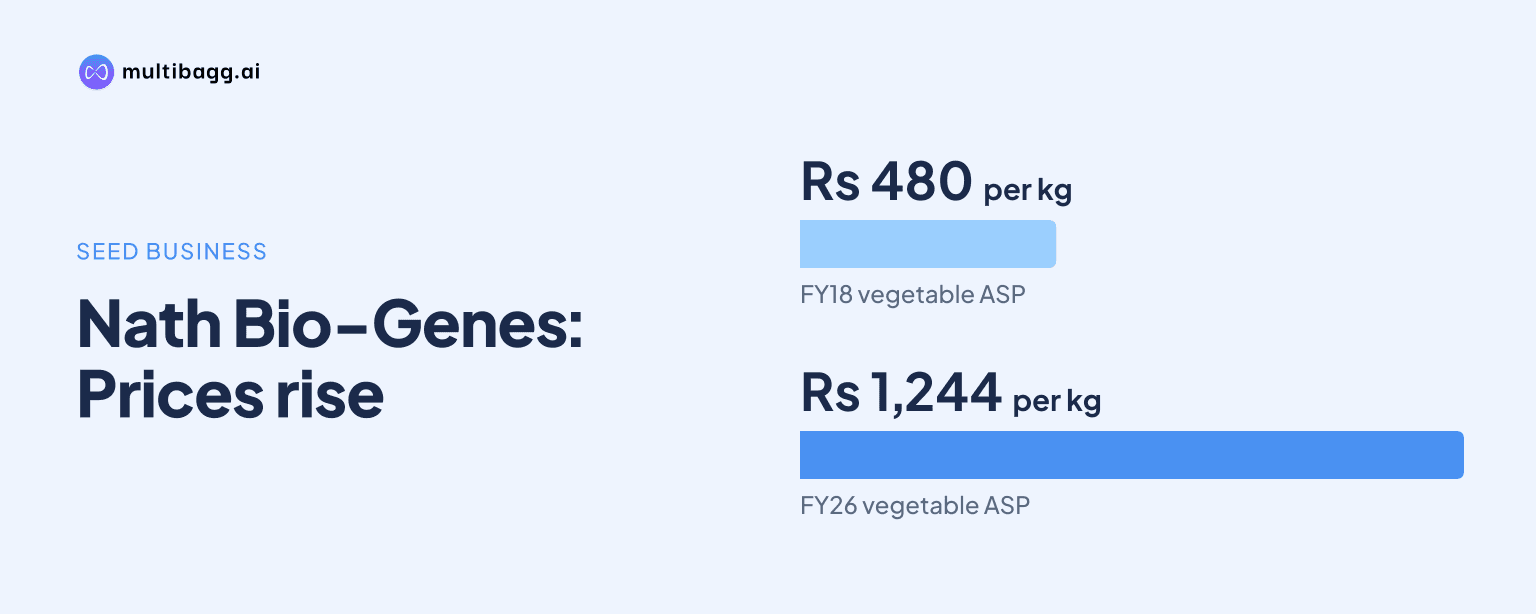
In financial year 2026 (FY26), Nath Bio-Genes (I) Ltd. reported vegetable average selling price about 159% higher at Indian rupees (Rs) 1,244 per kilogram (kg) than in FY18, while revenue more than doubled to Rs 431.6 crore from Rs 191.7 crore in FY19.
Know Nath Bio-Genes (India) inside out
Results, valuation, peers and who's buying, in one view.
How much did NATH SEEDS raise average selling prices?
NATH SEEDS raised reported average selling prices in both disclosed categories between FY18 and FY26. Field-crop average selling price increased from Rs 128 per kg to Rs 293 per kg, an increase of Rs 165 per kg, or about 129%. Vegetable average selling price increased from Rs 480 per kg to Rs 1,244 per kg, up Rs 764 per kg, or about 159%.
NATH SEEDS reported higher vegetable pricing than field-crop pricing at both endpoints. The gap was Rs 352 per kg in FY18, based on Rs 480 per kg for vegetables and Rs 128 per kg for field crops; it widened to Rs 951 per kg in FY26, based on Rs 1,244 per kg and Rs 293 per kg respectively. The presentation does not disclose sales volumes, product mix or crop-level pricing that would explain the change.
The slide calls the performance business delivery over the “last 9 years,” but its price table compares FY18 with FY26, an eight-year interval between fiscal-year endpoints. NATH SEEDS provides no annual prices between those dates, so the information supports an endpoint comparison rather than a conclusion on the timing or consistency of price changes.
How quickly did NATH SEEDS revenue grow?
NATH SEEDS reported revenue of Rs 431.6 crore in FY26, compared with Rs 191.7 crore in FY19, and stated a compound annual growth rate (CAGR) of 12.5%. The disclosed increase was Rs 239.9 crore, meaning FY26 revenue was about 125% above the FY19 figure.
Revenue more than doubled over the FY19-to-FY26 comparison, while the selling-price comparison begins in FY18. NATH SEEDS does not provide FY18 revenue, FY19 average selling prices or annual unit sales. It therefore does not show how much of the revenue increase came from pricing, volumes, crop mix or newly introduced products.
FY26 is the latest annual revenue figure on the supplied growth page, even though the investor presentation is labelled for the second quarter and first half of FY27. NATH SEEDS does not provide FY27 revenue on these pages and does not split FY26 revenue between field crops and vegetables. That prevents a calculation of each category’s contribution to the Rs 431.6 crore total.
Got a follow-up? Ask IRIS
Do the supplied pages show NATH SEEDS margin performance?
No, the supplied pages do not establish an earnings margin trend for NATH SEEDS. They provide no earnings before interest, tax, depreciation and amortisation (EBITDA) margin, profit after tax (PAT) margin, EBITDA amount or PAT amount for FY18, FY19 or FY26.
NATH SEEDS lists margin expansion through efficient operations as a business focus. However, the presentation gives no numerical starting margin, margin target or timetable for that objective. The disclosed price and revenue figures alone cannot demonstrate whether profitability margins increased or declined.
The pages also omit costs of seed production, processing, distribution, research and sales. In FY26, field-crop average selling price was Rs 293 per kg and vegetable average selling price was Rs 1,244 per kg, but no gross margin or segment profit is provided for either category. The topic’s assertion of declining margins is therefore not supported by the supplied presentation.
What operating capabilities does NATH SEEDS cite?
NATH SEEDS reports approximately 20,000 distributors and dealers, 17 branch offices, and 10 processing plants and warehouses spread across 23 Indian states. It presents this network alongside a crop focus on cotton, wheat, maize and fodder bajra, but provides no revenue or profit contribution for an individual crop or facility.
NATH SEEDS also cites research and development innovation centres, disease and pest resistance breeding, multistage trials and cold-storage, warehouse and conditioning capacity of 25,000 metric tonnes. These mechanisms are presented as supporting product development and supply-chain operations, rather than as quantified causes of the FY26 revenue result.
The presentation identifies Sanket as an example of a new and innovative product intended to expand market reach. It does not state Sanket’s launch date, category, selling price, unit sales or revenue. As a result, the distribution network and 25,000-metric-tonne capacity provide operating context but do not establish why revenue rose from Rs 191.7 crore in FY19 to Rs 431.6 crore in FY26.
Conclusion
NATH SEEDS’ disclosed endpoints show substantial increases in realised selling prices and revenue. Field-crop average selling price rose from Rs 128 per kg in FY18 to Rs 293 per kg in FY26, vegetable pricing rose from Rs 480 per kg to Rs 1,244 per kg, and revenue reached Rs 431.6 crore in FY26 from Rs 191.7 crore in FY19. The figures support higher prices and a stated 12.5% revenue CAGR, but not a conclusion on profitability margins.
The next item to watch is management’s stated plan for margin expansion through efficient operations, alongside product development focused on disease and pest resistance and market expansion through products such as Sanket. The supplied pages disclose no margin target or timetable, while FY27 revenue, earnings and category-level sales remain unresolved in the presentation material provided.