










Nath Seeds: paddy reaches 37% as cotton share falls in H1
Key highlights
- Paddy contributed 37% of Nath Seeds’ H1FY27 sales, up from 27% in H1FY26.
- Cotton’s H1FY27 sales share fell to 26% from 36%, while packet volume declined 2.29% to 10.6 lakh.
- Nath Seeds’ H1FY27 revenue increased 13% to Rs 360.1 crore.
- H1FY27 EBITDA declined 11% to Rs 41 crore and EBITDA margin was 11%, versus 14% a year earlier.
powered by IRIS
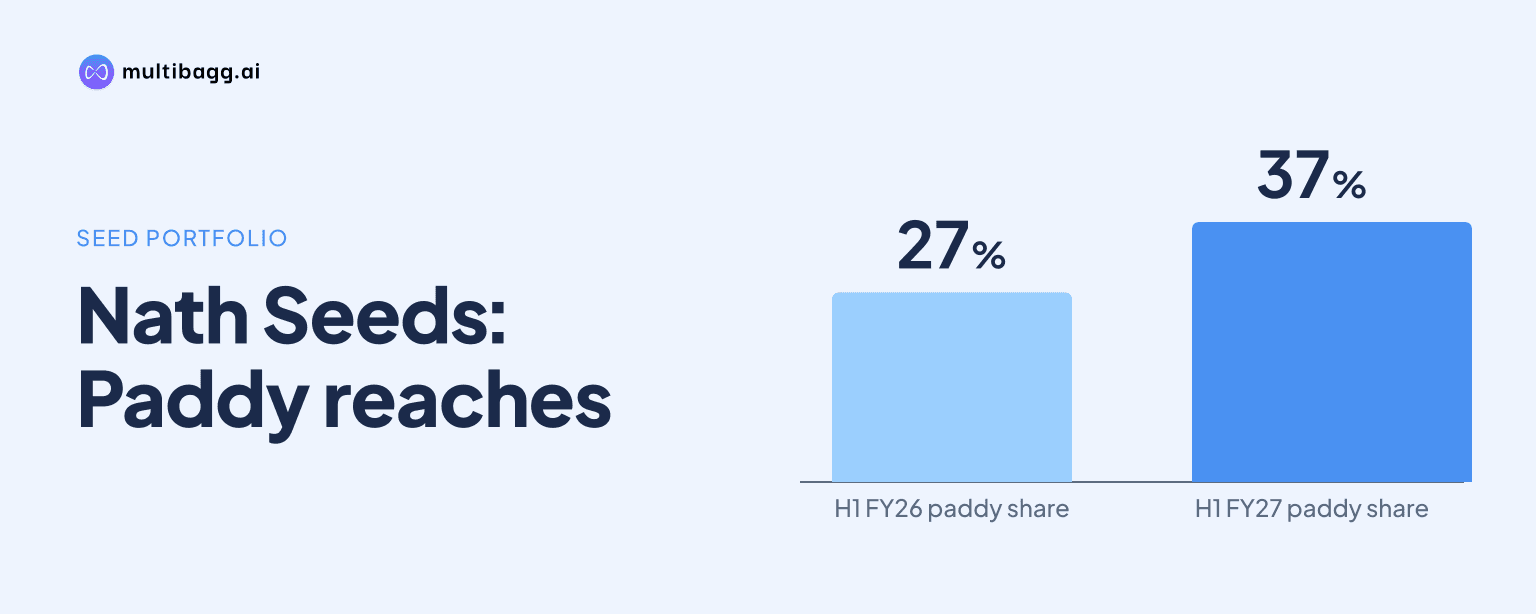
Nath Seeds’ H1FY27 presentation shows paddy at 37% of sales, overtaking cotton at 26% after their positions were reversed in H1FY26. Total revenue rose 13% year on year to Rs 360.1 crore, but earnings before interest, tax, depreciation and amortisation fell 11% to Rs 41 crore.
Know Nath Bio-Genes (India) inside out
Results, valuation, peers and who's buying, in one view.
How did Nath Seeds’ sales mix change in H1FY27?
Nath Seeds’ sales mix changed by 10 percentage points for each of its two largest crop segments in H1FY27. Paddy increased to 37% of revenue from 27% in H1FY26, while cotton declined to 26% from 36%. The presentation therefore shows paddy moving ahead of cotton within one year.
The remaining segment, labelled Others, represented 37% of sales in both H1FY27 and H1FY26. This means the reported movement between paddy and cotton occurred while the aggregate share assigned to Others did not change. H1FY27 revenue was Rs 360.1 crore, compared with Rs 319.9 crore in H1FY26.
Why did paddy become Nath Seeds’ largest crop contributor?
Paddy became Nath Seeds’ largest crop contributor because it accounted for 37% of H1FY27 sales, ahead of cotton at 26% and bajra at 13%. Management said paddy maintained stable performance because of a good monsoon in the Northern region. Paddy, cotton and bajra together contributed 76% of reported sales.
The 37% paddy share was 11 percentage points above bajra’s contribution and 31 percentage points above maize’s 6% share. The presentation does not disclose paddy packet volumes, paddy revenue in rupees, selling prices or prior-period crop-level revenue. It therefore identifies paddy’s relative contribution, rather than the volume or price factors behind its increase.
Paddy’s lead also came during a period of higher total sales. Revenue increased by Rs 40.2 crore between H1FY26 and H1FY27, equivalent to the company’s stated 13% year-on-year growth. The source links paddy’s stable performance to monsoon conditions in the Northern region but provides no forecast for paddy sales or volumes.
What crops sit outside Nath Seeds’ top three segments?
Nath Seeds’ crop-wise chart shows maize at 6% of H1FY27 sales, mustard and vegetables at 5% each, the category labelled PNS at 3%, jowar at 2%, and wheat and other field crops at 1%. These categories sit alongside the three core crops of paddy, cotton and bajra, which together represented 76% of sales.
The presentation describes the portfolio as spanning cereals, cotton, oilseeds, vegetables and PNS. Its segmental comparison separately groups 37% of revenue as Others in both half years and says that group includes jowar, bajra, maize, mustard and wheat. The crop-wise chart also lists vegetables and PNS separately, so the presentation provides a broader crop breakdown alongside the three-part segment comparison.
The figures in the crop-wise chart total 98% because the individual shares are presented as whole percentages. Bajra’s 13% share made it the third-largest named crop contributor, while maize’s 6% made it the largest of the smaller named crop categories. No crop-level rupee revenue is disclosed for these categories.
Got a follow-up? Ask IRIS
How did Nath Seeds’ financial performance compare with H1FY26?
Nath Seeds’ H1FY27 revenue and gross profit each rose 13%, while EBITDA and profit before tax declined. Gross profit reached Rs 192.2 crore from Rs 170.7 crore, whereas EBITDA fell to Rs 41 crore from Rs 46.1 crore. Profit before tax, after adjustment for the exceptional item, declined 16% to Rs 36.5 crore.
Gross margin was unchanged at 53% in both H1FY27 and H1FY26. EBITDA margin declined to 11% from 14%, while finance cost increased 50% to Rs 9.3 crore from Rs 6.2 crore. Profit after tax excluding extraordinary items fell 18% to Rs 34.9 crore from Rs 42.4 crore.
What happened to Nath Seeds’ cotton business in H1FY27?
Nath Seeds’ cotton business remained the second-largest reported crop contributor at 26% of H1FY27 sales, but cotton packet volume declined 2.29% to 10.6 lakh packets. Management attributed the volume decline to the monsoon. Cotton’s sales share was 10 percentage points below its H1FY26 contribution of 36%.
The presentation separates cotton’s volume disclosure from its sales-mix disclosure. It gives the H1FY27 packet volume of 10.6 lakh and the 2.29% decline, but does not provide cotton revenue in rupees, prior-year packet volume, realisation per packet or regional sales data. Those omissions prevent a breakdown of the contribution-share decline between volume and pricing.
Second-quarter figures show lower revenue within the half year. Q2FY27 revenue was Rs 37.3 crore, down 6% from Rs 39.8 crore in Q2FY26, while Q2FY27 EBITDA was Rs 6 crore, down 17% from Rs 7.2 crore. Q2FY27 EBITDA margin was 16%, compared with 18% a year earlier.
Conclusion
Nath Seeds’ H1FY27 results show a material reordering in its sales composition: paddy rose to 37% of revenue from 27%, while cotton declined to 26% from 36%. Revenue increased 13% to Rs 360.1 crore, but EBITDA declined 11% and profit after tax excluding extraordinary items declined 18%, showing that higher sales did not translate into higher reported earnings in the half year.
The next crop-mix update will show whether paddy retains its lead and whether cotton packet volumes recover after the 2.29% decline to 10.6 lakh packets. Management identified monsoon conditions as relevant to both paddy’s stable performance in the Northern region and cotton’s volume decline, while the presentation discloses no crop-level sales target or packet-volume outlook.