










Nava Limited targets July 2027 for 300 MW Zambia Phase II
Key highlights
- Nava targets July 2027 commissioning for its 300 MW Zambia Phase II expansion.
- Nava's 100 MW solar project had 88 MW flowing to the grid on November 12, 2026.
- The solar project receives a US$0.09 emergency tariff for its first year from September 2026.
- Nava expects Phase II to exceed 80% PLF within two to three months of commissioning.
powered by IRIS
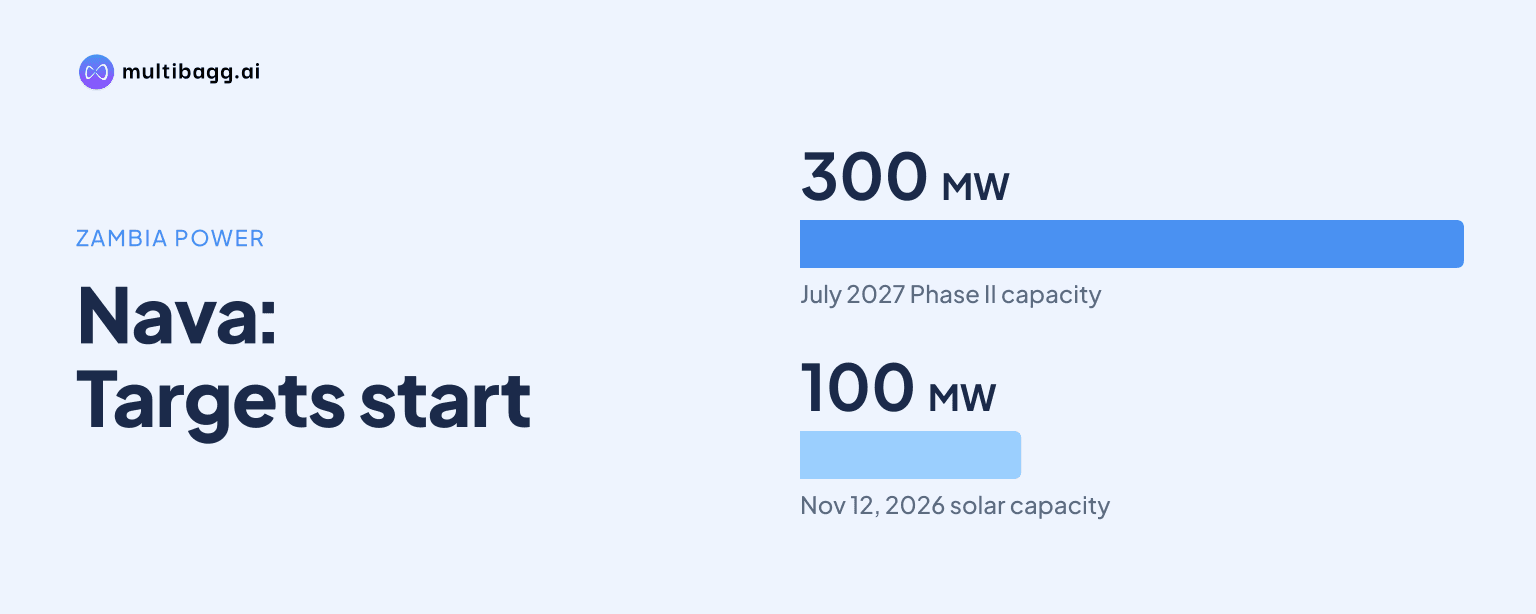
Nava Limited is targeting July 2027 commissioning for its 300 megawatt (MW) Zambia Phase II plant, while its 100 MW solar project had 88 MW flowing to the grid on November 12, 2026 and management expected full output by month-end. Management said Phase II earnings before interest, tax, depreciation and amortisation (EBITDA) would be similar to Phase I.
Know Nava inside out
Results, valuation, peers and who's buying, in one view.
When will Nava commission Zambia Phase II?
Nava is targeting July 2027 for commissioning the 300 MW Phase II expansion at its Maamba Energy Limited operation in Zambia. Management reiterated that date on the November 12, 2026 Q2 FY27 earnings call while describing the project as advancing. The expansion follows the September 2026 commissioning of the 100 MW solar project.
Nava did not provide a revenue, EBITDA or profit estimate for Phase II. Management said only that EBITDA from the 300 MW plant would be similar to Phase I, without disclosing Phase I EBITDA during the call. The financial contribution therefore remains dependent on commissioning, operating performance and applicable tariffs rather than a management-issued numeric forecast.
Nava said it was evaluating additional renewable projects but did not identify them because they remained under consideration. The disclosed Zambia plan is therefore limited to completing grid connection for the 100 MW solar facility and commissioning the 300 MW Phase II project by July 2027.
What will Nava earn from the new solar plant?
Nava said the 100 MW solar plant receives an emergency tariff of US$0.09 for its first year, beginning in September 2026. Management declined to provide a solar revenue forecast or a project EBITDA estimate when analysts asked about expected earnings. The first-year tariff is the clearest disclosed commercial term for the facility.
The solar plant was commissioned at the end of September 2026 but was connected in phases. By the November 12 call, 88 MW was flowing to the grid, and management expected the remaining 12 MW to connect by the end of November. The facility therefore contributed for only part of Q2 FY27, which ended September 30, rather than for the full quarter.
Management separately described an annual tariff increase based on the United States consumer price index (US CPI) in response to a question on the Zambia tariff arrangement. It said the increase occurred at the start of September and had applied since commissioning. The call did not state whether the US$0.09 first-year solar tariff has the same escalation mechanism as Phase I.
Got a follow-up? Ask IRIS
How is Nava funding the Zambia build-out?
Nava said cash balances of more than Rs 2,000 crore discussed by an investor included lender drawdowns for Phase II and the 100 MW solar project. Chief Financial Officer B. Srinivasa Rao said the funds were held in US dollars because of dollar shortages in African countries and were earning about 4.5% interest in current accounts.
Management said the larger drawdown reflected payments due over the next few months as commissioning activities approached, rather than a one-time draw of all sanctioned financing. It said the funding relates to both Phase II, targeted for July 2027, and the solar project, whose final 12 MW of grid connection was expected by the end of November 2026.
On debt, the Chief Financial Officer cited US$450 million as peak debt, with a three-year moratorium followed by seven years of repayment, making a 10-year repayment period. Executive Director GRK Prasad later described peak debt as dynamic and said a US$300 million to US$350 million range could be expected over the next four years as drawdowns and repayments overlap. The call did not reconcile the US$450 million figure with the later range.
Nava said further borrowing would be considered at the project level only if projects under evaluation are conceptualised and proceed. Management said generated cash could support corporate actions and new projects, while equity commitments remain for Kawambwa Sugar and Nava Avocado. The Kawambwa Sugar project is estimated to cost about US$200 million, financed 50:50 through debt and equity, with commissioning targeted for March 2028.
Will Phase II change Nava's plant availability?
Nava expects Phase II to reach a plant load factor (PLF) of more than 80% within about two to three months of commissioning. Management gave that ramp-up expectation for the 300 MW facility, indicating it expects utilisation to reach the stated level within months rather than over a six-to-12-month period.
Nava also plans major overhaul maintenance for Phase I on a unit-by-unit basis because it has operated continuously for five years. Management said shutdowns were expected to start around May and each unit shutdown would take about two months. It did not commit to the number of units or provide a detailed maintenance sequence.
The added 300 MW capacity and Phase I outages should therefore be considered together when assessing Zambia generation after the July 2027 commissioning target. Nava reported that all its India power plants operated at PLF of 82% or higher in Q2 FY27, while the Zambia plan combines a Phase II ramp-up above 80% with planned Phase I maintenance.
Conclusion
Nava’s Zambia build-out has two disclosed operating milestones: management expected the 100 MW solar project to achieve full grid flow by the end of November 2026, and it is targeting July 2027 commissioning for the 300 MW Phase II plant. The company has disclosed a US$0.09 first-year solar tariff and an expected Phase II EBITDA profile similar to Phase I, but it has not issued numeric revenue, EBITDA or profit guidance for either project.
The next points to watch are confirmation of the final 12 MW solar connection, execution toward the July 2027 Phase II target, and Phase I overhaul shutdowns expected to begin around May and last about two months per unit. Management is also still pursuing a tax holiday for Phase II, while the relationship between the US$450 million peak-debt figure and the US$300 million to US$350 million range remains unexplained.