










Nava Limited Reports Record Q2 Revenue of ₹1,252 Crore
Key highlights
- Nava reported record Q2 FY27 revenue of ₹1,252 crore, up 29.9% year-on-year.
- Consolidated PAT rose 127.3% year-on-year to ₹403.4 crore, aided by a tax reversal.
- Nava reported Q2 FY27 EBITDA of ₹561 crore with a 42.0% EBITDA margin.
- All Nava Indian power plants operated at a plant load factor of 82% or higher.
powered by IRIS
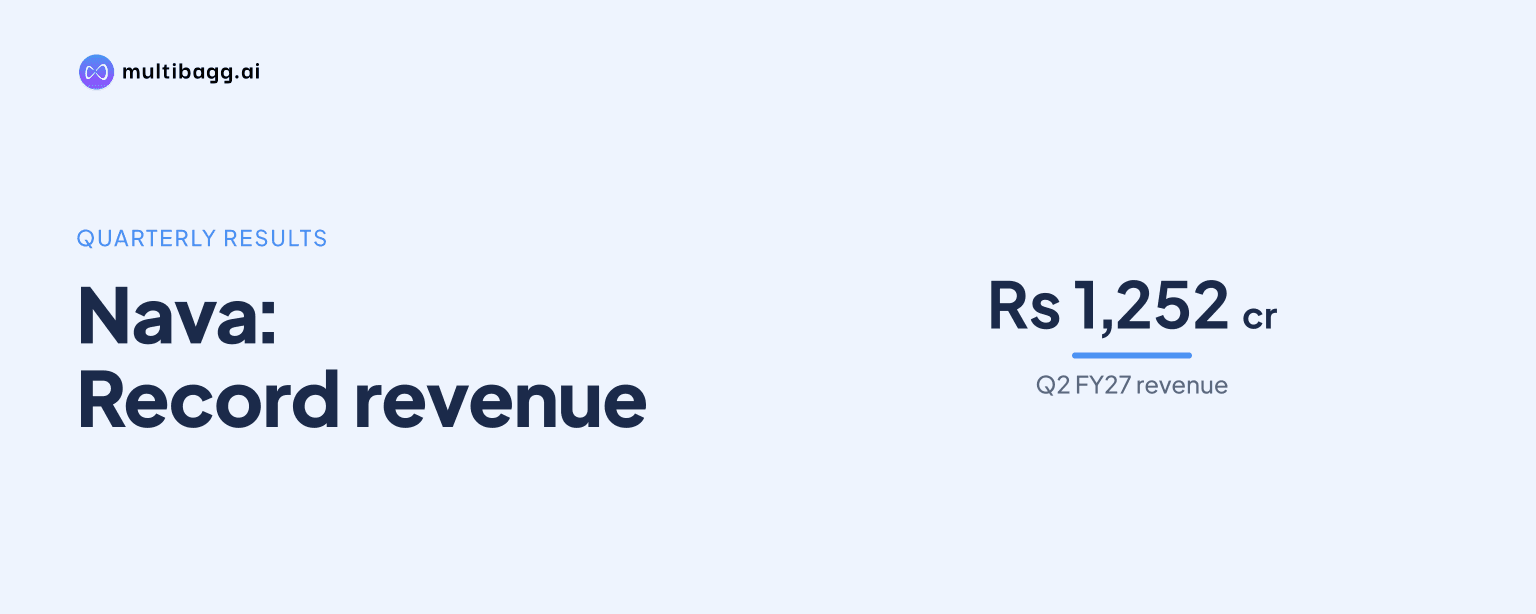
Nava Limited reported record revenue from operations of ₹1,252 crore in Q2 FY27, up 29.9% year-on-year, while consolidated profit after tax rose 127.3% to ₹403.4 crore. The quarterly performance matters because it combined stronger energy and mining operations with progress on the company’s power and solar expansion plans.
Know Nava inside out
Results, valuation, peers and who's buying, in one view.
What did Nava report for Q2 FY27?
Nava reported its highest quarterly revenue from operations at ₹1,252 crore for the quarter ended September 30, 2026. Consolidated EBITDA stood at ₹561 crore, translating into an EBITDA margin of 42.0%, according to the investor presentation. Consolidated PAT was reported at ₹403.4 crore, with a PAT margin of 30.2%.
The company said revenue increased nearly 30% from the corresponding quarter of the previous year. Net profit more than doubled year-on-year, rising 127.3%. The reported profit figure was also aided by a tax reversal, which is relevant when comparing the pace of profit growth with the increase in operating revenue.
What drove Nava's quarterly operating performance?
Nava attributed the quarter’s operational performance to its energy and mining businesses. Management said all Indian power plants operated at a plant load factor of 82% or higher during the period, while the company resumed silico-manganese production at its Odisha operations.
Mining operations recorded higher sales volumes, according to management. Nava also said exploration activities at its manganese concession in Côte d'Ivoire continued to progress. These updates indicate that the quarter’s performance was supported by activity across multiple operating segments rather than a single reported business line.
Management discussed a stronger backdrop for the Indian power sector. It noted that Indian Energy Exchange rates had risen by about 40% year-on-year. The company also said much of its merchant power surplus was contracted until May, providing stated demand visibility for that period.
Why are Nava's margins being closely watched?
Nava's investor presentation reported an EBITDA margin of 42.0% for Q2 FY27. Separately, the earnings-call summary described operating margin as declining to 38% from 43%, attributing the change to foreign-exchange and power-related losses. These are separately reported margin references and should not be treated as identical measures without further company disclosure.
The difference matters because revenue growth and PAT growth were strong, but the company did not provide numerical forward guidance on the call. Management also did not provide specific guidance on solar EBITDA, according to the earnings-call summary. Investors therefore have reported quarterly data and operational updates, but limited quantified management outlook.
The tax reversal that aided PAT is another consideration. It contributed to the reported profit outcome, while EBITDA offers a separate view of operating earnings before tax effects. The company’s revenue, EBITDA and PAT disclosures together provide the clearest reported snapshot for Q2 FY27.
Got a follow-up? Ask IRIS
What projects did Nava update investors on?
Nava said its 300 MW Phase 2 power expansion at MEL was progressing, with commissioning targeted for July 2027. Management described the project as part of its priorities for the second half of FY27, alongside sustaining operating performance, maintaining financial discipline and advancing ongoing projects.
The company also reported phased commissioning of its 100 MW solar project in Zambia during the call. In addition, management referred to progress in integrated sugar and avocado operations in Zambia. The disclosures show that the company is pursuing growth projects alongside its established energy, mining and ferro-alloy activities.
Nava did not give a detailed financial contribution forecast for these projects during the call. As a result, the disclosed milestones are operational targets and progress updates rather than earnings guidance. The July 2027 target for the MEL Phase 2 expansion is the clearest dated project milestone cited by management.
How does the update affect Nava investors and operations?
For investors, the principal reported positives are record quarterly revenue, higher EBITDA, more than doubled PAT and high plant utilisation at the Indian power operations. The improvement in Indian power-market rates cited by management also provides context for the energy business during the quarter.
At the same time, the margin commentary and lack of numerical guidance leave key variables unresolved. The operating-margin decline cited in the earnings-call summary, along with the role of the tax reversal in PAT, means headline profit growth should be read alongside the company’s reported EBITDA and margin disclosures.
For operations, the resumption of silico-manganese production in Odisha and higher mining sales volumes indicate activity across the portfolio. Further progress on the 300 MW MEL expansion and the Zambia solar project will remain important disclosed milestones for assessing execution.
Conclusion
Nava delivered a record Q2 FY27 on reported revenue, with ₹1,252 crore of revenue from operations and ₹403.4 crore of consolidated PAT. Its Indian power plants operated at plant load factors of at least 82%, while mining volumes increased and silico-manganese production resumed in Odisha. However, the tax reversal supporting PAT and the separate operating-margin commentary require attention when evaluating the quarter.
The next disclosed operational milestone is the targeted July 2027 commissioning of the 300 MW Phase 2 expansion at MEL. Investors will also watch for further updates on phased commissioning of the 100 MW Zambia solar project, power-market conditions, margins and any future numerical guidance from management.