










Navin Fluorine adds $180m in Solstice contract extension
Key highlights
- Navin Fluorine extended its Solstice HFO supply contract to December 2032, taking the total term from 7 years to 11 years.
- The four-year extension adds about USD 180 million of potential revenue from the same asset base.
- Management said the revised Solstice agreement guarantees larger HFO volumes than the earlier contract.
- Navin Fluorine reported Q2 FY27 operating revenue of Rs 1,191 crore and operating EBITDA of Rs 407 crore, up 57% and 66% year on year.
powered by IRIS
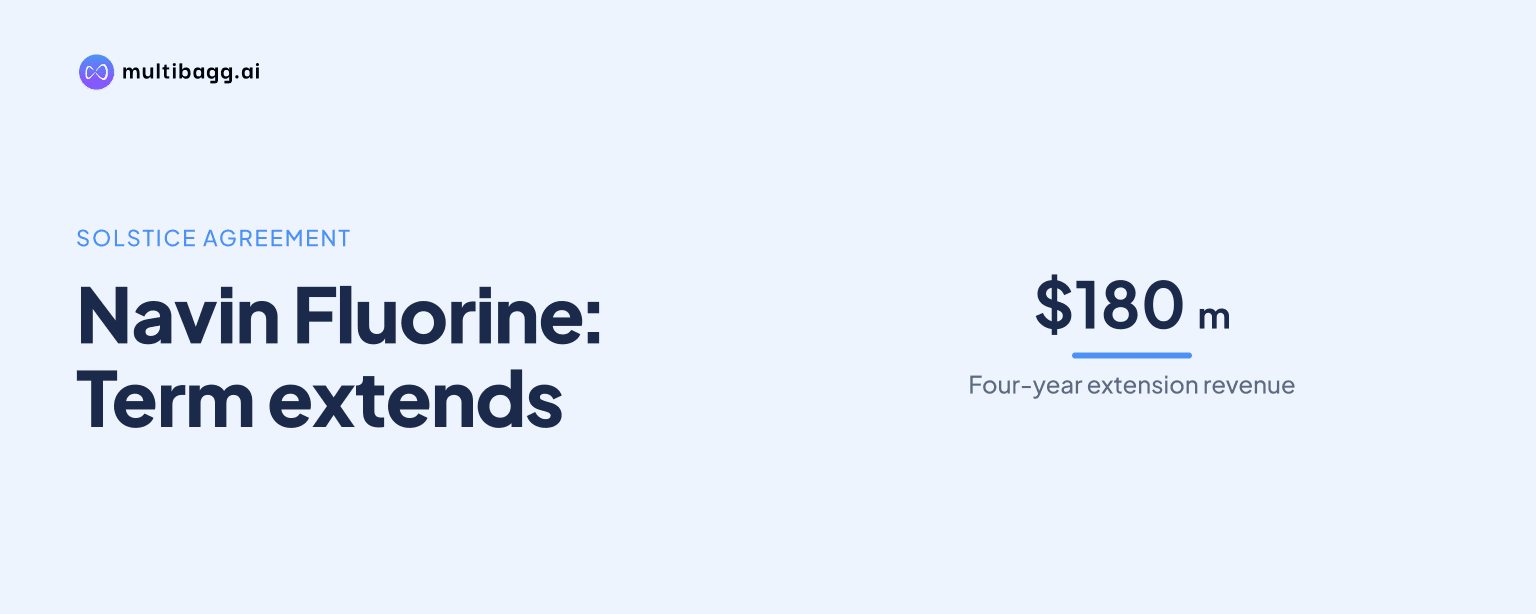
Navin Fluorine extended its Solstice Advanced Materials hydrofluoroolefin supply contract to December 2032, adding about USD 180 million of potential revenue over four years and converting a seven-year arrangement into an 11-year contract. Management said on October 30, 2026 that the extension protects the post-FY28 base and guarantees larger volumes.
Know Navin Fluorine International inside out
Results, valuation, peers and who's buying, in one view.
What did Navin Fluorine extend with Solstice?
Navin Fluorine extended its existing HFO supply arrangement with Solstice by four years to December 2032. Management described the earlier arrangement as a seven-year contract that now becomes an 11-year contract, addressing the question of what happens to the HFO supply relationship after FY28.
The contract concerns Navin Fluorine's Orchid HFO business. During Q2 FY27, management said growth in Orchid contributed to sequential growth in the High Performance Products, or HPP, segment, alongside better refrigerant-gas pricing and higher volumes from the new anhydrous hydrogen fluoride, or AHF, facility.
Management said the extension uses the same asset base rather than requiring a newly announced HFO plant. It did not disclose the contract's annual volumes, specific prices, capital expenditure or profit contribution, but said the longer period adds revenue visibility and operating leverage potential from the existing assets.
How much revenue and volume visibility does the Solstice extension provide?
The extension adds about USD 180 million of potential revenue over the next four years and guarantees larger volumes than the earlier contract, according to management. The disclosed revenue amount applies to the additional four-year period, not to the full 11-year contract.
Analysts on the October 30, 2026 call calculated an implied USD 45 million annual rate by dividing USD 180 million by four. One analyst compared that calculation with an estimated USD 58 million historical annual run rate, while another cited about USD 60 million over the preceding seven years; management did not endorse either comparison as a forecast.
The direct comparison is therefore between contract duration and volume expectations, rather than between simple annual averages. Navin Fluorine said the revised agreement extends the period, volumes and potential revenue from the same assets, while protecting the business base that investors had considered exposed after FY28.
Why is USD 45 million a year not Navin Fluorine's forecast?
USD 45 million a year is not Navin Fluorine's forecast because management said pricing under these contracts operates through a pass-through mechanism. It said outcomes can differ once capital expenditure is recovered, so dividing potential revenue by four years does not capture the commercial terms or establish annual revenue or profitability.
Management also said the pricing environment of the current contract, set in 2020 or 2022, differs from the environment expected from 2028 onward. It did not provide a year-by-year price schedule, fixed annual revenue commitment or contract-specific margin target for the added period through December 2032.
The group results show the scale of the wider business but do not quantify the Solstice contribution. In Q2 FY27, Navin Fluorine reported consolidated operating revenue of Rs 1,191 crore, up 57% year on year, and operating earnings before interest, tax, depreciation and amortisation, or EBITDA, of Rs 407 crore, up 66%, with a 34.2% margin.
For the first half of FY27, consolidated operating revenue rose 51% to Rs 2,236 crore and operating EBITDA increased 69% to Rs 765 crore, also at a 34.2% margin. These figures include HPP, Specialty Chemicals and contract development and manufacturing organisation, or CDMO, operations, so they cannot be used to calculate revenue or margin from the Solstice HFO agreement.
Got a follow-up? Ask IRIS
Will the Solstice contract limit Navin Fluorine's other HFO plans?
Navin Fluorine said the Solstice contract will not prevent other HFO projects as long as they do not overlap with the contracted application. Management said there are 40 different HFO varieties and that the company would not enter the same application covered by the Solstice arrangement.
For other HFO opportunities, Navin Fluorine said it may use partnership models or product-led models, depending on what suits the opportunity. Management did not disclose a launch date, investment amount, customer programme or revenue target for any separate HFO product, so the statement indicates flexibility rather than a confirmed expansion plan.
HPP has other near-term capacity drivers separate from the extended HFO agreement. Management said the R32 project was progressing as planned and was close to commissioning, with some incremental contribution expected during the quarter of commissioning and a fuller ramp-up possibly in the following quarter.
The Specialty Chemicals segment also added capacity in September 2026 through debottlenecking at the Dahej multipurpose plant, or MPP. Management said this capacity had not yet been reflected in reported numbers and expected it to support growth beyond the approximately Rs 350 crore run rate previously indicated for the specialty business.
What should investors compare with the contract extension?
Investors should compare the extension's stated volume increase and four-year USD 180 million potential with the absence of annual pricing and margin disclosures. Management's response to the USD 45 million calculation was not that revenue would be flat or lower, but that pass-through pricing, capital recovery and commercial structure make the annualised figure incomplete.
The broader operating backdrop was favourable in the first half of FY27, when operating profit before tax rose 93% to Rs 619 crore from Rs 320 crore in the first half of FY26. Management attributed Q2 HPP growth to pricing, AHF volumes and Orchid HFO, while Specialty Chemicals and CDMO also contributed to the 51% increase in consolidated first-half revenue.
Management said it would work toward FY27 margins in the range of the 34.2% reported in the first half, while retaining longer-term EBITDA margin guidance of 30%. That guidance is company-wide rather than HFO-specific, and management cited volatile geopolitics as a reason not to project margins five or six years ahead.
Conclusion
Navin Fluorine's extension to December 2032 lengthens the Solstice HFO relationship from seven to 11 years, adds USD 180 million of potential revenue over the extra four years and comes with management's statement that volumes will be larger. The finding is greater post-FY28 revenue visibility from existing assets, not a disclosed annual HFO revenue or margin forecast.
The next indicators are the R32 commissioning and ramp-up, the contribution from September 2026 MPP debottlenecking, and HPP volume trends as the extended contract progresses. Management also said it expects FY27 margins to remain around the first-half 34.2% range while maintaining its 30% longer-term EBITDA margin guidance.