










NCC smart-meter SPVs install 54% after Rs 1,461 crore debt
Key highlights
- NCC’s Maharashtra smart-meter SPVs had drawn Rs 1,461 crore of project debt by 30 September 2026.
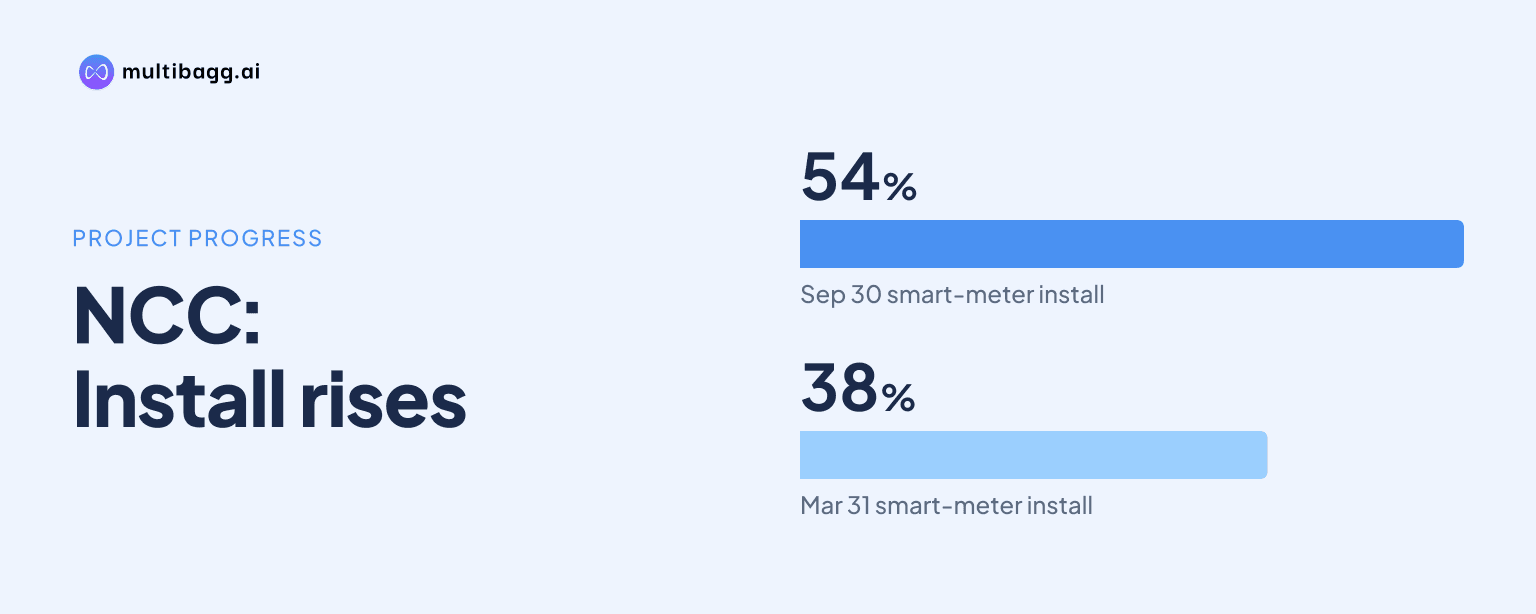
- The Maharashtra SPVs reported smart-meter installation at about 54% at 30 September 2026, versus about 38% at 31 March 2026.
- NCC’s equity and loan investment in the Maharashtra SPVs was Rs 469 crore at 30 September 2026.
- NCC disclosed three smart-meter contracts worth Rs 8,080 crore covering about 8 million meters.
powered by IRIS
NCC LIMITED’s two Maharashtra smart-meter special purpose vehicles had drawn Rs 1,461 crore of project debt and reported installations at about 54% of their total by 30 September 2026. The funding supports a design, build, finance, own, operate and transfer model in which payments continue for eight years after installation.
Know NCC inside out
Results, valuation, peers and who's buying, in one view.
How does NCC’s smart-meter model generate revenue?
NCC’s smart-meter model earns installation revenue first and fixed periodic per-meter payments during the eight-year operating phase. Under the Government of India’s Revamped Distribution Sector Scheme, or RDSS, a distribution company, or DISCOM, appoints an advanced metering infrastructure service provider, or AMISP, to design, finance, supply and install meters, network infrastructure and a data platform.
The installation phase requires capital expenditure on meters, the network and the data platform, funded through mobilisation advances, equity and project debt. NCC recognises revenue as installation progresses, while per-meter payments are progressively released after installation. This means reported installation revenue and the eventual operating-period cash receipts follow different stages of the project.
After installation, fixed periodic per-meter charges are payable over an eight-year concession. The presentation says these receipts are intended to service debt, recover capital and fund operating and maintenance, or O&M, costs. At concession end, the smart-meter assets transfer to the DISCOM under the design, build, finance, own, operate and transfer, or DBFOOT, structure.
Which smart-meter contracts does NCC hold?
NCC holds three smart-meter contracts with a combined disclosed value of Rs 8,080 crore, covering about 8 million meters. The presentation qualifies the contract-value figure as being on a basis to be confirmed. It also reports about 4 million meters installed across the three contracts by 30 September 2026.
Two Maharashtra packages for Maharashtra State Electricity Distribution Company Limited, or MSEDCL, are held through two special purpose vehicles, or SPVs, that are 100% held by NCC Quantum Technologies. The Bihar contract for North Bihar Power Distribution Company Limited, or NBPDCL, is executed directly by NCC and reported within the Construction segment, rather than through the Maharashtra SPV structure.
Management said on the H1 FY27 commentary page that installation had progressed across all three contracts, with Maharashtra ahead of Bihar. That commentary described programme installation as 50% at 30 September 2026, while the detailed Maharashtra SPV funding table reported about 54%. The difference reflects separately rounded disclosures in the presentation rather than a separately stated reconciliation.
How have NCC’s Maharashtra SPVs been funded?
NCC’s two Maharashtra SPVs had drawn Rs 1,461 crore of project debt by 30 September 2026, unchanged from 30 June 2026 and up from Rs 1,093 crore at 31 March 2026. NCC’s investment through equity and loans was Rs 469 crore at both 30 June and 30 September, compared with Rs 468 crore at 31 March.
Installation in the two SPVs increased from about 38% at 31 March 2026 to about 45% at 30 June and about 54% at 30 September. Thus, project debt increased by Rs 368 crore during the first quarter of FY27, when installed-meter share rose by about seven percentage points. Debt remained at Rs 1,461 crore in the following quarter as installation rose by about nine percentage points.
NCC states that the project debt carried a 9.15% rate at financial closure. It also says SPV debt sits in consolidated debt only. The funding arrangement therefore applies to the Maharashtra SPVs, while the Bihar DBFOOT contract is directly executed in NCC’s Construction segment.
Got a follow-up? Ask IRIS
What financial contribution did the Maharashtra SPVs report?
The two Maharashtra SPVs reported revenue from operations of Rs 1,254 crore in FY26 and Rs 488 crore in H1 FY27. FY26 smart-meter revenue represented 6% of group revenue, according to the presentation. H1 FY27 is a six-month period, so its revenue cannot be treated as a like-for-like comparison with the full-year FY26 amount.
Profit before tax was Rs 148 crore in FY26 and Rs 50 crore in H1 FY27, while profit after tax was Rs 111 crore and Rs 38 crore, respectively. Period-end net worth increased by Rs 37 crore from Rs 380 crore at FY26-end to Rs 417 crore in H1 FY27. These figures cover the two Maharashtra SPVs and exclude the Bihar contract reported in the Construction segment.
The presentation distinguishes revenue recognition from cash collection in both phases. During installation, revenue is recognised as work progresses and per-meter payments are progressively released after installed assets are accepted. After installation, the eight-year periodic charges are the disclosed mechanism for debt service, capital recovery and O&M funding.
What should readers track in the next smart-meter phase?
The key operational measure is further progress from the approximately 54% installation level reported for the Maharashtra SPVs at 30 September 2026. The overall three-contract programme covered about 8 million meters, of which about 4 million had been installed at that date. Management’s statement that Maharashtra was ahead of Bihar makes relative installation progress across the two locations relevant to the programme’s next stage.
The other measure is the transition from installation-led activity to periodic operating payments under the eight-year concession. The presentation identifies smart-meter installation progress as one of NCC’s FY27 priorities, alongside execution where work fronts and funding are ready, collections and working capital. It does not provide a completion date for the three contracts or a meter-installation target for the next reporting period.
Conclusion
NCC’s disclosures show that its smart-meter activity combines construction-style installation revenue with project-level funding and subsequent annuity-like per-meter receipts. By 30 September 2026, the Maharashtra SPVs had reported about 54% installation, Rs 1,461 crore of drawn project debt and Rs 469 crore of NCC equity and loan investment, while the three-contract programme covered roughly 8 million meters.
Readers should watch installation completion across Maharashtra and Bihar, the pace at which periodic payments begin after installation, and project-debt servicing as the operating phase expands. Management has identified smart-meter installation progress, collections and working capital as FY27 priorities, but the presentation does not disclose a scheduled date for full deployment.