










NDR Auto Components Ltd targets Rs 3,000 crore by FY2030
Key highlights
- NDR Auto targets Rs 3,000 crore of revenue and approximately 35% or higher ROCE by FY2030.
- NDR Auto reported Rs 823 crore of revenue from operations and Rs 94 crore of EBITDA in FY26.
- NDR Auto reported 23.28% ROCE and 36.22% adjusted ROCE in FY26.
- Domestic passenger-vehicle sales rose 25.9% and two-wheeler sales rose 20.4% in Q1FY27.
powered by IRIS
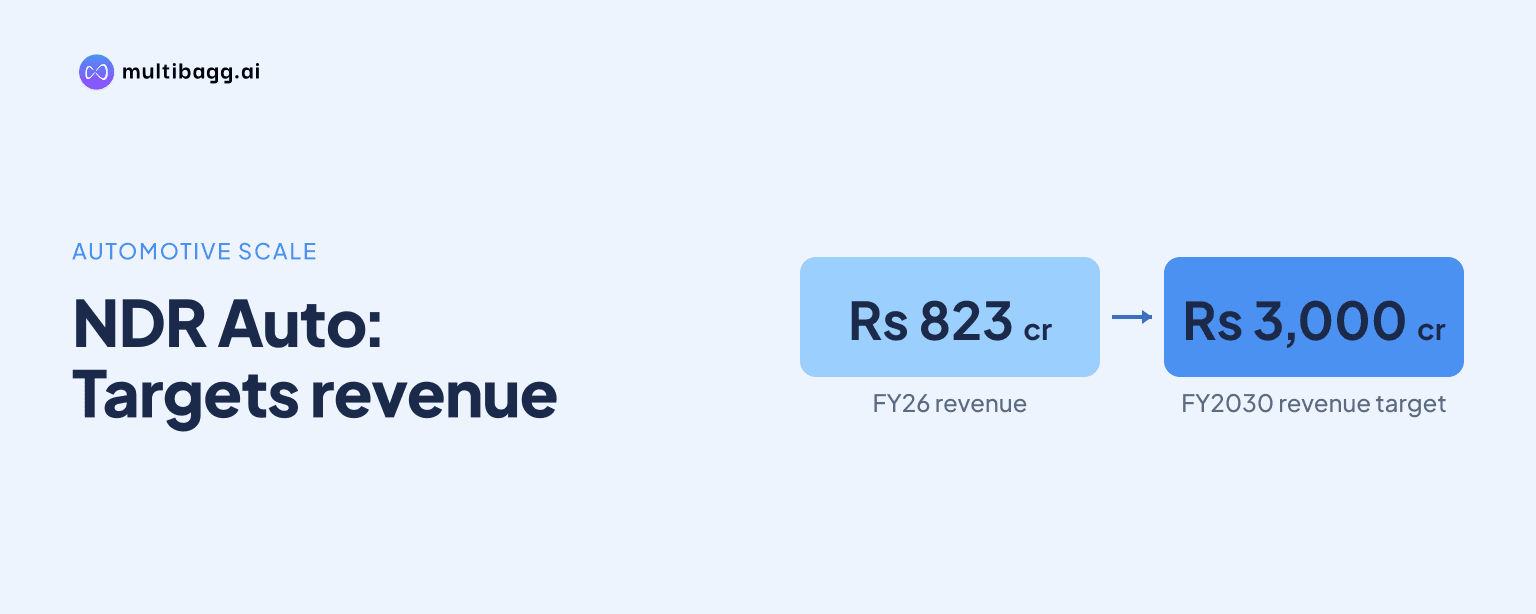
NDR Auto has set a FY2030 aspiration of Rs 3,000 crore in revenue, compared with Rs 823 crore of revenue from operations in FY26. It also aims for approximately 35% or higher return on capital employed, or ROCE, versus reported ROCE of 23.28% in FY26, through OEM expansion, products, capacity and execution.
Know NDR Auto Components inside out
Results, valuation, peers and who's buying, in one view.
What are NDR Auto’s FY2030 financial targets?
NDR Auto aims to reach Rs 3,000 crore of revenue by FY2030, gradually improve margins and deliver approximately 35% or higher ROCE. The presentation describes these as aspirations, rather than near-term guidance, and does not provide annual revenue, margin or capital-spending milestones between FY26 and FY2030.
The Rs 3,000 crore revenue aspiration compares with Rs 823 crore reported in FY26. NDR Auto reported earnings before interest, tax, depreciation and amortisation, or EBITDA, of Rs 94 crore in FY26, equivalent to an 11.3% EBITDA margin, while profit after tax, or PAT, was Rs 62 crore and the PAT margin was 7.5%.
NDR Auto also reported adjusted ROCE of 36.22% in FY26, above its 23.28% reported ROCE. It defines adjusted ROCE as earnings before interest and tax, excluding non-productive land income and surplus cash income, divided by average capital employed comprising net fixed assets and working capital. The FY2030 slide calls its ambition ROCE and does not state whether it uses this adjusted calculation.
How does NDR Auto plan to reach Rs 3,000 crore revenue?
NDR Auto plans to pursue the FY2030 revenue objective through deeper original equipment manufacturer, or OEM, relationships, broader product content and additional manufacturing capacity. Its stated customer actions are to grow with existing OEMs, add new OEM relationships and evaluate export opportunities with existing OEM customers.
Portfolio expansion is the second execution lever. NDR Auto intends to increase content per vehicle and introduce new and innovative auto-ancillary products. The presentation identifies seating systems, metal frames and interior components as relevant to its market opportunity, while citing higher safety, comfort and feature content as a mechanism for raising component demand per vehicle.
Capacity expansion is intended to serve a wider OEM base and new product categories. NDR Auto also says it will strengthen organisational capabilities through operational excellence, quality, cost competitiveness and technology adoption. The presentation does not disclose the number of plants, production volumes, investment amounts or timing for individual capacity projects.
Got a follow-up? Ask IRIS
What industry demand does NDR Auto expect to support growth?
NDR Auto identifies rising vehicle production, premiumisation, localisation and exports as the demand backdrop for its FY2030 plan. Domestic passenger-vehicle sales increased 25.9% to 12.74 lakh units in Q1FY27 from 10.12 lakh units in Q1FY26, while two-wheeler sales rose 20.4% to 56.29 lakh units from 46.75 lakh units.
For FY27, the presentation cites expected passenger-vehicle industry volume growth of 5% to 7% and two-wheeler volume growth of 7% to 9%. Utility vehicles are expected to account for 69% of passenger-vehicle volumes in FY27, compared with 67% in FY26. NDR Auto links that shift to feature-rich vehicle content, but does not disclose its own revenue exposure to utility vehicles.
The long-term market slide estimates India’s auto-component industry could grow from about US$70 billion in 2023 to about US$200 billion in 2030, a compound annual growth rate of about 16%. It also estimates domestic auto-component market growth of 7% to 8% annually through 2030, against 5% to 6% for the overall automotive market. These market figures are estimates identified in the presentation, rather than NDR Auto forecasts.
How does NDR Auto’s FY26 performance compare with earlier years?
NDR Auto’s revenue from operations rose to Rs 823 crore in FY26 from Rs 713 crore in FY25 and Rs 114 crore in FY21. EBITDA increased to Rs 94 crore from Rs 78 crore in FY25 and Rs 14 crore in FY21, while PAT reached Rs 62 crore compared with Rs 53 crore and Rs 9 crore, respectively. The company reports FY21-to-FY26 compound annual growth rates of 46.61% for revenue, 46.02% for EBITDA and 48.66% for PAT.
NDR Auto’s FY26 EBITDA margin of 11.3% was 0.5 percentage points above FY25’s 10.8% but below FY21’s 11.6%. PAT margin was 7.5%, compared with 7.4% in FY25 and 7.0% in FY21. Reported ROCE moved from 23.08% in FY25 to 23.28% in FY26, while adjusted ROCE rose from 32.29% to 36.22%.
Working-capital days fell by 284 days, from 299 in FY21 to 15 in FY26. Net capital turnover increased from one time in FY21 to 23 times in FY26. These operating measures provide the FY26 context for the company’s separate aim of approximately 35% or higher ROCE by FY2030.
Conclusion
NDR Auto’s FY2030 framework combines a Rs 3,000 crore revenue aspiration with approximately 35% or higher ROCE. Its plan depends on expanding OEM relationships, increasing content per vehicle, introducing products, widening capacity and improving organisational execution, against a market outlook shaped by passenger vehicles, two-wheelers, premiumisation and localisation.
The next disclosed items to watch are progress on new OEM relationships, product introductions, capacity expansion and evaluation of exports with existing OEM customers. NDR Auto has not provided annual milestones to FY2030, so its reported revenue growth from the FY26 base of Rs 823 crore, margins and reported ROCE will show how the plan is progressing.