










Nephrocare Health Services Limited tax demand voided in Uzbekistan
Key highlights
- The October 27, 2026 court order invalidated a Rs 14.79 crore assessment and penalty against the Uzbekistan subsidiary.
- The invalidated amount included Rs 11.50 crore of additional tax and Rs 3.29 crore of penalty.
- The underlying tax audit covered January 1, 2023 to December 31, 2025.
- Reconsideration must be completed within 30 days after the court decision enters into force.
powered by IRIS
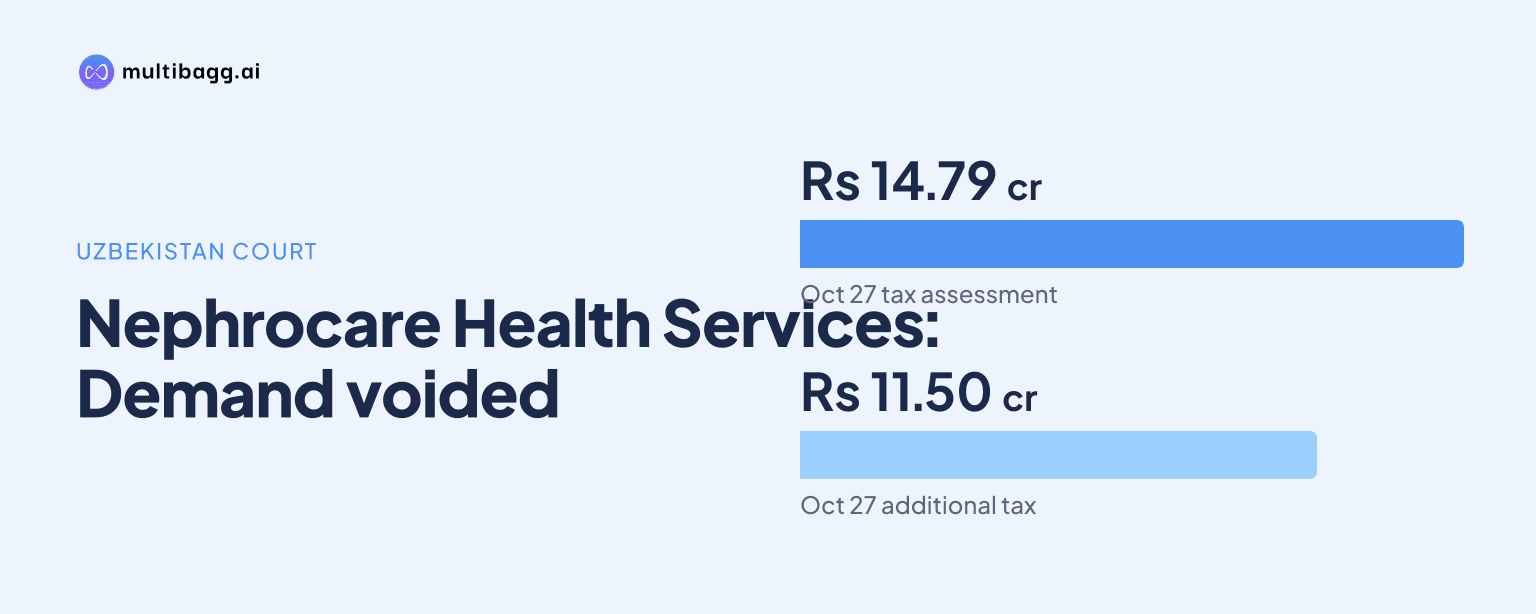
Nephrocare Health Services Limited said the Tashkent Inter-District Administrative Court invalidated its Uzbekistan subsidiary’s Rs 14.79 crore tax assessment and penalty on October 27, 2026, removing the operative demand while directing the tax department to reconsider the audit materials. The order was received by the subsidiary on November 2, 2026.
Know Nephrocare Health Services inside out
Results, valuation, peers and who's buying, in one view.
What did the Uzbekistan court decide on the Company’s tax demand?
The court allowed the application of the Company’s wholly owned overseas subsidiary, Nephrocare Health Services Central Asia LLC, and declared invalid the Tashkent City Tax Department’s Decision No. 721.1 of August 24, 2026. The invalidated decision followed a tax audit covering January 1, 2023 to December 31, 2025 and carried an aggregate demand of about Rs 14.79 crore, excluding late-payment interest.
The Tashkent Inter-District Administrative Court issued its decision in Case No. 5-1001-2602/2451 on October 27, 2026. The subsidiary received the decision on November 2, 2026, when the Company disclosed the development to the stock exchanges under Regulation 30 of the Securities and Exchange Board of India Listing Obligations and Disclosure Requirements Regulations, 2015.
The court directed the Tax Department to reconsider the audit materials after considering documents submitted by the subsidiary and the court’s legal position. The Company said the assessment and penalty are no longer operative, but also said the financial outcome remains dependent on the reconsideration and any further proceedings.
Why did the court invalidate the Uzbekistan tax decision?
The court identified procedural irregularities in the audit, including the absence of prior notice to the subsidiary. It also found that the audit period had been extended after its expiry and that the audit materials were reviewed without the subsidiary’s participation, according to the November 2, 2026 disclosure.
The court also held that the tax calculations underlying the August 24, 2026 decision required verification. Its order therefore addressed both the audit process and the calculations used to arrive at the Rs 14.79 crore aggregate of additional tax and penalty.
The disclosed direction provides that reconsideration cannot worsen the subsidiary’s position compared with the invalidated decision. This means the previous assessment has been removed from operation, while the Tax Department must revisit the same audit-related materials subject to the court’s stated limitation.
The Company did not disclose a revised tax calculation, a fresh tax demand or an expected date for the reconsideration outcome. It separately stated that late-payment interest was excluded from the Rs 14.79 crore figure, so the filing does not quantify any interest consequence that may arise in subsequent proceedings.
Got a follow-up? Ask IRIS
How much was at stake in the invalidated assessment?
The invalidated August 24, 2026 decision comprised about Rs 11.50 crore of net additional tax and about Rs 3.29 crore of penalty. Together, those components totalled approximately Rs 14.79 crore, with late-payment interest excluded from the aggregate disclosed by the Company.
The audit period ran from January 1, 2023 to December 31, 2025. Before the October 27, 2026 ruling, the August 24 assessment was the operative decision against the wholly owned Uzbekistan subsidiary; after the ruling, it stands invalidated and reconsideration is pending.
The Company’s annexure stated that the subsidiary made no claim in the litigation. The disclosed proceeding was instead a challenge to the Tax Department’s decision, which had assessed additional tax and imposed a penalty following the audit of the three calendar-year period.
What happens next in the Company’s Uzbekistan tax case?
The Tax Department’s reconsideration is pending and must be completed within 30 days after the court decision enters into force. The Company did not state when the October 27, 2026 decision would enter into force, so the filing does not provide a calendar deadline for the reconsideration.
The court decision is appealable before the Tashkent City Administrative Court within one month of its issuance. The Company did not disclose whether the subsidiary or the Tax Department intends to appeal the October 27, 2026 ruling.
The November 2, 2026 filing followed the Company’s earlier August 31, 2026 disclosure about the tax assessment order. The Company said it would continue to monitor the matter and disclose further material developments under the listing regulations.
The case therefore has two disclosed process points still open: reconsideration of the audit materials by the Tax Department and the one-month period in which the court decision may be appealed. Neither a reassessed amount nor a final tax liability was disclosed as of November 2, 2026.
Conclusion
The October 27, 2026 court order changes the immediate position for the Company’s Uzbekistan subsidiary by invalidating the Rs 14.79 crore assessment and penalty imposed on August 24, 2026. The court cited procedural deficiencies in the audit and said the tax calculations required verification, while leaving the underlying audit materials to be reconsidered.
Next, the Tax Department is required to complete reconsideration within 30 days after the decision enters into force, and the ruling may be appealed to the Tashkent City Administrative Court within one month of issuance. The Company has not disclosed the effective date of the order, a new assessment amount or any stated intention to appeal.