










NephroPlus says Saudi dialysis pricing is 13.6 times India
Key highlights
- Saudi Arabia pricing is US$300 per dialysis treatment, or 13.6 times India’s US$22 level.
- NephroPlus projects FY24-29 market growth of 17% to 23% across India, the Philippines, Uzbekistan and Saudi Arabia.
- Saudi Arabia’s dialysis-services market is projected to reach US$3,214 million in FY29 from US$1,435 million in FY24.
- NephroPlus reported 570 clinics globally as of September 30, 2026.
powered by IRIS
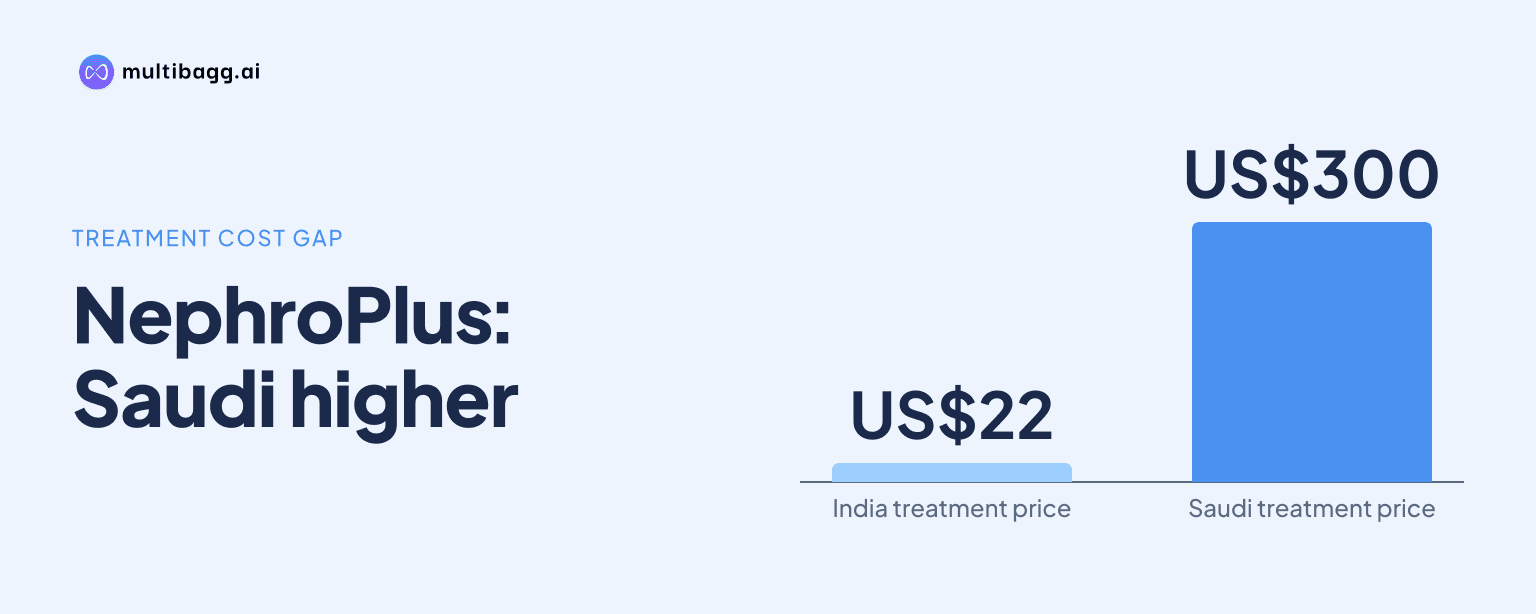
NephroPlus says dialysis treatment pricing in Saudi Arabia is US$300 per session, or 13.6 times India’s US$22 level, while its named Asian markets are projected to grow at 17% to 23% annually from FY24 to FY29. The presentation positions higher pricing, lower treatment penetration and recurring demand as supports for extending its India model overseas.
Know Nephrocare Health Services inside out
Results, valuation, peers and who's buying, in one view.
Why does NephroPlus see an overseas dialysis opportunity?
NephroPlus sees an overseas opportunity because the Philippines, Uzbekistan and Saudi Arabia combine projected dialysis-service market growth of 17% to 23% from FY24 to FY29, compared with the approximately 7% global-market growth rate cited in its presentation. India is projected to grow at 19%, the Philippines at 23%, Uzbekistan at 17% and Saudi Arabia at 18%.
The company cites chronic kidney disease, or CKD, as the clinical need underlying this market. Its presentation says one in 10 people globally suffers from CKD, with more than 750 million people affected. It also says 25 million people globally lack access to dialysis services, citing treatment non-adherence, low awareness, geographic disparities and financial barriers.
Diabetes and hypertension are presented as major drivers of kidney disease. NephroPlus says one in three diabetic adults may have kidney disease, while one in five adults with high blood pressure may have kidney disease. The presentation puts the global diabetes population at 1.4 billion by 2030 and the hypertension population at 1.4 billion in 2022.
Dialysis also requires continuing treatment rather than episodic care. NephroPlus states that the standard requirement is three treatments a week and that people with end-stage renal disease, or ESRD, cannot survive for more than two weeks without dialysis or a transplant. It says guests spend more than 15 hours a week in a clinic and that 95% remain with the same dialysis clinic.
How do NephroPlus's named markets compare on size and growth?
Saudi Arabia is NephroPlus's largest named dialysis-services market by both FY24 and projected FY29 size, at US$1,435 million and US$3,214 million respectively. India ranks second at US$818 million in FY24 and US$1,979 million in FY29, followed by the Philippines and Uzbekistan.
The Philippines has the fastest projected growth rate at 23%, six percentage points above Uzbekistan's 17%, although its projected FY29 market size of US$1,361 million is less than half Saudi Arabia's US$3,214 million. India is projected to add US$1,161 million in market size between FY24 and FY29, compared with US$869 million for the Philippines.
NephroPlus also identifies a US$1.9 billion combined FY24 market across India, the Philippines and Uzbekistan. It describes its strategy as replicating the India model in sizable, faster-growing markets with higher treatment price points. The presentation does not disclose revenue, clinic-count or market-share targets for any of the four markets.
How much higher is dialysis pricing outside India?
Saudi Arabia has the highest dialysis treatment price in NephroPlus's comparison at US$300, versus US$22 in India, making it 13.6 times the India price. The Philippines is priced at US$111 per treatment, or 5.0 times India’s level, and Uzbekistan at US$72.5, or 3.3 times the India price.
The difference between Saudi Arabia and India is US$278 per treatment, based on the presentation's stated prices. Saudi pricing is US$189 above the Philippines and US$227.5 above Uzbekistan. These figures are price-point comparisons and do not disclose realised revenue per treatment, reimbursement terms, operating costs or profitability.
As of September 30, 2026, NephroPlus reported a US$22-to-US$300 treatment-price range across its geographies. In Saudi Arabia, it has established a 51:49 joint venture with publicly listed Arabian International Healthcare Holding Company, referred to in the presentation as Tibbiyah. The material does not disclose the venture's revenue, clinic capacity, completed sessions or financial contribution.
Got a follow-up? Ask IRIS
How much dialysis demand remains untreated in NephroPlus's markets?
India has the lowest dialysis penetration among NephroPlus's four named markets at about 7%, while Saudi Arabia has the highest at about 35%. The Philippines is shown at about 16% and Uzbekistan at about 27%, leaving each market below half of people requiring dialysis under the company's measure.
NephroPlus defines penetration as the number of guests undergoing dialysis in 2024, measured in thousands, divided by the number of guests requiring dialysis in 2024, also measured in thousands. The gap between India’s approximately 7% penetration and Saudi Arabia’s approximately 35% is 28 percentage points, despite Saudi Arabia having the highest stated price per treatment.
The presentation compares dialysis growth with other India single-specialty healthcare segments. It cites a 20% to 22% FY24-29 compound annual growth rate for dialysis, compared with 14% to 16% for eye care and orthopaedics, 12% to 14% for diagnostics and in-vitro fertilisation, 11% to 13% for oncology, and 9% to 11% for mother and child health.
NephroPlus also contrasts clinic economics with oncology in its presentation. It puts dialysis clinic cost at Rs 1 crore to Rs 1.5 crore, compared with Rs 100 crore to Rs 150 crore for oncology, and states a dialysis payback period of 1.5 to 2 years versus 7 to 10 years for oncology. These are industry comparisons cited by the company, rather than NephroPlus financial forecasts.
What operating model supports NephroPlus's expansion?
NephroPlus says its operating model supports expansion through home haemodialysis, dialysis on call, dialysis on wheels, greenfield clinics, brownfield clinics, in-hospital captive clinics and government-backed public-private partnerships. The company illustrates a five-bed average capacity format with a first-year run rate of 250 treatments and cites a 165-bed clinic in Tashkent, Uzbekistan.
The presentation says brownfield clinics can require lower upfront capital investment and provide quicker market entry, faster operational ramp-up, and access to an existing guest base, infrastructure and local staff. In Saudi Arabia, dialysis sessions have commenced at the Riyadh clinic, while home dialysis has commenced in Riyadh and Jeddah. NephroPlus has also submitted a Ministry of Health tender request for information.
As of September 30, 2026, NephroPlus reported 570 clinics globally and operations across 314 Indian cities. About 80% of its clinics were in tier II and tier III cities and towns. Those locations accounted for about 77% of H1FY27 revenue salience, excluding other operating revenue and revenue generated from Nepal.
NephroPlus also reported the acquisition of DataVia India and 18 subsidiaries in the Philippines. The presentation does not state the acquisition values or quantify their contribution to revenue, sessions or earnings. It does, however, identify clinic formats and local partnerships as mechanisms for extending the model across different geographies.
Conclusion
NephroPlus's overseas market case combines a US$300 Saudi treatment price, compared with US$22 in India, with projected FY24-29 growth of 17% to 23% in its named markets and penetration ranging from about 7% to 35%. Saudi Arabia has the highest stated price and largest projected FY29 market, while the Philippines has the fastest projected growth rate.
The next disclosed operating milestones are the development of the 51:49 Saudi joint venture with Tibbiyah, the progress of the Riyadh clinic and home dialysis services in Riyadh and Jeddah, and any outcome from the Ministry of Health tender request for information. The presentation leaves unresolved the future clinic count, session volumes, revenue and financial contribution from the international markets.