










NES DATA outlines 60 MW campus from 4 MW live capacity
Key highlights
- NES DATA operates 4 MW of live Tier-III data-centre capacity in Pune.
- NES DATA's Pune facility has 304 racks, including 15 high-density racks.
- NES DATA has outlined a proposed Hinjewadi campus with capacity of up to 60 MW.
- NES DATA's long-term hyperscale-campus blueprint is 100 MW.
powered by IRIS
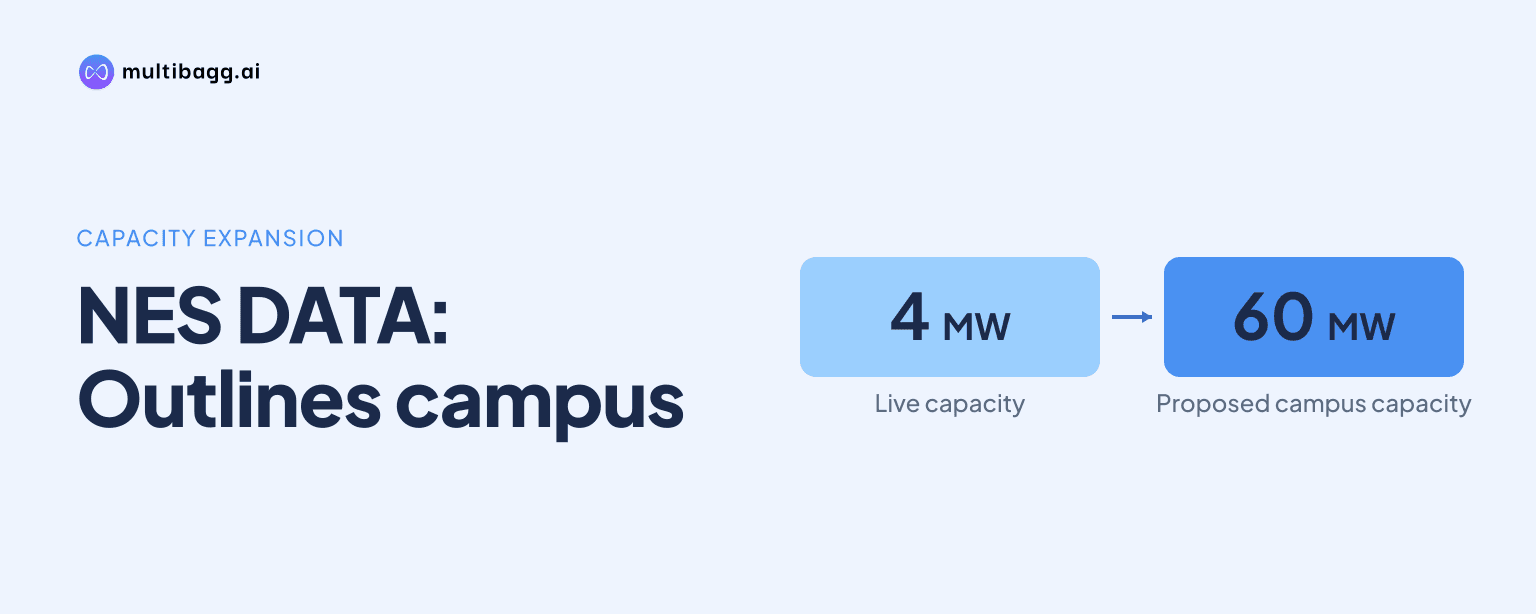
NES DATA operates 4 MW of live Tier-III data-centre capacity at its Pune facility and has outlined a proposed Hinjewadi campus of up to 60 MW, alongside a 100 MW long-term hyperscale blueprint. The proposed campus would be 15 times the live capacity at its stated maximum, but NES DATA has not disclosed a commissioning timetable, investment amount or contracted demand.
Know TCC Concept inside out
Results, valuation, peers and who's buying, in one view.
What capacity does NES DATA operate and propose?
NES DATA operates 4 MW, or megawatts, of live Tier-III capacity at its Pune facility and proposes an up-to-60 MW Hinjewadi campus, with a separate 100 MW long-term hyperscale-campus blueprint. The presentation distinguishes the three stages as commissioned capacity today, a phased expansion opportunity and long-term hyperscale optionality. It does not describe the 60 MW or 100 MW stages as operational capacity.
The Pune facility has 304 racks, including 15 high-density racks, alongside its 4 MW live capacity. At its maximum stated size, the proposed Hinjewadi campus would be 15 times the Pune capacity, while the 100 MW blueprint would be 25 times the operating base. Those multiples compare disclosed capacity figures only and do not indicate that future capacity is funded, built or commissioned.
How does NES DATA plan to monetise its capacity?
NES DATA lists colocation and private suites, hosting, managed infrastructure and capacity-led expansion contracts as its revenue streams. Its target sectors are enterprise, hyperscale, banking, financial services and insurance (BFSI), software-as-a-service (SaaS) and cloud-led workloads. The 4 MW Pune site is therefore presented as a platform for several customer segments rather than as capacity assigned to a named customer or tenant.
NES DATA identifies driving occupancy and enterprise-customer acquisition as its utilisation priority. It also sets out modular expansion formats of 2 MW to 100 MW, spanning smaller deployments and the long-term hyperscale blueprint. The presentation does not disclose the current occupancy rate, contracted MW, customer count, pricing, revenue or utilisation of the 304 Pune racks.
The stated cloud-services offering includes migration, security, FinOps, DevOps, disaster recovery (DR), and artificial intelligence and machine learning cloud services. These offerings sit alongside physical infrastructure capacity and the stated revenue streams for hosting and managed infrastructure. NES DATA does not state how much, if any, of the 4 MW Pune capacity is used for cloud services, AI workloads or any one revenue stream.
What market backdrop does NES DATA cite for expansion?
NES DATA cites Indian data-centre capacity additions from 1.3 gigawatts (GW) currently to 1.7 GW in FY27 as part of its market backdrop. One GW equals 1,000 MW. The same presentation page separately shows about 1.75 GW of operational capacity in H1 2026, so the disclosed figures are labelled under different measures and periods and are not presented as a single reconciled series.
The market page also cites about US$173 billion of investment commitments since 2021 and a 6 GW capacity outlook for July 2029. It identifies AI workloads as a source of higher-density computing requirements. That context is relevant to the 15 high-density racks at NES DATA's Pune site and to its 2 MW-to-100 MW modular formats, but it is not a forecast of NES DATA demand, funding or revenue.
NES DATA also cites an Indian cloud-computing market estimate of US$37.1 billion in 2025 and US$266.9 billion in 2034. It shows Indian public-cloud end-user spending of US$17.5 billion for 2026, up 28.1%. These figures support the presentation's cloud-led opportunity framing, while leaving undisclosed NES DATA's share of cloud spending, its cloud customers and its cloud-services revenue.
Got a follow-up? Ask IRIS
What could determine whether NES DATA delivers the roadmap?
NES DATA identifies power availability, sustainability and site selection as critical execution variables for data-centre development. These matters apply directly to the up-to-60 MW Hinjewadi proposal and 100 MW blueprint because each is substantially larger than the operating 4 MW Pune facility. The presentation does not disclose power allocations, land control, environmental specifications, construction milestones or capital expenditure for the future stages.
Utilisation is another disclosed variable because NES DATA's roadmap specifically calls for occupancy and enterprise-customer growth. The company has an operating base of 304 racks, including 15 high-density racks, but gives no occupancy percentage or contracted rack count. As a result, the presentation establishes the available base capacity and expansion ambition without quantifying the demand already secured against either the Pune site or the proposed campus.
The presentation describes its core capability as secure facilities, reliable power and cooling, high uptime and connectivity. It also lists controlled environments, redundancy and continuous availability as operating features. These are the stated platform characteristics, but NES DATA does not provide service-level metrics, outage data, power-usage information or customer-retention figures for the 4 MW facility.
How does the proposed campus compare with the live Pune site?
NES DATA's proposed Hinjewadi campus is up to 60 MW, compared with 4 MW of live Tier-III capacity in Pune. The difference is up to 56 MW, and the proposed maximum is 15 times the existing live base. The 100 MW hyperscale blueprint is a further 40 MW above the proposed campus's stated maximum and 25 times the current Pune capacity.
The change from the live site to the proposed campus is therefore not simply an increase in rack count, because the presentation provides only the 304-rack figure for Pune. It presents the future build-out in MW capacity rather than in racks, utilisation or customer contracts. NES DATA also does not assign a date to the 60 MW campus or the 100 MW blueprint, beyond describing the latter as long-term.
NES DATA's edge strategy adds another format to the roadmap: aligning smaller footprints with Tier II and Tier III demand. That approach appears alongside the 2 MW-to-100 MW expansion formats, the 4 MW Pune facility and the larger Hinjewadi and hyperscale markers. The presentation does not specify the number of smaller sites, their locations or their planned capacity.
Conclusion
NES DATA's disclosure shows a substantial gap between its present operating footprint and its stated development ambition. The company has 4 MW of live Tier-III capacity, 304 racks and 15 high-density racks in Pune, while its roadmap identifies an up-to-60 MW proposed campus and a 100 MW long-term blueprint. Monetisation depends on the stated focus on occupancy, enterprise customers, colocation, hosting, managed infrastructure and expansion contracts.
The next items to watch are progress on the proposed Hinjewadi campus and any disclosure of power availability, site arrangements, construction stages, investment and commissioning dates. NES DATA has also identified occupancy and enterprise-customer growth as priorities, while sustainability and site selection remain stated execution variables for the 60 MW proposal and 100 MW hyperscale blueprint.