










NHPC identifies 17,930 MW pumped-storage schemes across states
Key highlights
- NHPC has identified 17,930 MW of pumped-storage schemes across seven states.
- Maharashtra accounts for 7,500 MW across four NHPC pumped-storage schemes.
- Indrasagar-Omkareswar’s 640 MW DPR was concurred by the Central Electricity Authority on 17 August 2026.
- Jalond at 2,400 MW, Kurund at 1,000 MW and Hasdeo Bango at 800 MW have disclosed wildlife-related considerations.
powered by IRIS
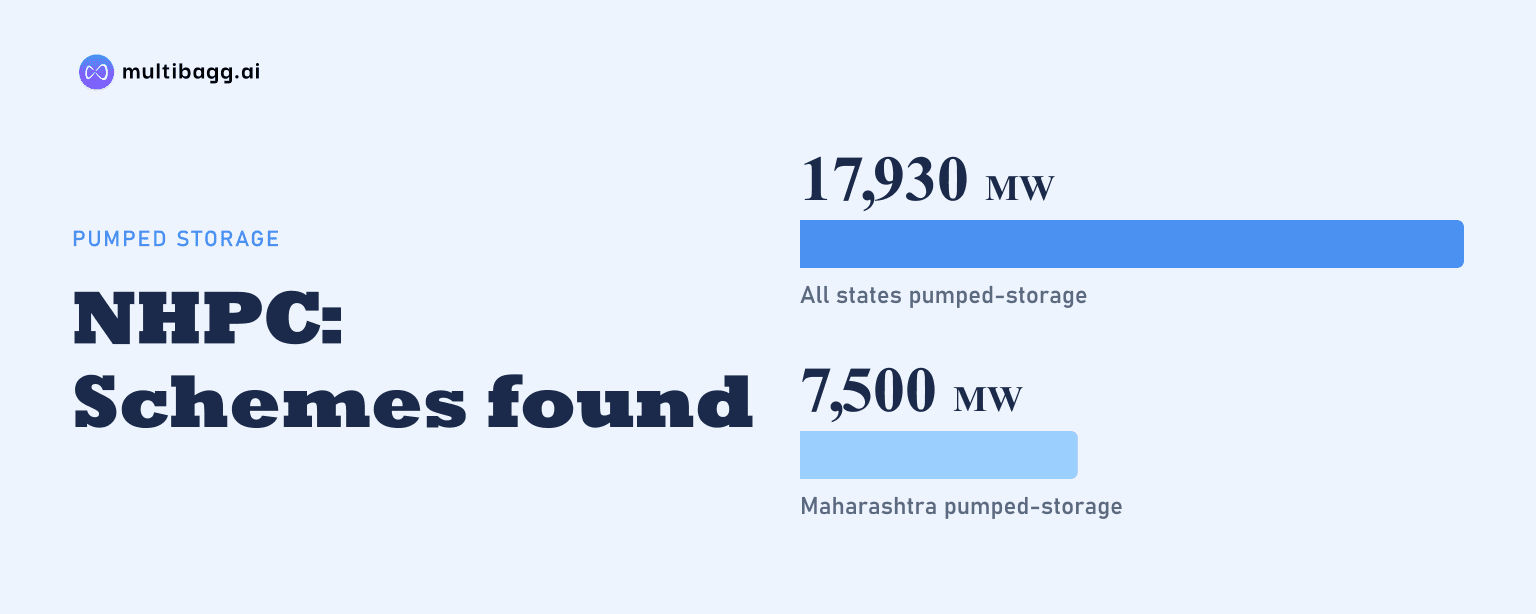
NHPC Limited has identified 17,930 MW of pumped-storage schemes across seven states, led by Maharashtra’s 7,500 MW, but its project updates show that most of the capacity remains subject to studies, reports, clearances, state approvals, local access or viability processes rather than disclosed commissioning schedules.
Know NHPC inside out
Results, valuation, peers and who's buying, in one view.
How large is NHPC’s pumped-storage portfolio?
NHPC’s identified pumped-storage portfolio totals 17,930 MW across 14 schemes in Maharashtra, Andhra Pradesh, Madhya Pradesh, Odisha, Gujarat, Rajasthan and Chhattisgarh. Maharashtra is the largest allocation at 7,500 MW across four projects, while Andhra Pradesh follows with 3,270 MW across three schemes being pursued through the ANGEL joint venture.
Maharashtra’s 7,500 MW is more than twice Andhra Pradesh’s 3,270 MW and includes Savitri and Jalond at 2,400 MW each, Kalu at 1,800 MW and Kengadi at 900 MW. The next-largest individual scheme is Aravetipalli in Andhra Pradesh at 1,320 MW, followed by Gadikota at 1,200 MW.
The 17,930 MW figure is identified scheme capacity, not disclosed operational or commissioned capacity. NHPC’s seven-state update lists preliminary feasibility reports, detailed project reports, exploratory drilling, water allocation, environmental studies, clearances and state requests, but gives no commissioning date for any of the 14 schemes.
Which NHPC pumped-storage projects have progressed furthest?
Indrasagar-Omkareswar in Madhya Pradesh has the most advanced disclosed works-procurement milestones, with its 640 MW detailed project report, or DPR, concurred by the Central Electricity Authority on 17 August 2026. NHPC had issued tenders for electromechanical and hydro-mechanical works, while the civil-works tender was at an advanced stage.
Indrasagar-Omkareswar still had forest-clearance and land matters pending. Its update refers to 198 hectares of forest land, for which a Forest Advisory Committee meeting was held on 23 October 2026, and 37.48 hectares of revenue forest land for muck disposal, where the land-diversion proposal was under evaluation by the Ministry of Environment, Forest and Climate Change.
At Savitri, the 2,400 MW Maharashtra scheme, layout-finalisation chapters had been cleared by the Central Electricity Authority, exploratory drilling was under way and NHPC had received a water-availability certificate. The project had also received terms of reference for environmental impact assessment and environmental management plan studies, with first-season data collected.
Kalu, Maharashtra’s 1,800 MW scheme, had also received layout-finalisation clearance and terms of reference for environmental studies, while exploratory drilling continued. In Odisha, the 1,000 MW Masinta scheme had water-allocation approval and layout clearance, but its DPR remained under preparation despite first-season environmental-study data having been collected.
What hurdles are disclosed for NHPC’s projects?
Wildlife, forest and commercial-viability issues are explicit constraints in several NHPC updates. Jalond, a 2,400 MW Maharashtra scheme, falls within a wildlife sanctuary and its feasibility was being examined, while the 1,000 MW Kurund project in Chhattisgarh falls inside the eco-sensitive zone of Udanti Sitamadi Tiger Reserve.
For Kurund, NHPC had requested state concessions or incentives to make the scheme commercially viable and sought facilitation of wildlife clearance. The 800 MW Hasdeo Bango scheme, also in Chhattisgarh, is planned in joint-venture mode after NHPC signed a memorandum of understanding with the Chhattisgarh government and CSPGCL, but its update says it falls inside Lemuru Elephant Reserves and confirmation from the state government is awaited.
At Kuppa in Gujarat, a 900 MW project, site surveys could not be completed despite three attempts because of protests by local villagers. NHPC sought administrative support from the Gujarat government for survey and investigation work, alongside concessions intended to make the project viable.
Badanalla in Odisha, at 800 MW, was under optimisation because of high tariff. NHPC requested permission to explore nearby sites to achieve commercial viability, and confirmation from the Odisha government was awaited; this is a different constraint from Harbhangi’s 1,020 MW preliminary feasibility report, which was under examination by Odisha’s single-window committee.
Got a follow-up? Ask IRIS
How do development stages vary across NHPC’s seven states?
NHPC’s disclosure shows different development stages within the 17,930 MW total. Indrasagar-Omkareswar is the only 640 MW scheme described with issued works tenders, whereas Andhra Pradesh’s 1,320 MW Aravetipalli and 750 MW Deenepalli were still at the stage of tendering for consultants to prepare their DPRs.
Gadikota, Andhra Pradesh’s 1,200 MW scheme, sat between those stages: a consultant’s draft DPR was under examination, while environmental and forest clearances were being pursued. Aravetipalli had initial-filling water allocation from the Andhra Pradesh Water Resources Department, but consultant appointment remained in progress.
Maharashtra’s 7,500 MW allocation also spans different conditions. Savitri and Kalu had drilling and environmental-study milestones, Kengadi’s revised 900 MW preliminary feasibility report had been submitted to the Maharashtra government with its layout chapter under preparation, and Jalond remained under wildlife-sanctuary feasibility examination.
Singli in Rajasthan, at 1,000 MW, had obtained water allocation, completed project-registration formalities and secured a no-objection certificate from the divisional forest officer in Banswara for survey and investigation. These milestones differ from the 900 MW Kuppa scheme, where surveys had been interrupted by local protests.
What should be monitored in NHPC’s pumped-storage plan?
The disclosed next steps for Indrasagar-Omkareswar are forest clearance for 198 hectares, evaluation of the 37.48-hectare land-diversion proposal and progress on the civil-works tender. For Gadikota, the stated matters are completion of examination of the draft DPR and pursuit of environmental and forest clearances.
For the largest identified allocations, outcomes at specific sites remain material to progress. NHPC has disclosed a wildlife-sanctuary feasibility review for Jalond, a request for local administrative support and concessions at Kuppa, pending permission for nearby-site exploration at Badanalla, and awaited confirmation on the elephant-reserve position at Hasdeo Bango.
Conclusion
NHPC has set out a 17,930 MW pumped-storage pipeline across seven states, with Maharashtra accounting for 7,500 MW and Andhra Pradesh for 3,270 MW. The portfolio combines a 640 MW scheme with issued works tenders, projects with drilling and environmental-study activity, and others dependent on DPR preparation, state decisions, local access, forest processes or viability measures.
What to watch next is the approval and procurement sequence NHPC has already disclosed: forest and land decisions for Indrasagar-Omkareswar, environmental and forest clearance progress at Gadikota, wildlife-related outcomes at Jalond and Kurund, and state responses on access or viability at Kuppa and Badanalla. NHPC has not disclosed commissioning schedules for the 14 schemes.