








Nifty 50 Holds Gains as Nasdaq Swings Raise Intraday Volatility
MAX Plan at ₹4,999/yr

Find your next multibaggerBe a Pro Investor
Research stocks and track your picks on the go. Download the app.
Key highlights
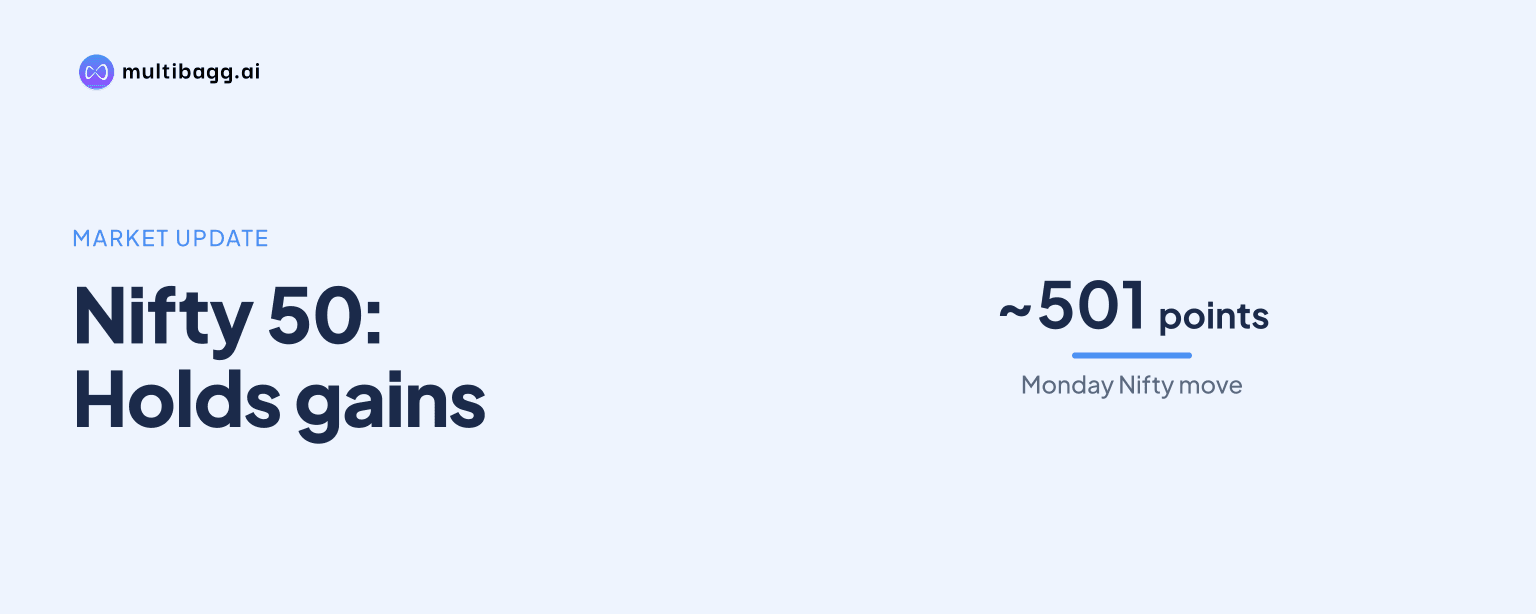
- Nifty moved about 501 points from its Monday high of 25,992.60 to its low of 25,491.30.
- India VIX touched 18.65 intraday on Monday after opening at 17.32.
- India VIX was at 16.84 on 27 November, down 4.7% from 17.67.
- The Nasdaq Composite declined 5.28% in the cited US AI-led sell-off.
powered by IRIS
Nifty 50 held its monthly gains despite a 5.28% Nasdaq decline, but India VIX rose to an intraday high of 18.65 on Monday as global risk sentiment and concentrated derivatives activity amplified domestic price swings.
Why does Nifty react after Nasdaq sell-offs?
Nifty reacts to Nasdaq sell-offs because overseas weakness shapes risk sentiment before the Indian market opens. The context identifies swings in the AI trade as a principal source of heightened global equity-market volatility, with declines in the Nasdaq also affecting AI-linked markets in South Korea, Taiwan and Japan.
India's trading session begins after the US market has closed, giving domestic investors their first opportunity to respond to the overnight move. This can make the opening period particularly sensitive to global cues. The context notes that the Nifty open is unusually exposed to overnight sentiment, while the later partial overlap with European trading can add another layer to the session.
The relationship is not presented as a fixed directional rule. Nifty has outperformed even as overseas AI-related markets weakened: it was reported up more than 15% for the month in dollar terms, versus a 7% decline in the MSCI Asia-Pacific ex-Japan index. Still, a sharp Nasdaq move can raise the odds of a volatile Indian session.
What did the latest Nifty session show?
The latest data showed Nifty recovering while volatility eased, after a prior session in which intraday movement was much larger. On 27 November, Nifty was at 25,884.50, up 65.25 points or 0.25%, while India VIX was at 16.84, down 0.83 points or 4.7% from the previous close of 17.67.
That calmer reading followed substantial movement earlier in the week. On Monday, Nifty opened near 25,929, rose to 25,992.60 and then fell to 25,491.30. The 501-point high-to-low movement came as the domestic market absorbed the weak US lead and traders adjusted derivatives positions.
The 27 November snapshot also showed a mixed overseas backdrop. GIFT NIFTY was down 0.43%, Nasdaq was down 0.62%, and the Nikkei 225 was up 1.64%. Such cross-currents can limit the usefulness of any single overseas indicator for judging Nifty's likely intraday direction.
How did derivatives expiry affect Nifty volatility?
Derivatives expiry concentrated position closures and rollovers into Monday, increasing the potential for sharper Nifty moves. Weekly and November monthly expiry for Nifty, Bank Nifty, FinNifty, Midcap Select and individual-stock contracts had been moved to that day because of a holiday.
The context specifically says derivatives trading aggravated both down moves and up moves in India on Monday. Expiry-day hedging flows can be faster than in a typical session, particularly in Bank Nifty and in the final hour, as options market participants adjust their exposure when the underlying index moves.
This is also why a single intraday indicator setting may not describe the entire trading day. The 9:15 a.m. to 9:45 a.m. period is marked by gap resolution and a higher chance of false signals, while volume typically thins after the opening burst. A move immediately after the open may therefore reflect adjustment to overnight information rather than a durable all-day trend.
Got a follow-up? Ask IRIS
Which India VIX levels frame Nifty risk?
India VIX provides a market-based measure of expected 30-calendar-day volatility derived from Nifty options prices, rather than a prediction of direction. It rose to 17.99 at 10:13 a.m. on 23 November and later closed at 17.89, after opening at 17.32 and reaching 18.65 intraday.
The gauge had already risen 7.51% to 17.32 on the preceding Friday, its highest close since 11 November according to the context. It then fell 7.18% intraday to 16.43 on 25 November before recovering much of that decline by the close, when it was down just 0.11% at 17.68.
The latest fall to 16.84 points to lower expected volatility than the immediately preceding close, but it does not erase the recent fluctuations. The relevant message for traders is not that VIX determines whether Nifty rises or falls. Rather, a higher or rapidly changing VIX can signal greater scope for sharp intraday moves while global and derivatives-related pressures remain active.
Can Nifty's monthly strength continue amid global volatility?
Nifty's monthly strength has so far stood apart from the pressure on several overseas markets, but the context does not establish that the divergence will persist. The index had gained 2.61% to close at 25,800.60 before the 23-27 November week, and commentary described it as the only high-performing market globally during the month.
The test identified in the discussion is the 26,000 level, alongside the effect of global AI-trade moves and domestic positioning. Renewed US tariff concerns, selling in Asian equities and uncertainty around key US economic releases were also cited as factors that restricted the decline in India VIX despite a recovery in domestic equities.
Conclusion
Nifty has remained relatively resilient during the month, but the comparison with Nasdaq highlights an important distinction: domestic outperformance does not prevent sharp intraday reactions to overnight US moves. The Nasdaq's 5.28% sell-off formed the global backdrop for a 501-point Nifty swing, while India VIX's move to 18.65 reflected the elevated demand for protection during that adjustment.
Investors will next watch whether Nifty can sustain trade around the 26,000 test level, whether India VIX remains below its recent highs, and whether further moves in the Nasdaq-led AI trade affect Asian risk sentiment. The impact of derivatives positioning after the concentrated expiry session also remains an unresolved factor for intraday trading conditions.

