










Stock Market Today: Nifty Reclaims 25,000 as Banks Lead
Key highlights
- Nifty recovered more than 100 points from its intraday low to close above 25,000 on November 9.
- Sensex rebounded more than 400 points from its low after falling to 80,637.27 intraday.
- The PSU banking index rose 3%, led by State Bank of India, while IT remained under pressure.
- Brent crude traded around $96-$98 a barrel, easing support concerns for India’s oil import bill.
powered by IRIS
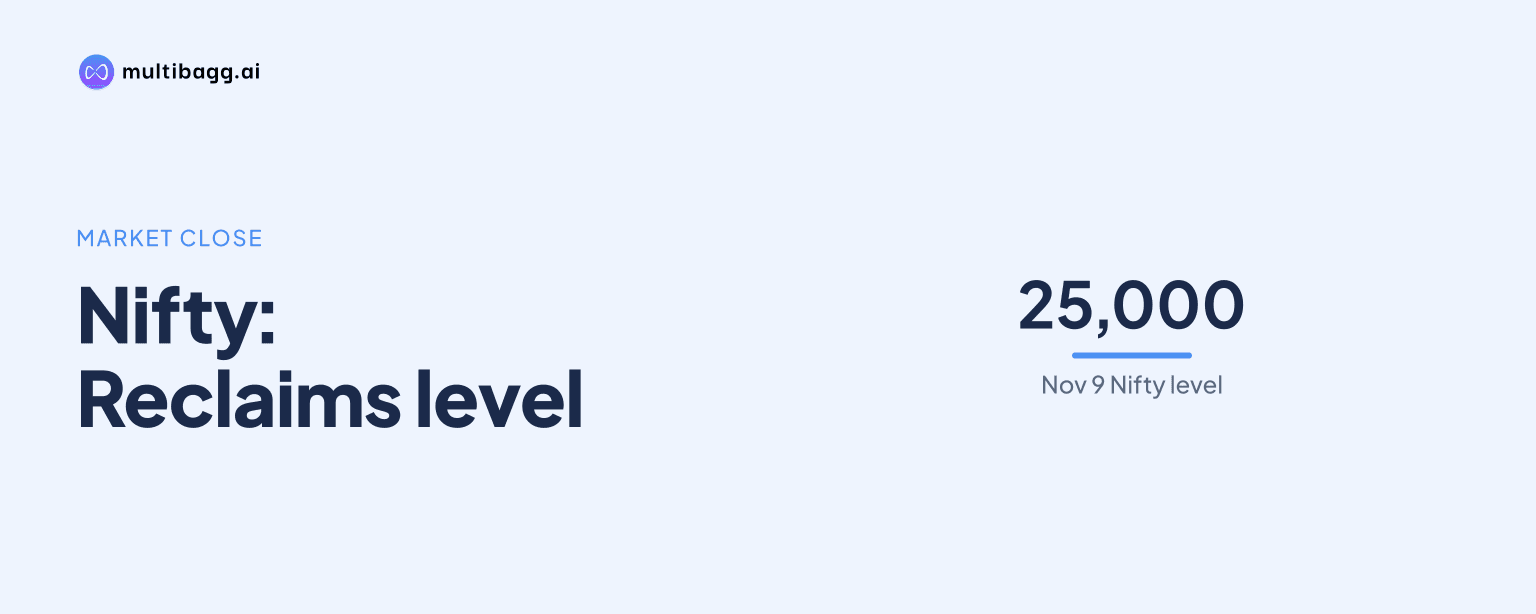
Indian stock market benchmarks ended higher on November 9, with Nifty reclaiming 25,000 after recovering more than 100 points from its intraday low and Sensex rebounding over 400 points from the day’s low. Easing crude prices and buying in heavyweight banks drove the recovery, while information technology shares remained under pressure.
Why did Nifty today recover above 25,000?
Nifty today recovered above 25,000 because investors returned to bank and financial shares as Brent crude eased and overseas buying remained supportive. The session was far from one-way. The index had slipped to 24,882 around midday, while Sensex fell as much as 362 points, or 0.45%, to 80,637.27, as selling broadened across IT, metals and cement.
The turnaround reflected selective buying rather than a broad market surge. HDFC Bank, ICICI Bank and State Bank of India supported the benchmarks, with the PSU banking index reportedly rising 3% on SBI-led strength. L&T was also among the stronger Nifty names. Market breadth, however, remained negative, showing that the late recovery was concentrated in large, liquid counters.
Profit-taking was unsurprising after a sharp recent advance. The benchmarks had gained more than 10% in seven sessions through Friday, supported by foreign inflows, lower crude and improving corporate earnings. Monday’s trade suggested investors were prepared to retain exposure to large banks but were less willing to chase gains across cyclical and technology shares.
Which sectors shaped Sensex today?
Banking, private banks, PSU banks, pharmaceuticals and healthcare provided the market’s support, while IT was the clearest drag on Sensex today. Pharma shares gained after strong quarterly results, with Divi’s Laboratories and Laurus Labs reported at fresh record highs. Healthcare demand and company-specific earnings gave the sector a more defensive profile during a volatile global week.
Information technology stocks faced the opposite set of forces. TCS, Infosys and HCL Technologies were among the major laggards as worries around the global artificial-intelligence investment cycle and potential US regulation of data-centre expansion weighed on sentiment. Tata Steel and UltraTech Cement also featured among weaker Nifty stocks, underlining pressure beyond technology in parts of the cyclical basket.
The divergence matters for investors. Bank leadership can sustain an index recovery because financials carry substantial benchmark weight, but weak breadth and concentrated gains call for caution. The market is rewarding earnings visibility and domestic credit exposure while reassessing sectors more directly tied to global technology spending.
How did global markets and crude influence India?
Global cues improved after a severe technology-led sell-off last week, but they remained fragile. Asian markets rose on Monday, with Japan’s Nikkei advancing 3.4%, Taiwan’s Taiex gaining around 5.7%, and South Korea’s Kospi rising 1.7%. The bounce followed heavy losses in semiconductor and AI-linked stocks after concerns emerged over tighter US regulation and the durability of data-centre spending.
For India, oil offered a more immediate cushion. Brent crude slipped below $100 a barrel and traded around $96-$98 after signs that the risk of further US military action against Iran had eased. Lower oil is constructive for India’s import bill, inflation expectations and corporate input costs. It also reduces one near-term pressure point for the rupee and domestic monetary policy.
That relief is not a resolution. Attacks on Saudi infrastructure and incidents around the Strait of Hormuz kept supply risks in view. Any renewed disruption could quickly restore a geopolitical premium to crude, weakening one of the factors that helped stabilise Indian equities.
Got a follow-up? Ask IRIS
What are foreign flows and the rupee signalling?
Foreign flows and a firmer rupee are signalling improved overseas appetite for Indian assets, though the trend will remain sensitive to global rates. Overseas investors had injected more than $4.1 billion into Indian equities so far in November, according to the market context, while USD/INR traded near 93.80 and the rupee hovered close to a seven-month high.
The combination of lower oil and foreign buying has been a useful support for domestic risk appetite. It has also helped India stand out while global investors reassess expensive AI-linked equities. Indian large caps have attracted attention because valuations are viewed as relatively more reasonable and the market has lower direct exposure to the global semiconductor trade.
Still, foreign allocations can change quickly if US yields rise. Stronger-than-expected US payrolls, up 165,000 in October, have lifted expectations that the Federal Reserve could raise rates in December. Higher US rates can strengthen the dollar, pressure emerging-market currencies and temper foreign equity flows.
Which company developments deserve attention?
Tata Motors Ltd is nearing full control of Iveco Group after its subsidiary provisionally reached a 96.29% stake following the reopened tender offer. The subsidiary plans to begin a Dutch legal squeeze-out, which is the next step toward consolidating ownership. Investors will watch execution, funding implications and the strategic integration of the commercial-vehicle business.
Jindal Photo Ltd disclosed a discovered delisting price of ₹1,161 per equity share after its reverse book-building process closed on November 6. The discovered price is a critical reference point in the delisting process, though investors should follow subsequent promoter decisions and exchange disclosures for the final outcome.
Spandana Sphoorty Financial Ltd appointed PKF Consulting Services LLP for a forensic audit into a cyber fraud involving allegedly unauthorised bank transactions of about ₹7.80 crore. The audit makes disclosure quality, the scale of any control gaps and management’s remedial actions the central issues for shareholders.
What should investors watch after this recovery?
Investors should watch whether bank strength broadens into the wider market and whether IT selling stabilises after the global AI-led volatility. Nifty above 25,000 is a positive closing marker, but the day’s negative breadth and intraday weakness show that the recovery has not yet become uniformly broad-based.
The immediate macro calendar is also important. US consumer-price data is due Tuesday, producer-price data follows on Friday, and Federal Reserve speakers may shape expectations for the December policy meeting. China inflation and trade figures, European growth data and developments in the Middle East will influence risk appetite, yields and crude prices.
Conclusion
The stock market today showed resilience rather than an unqualified risk-on move. Nifty’s recovery above 25,000 and the Sensex rebound from the day’s low were driven by banks, pharmaceuticals, easing oil and supportive foreign flows, while IT weakness and negative market breadth kept the advance measured.
Next, investors should track US inflation releases, Federal Reserve commentary and Brent crude for clues on global rates and India’s inflation outlook. At the stock level, Tata Motors’ Iveco squeeze-out process, Jindal Photo’s delisting steps and Spandana Sphoorty Financial’s forensic-audit findings are the disclosed events that merit follow-through.