










Vinati Organics Limited Lowers FY27 Margin Outlook to 24-25%
Key highlights
- Vinati Organics Limited reported standalone Q2 FY27 revenue of ₹668.00 crore, compared with ₹546.27 crore a year earlier.
- Standalone Q2 FY27 EBITDA fell 27% year on year to ₹142 crore.
- Vinati Organics Limited lowered FY27 EBITDA margin guidance to 24-25% from 25-30%.
- The company announced ₹500 crore of specialty chemicals capex funded through internal accruals.
powered by IRIS
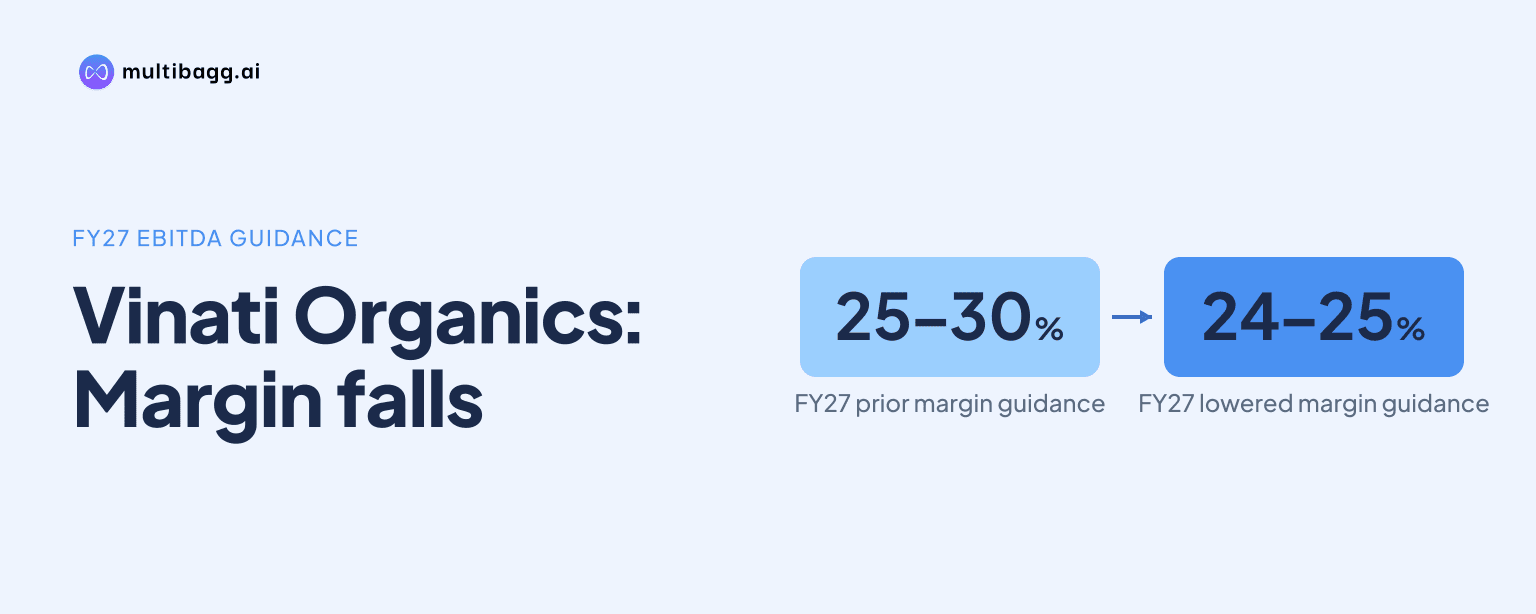
Vinati Organics Limited lowered its FY27 EBITDA margin guidance to 24-25% after standalone Q2 FY27 EBITDA fell 27% year on year to ₹142 crore, as ATBS customer destocking and higher logistics and energy costs weighed on profitability. The company continues to expect 20-25% topline growth for the full year.
Know Vinati Organics inside out
Results, valuation, peers and who's buying, in one view.
What did Vinati Organics report in Q2 FY27?
Vinati Organics reported higher revenue but lower profitability in the quarter ended September 30, 2026. Standalone revenue rose to ₹668.00 crore from ₹546.27 crore a year earlier. However, standalone EBITDA declined 27% year on year to ₹142 crore, while profit after tax fell to ₹86.84 crore from ₹129.02 crore.
On a consolidated basis, revenue increased to ₹680.21 crore from ₹550.22 crore in the corresponding quarter of the previous year. Consolidated EBITDA fell 24% to ₹138 crore and consolidated profit after tax declined to ₹78.36 crore from ₹114.88 crore. The results indicate that revenue growth did not translate into comparable earnings growth during the quarter.
Management attributed the pressure primarily to elevated logistics and energy costs, alongside lower-than-expected demand in ATBS. Customers continued to reduce inventory during the first half, delaying the expected recovery in ATBS volumes. This affected the company’s half-year targets even as its antioxidant, IB and IBB businesses recorded stronger performance.
Why did Vinati Organics lower its FY27 margin outlook?
Vinati Organics lowered its FY27 EBITDA margin guidance to 24-25%, compared with its earlier range of 25-30%. The revision reflects current market conditions, including ATBS destocking, higher operating costs and delays in the ramp-up of certain projects.
The company said ATBS demand did not recover as anticipated in the first half because customers were reducing their inventories. ATBS is one of Vinati Organics' key products, so lower volumes in this business affected profitability despite growth in other product segments. Management expects better ATBS volumes and prices in the second half, but the revised guidance establishes a lower full-year margin range.
Logistics costs have begun easing in the third quarter, according to management, with further reduction expected in the fourth quarter. This could support profitability if the cost trend continues. The company has indicated an EBITDA margin expectation of about 25-26% for FY28, though this remains management guidance rather than a reported financial result.
What is Vinati Organics' ₹500 crore specialty chemicals capex plan?
Vinati Organics has announced ₹500 crore of capital expenditure for new specialty chemicals, to be funded through internal accruals. Management indicated an expected return on investment of 15-20% and asset turnover of around 1-1.5 times for the proposed investment.
The company said the products are linked to its existing chemistries, which it believes should support the proposed asset-turnover profile. Management also indicated that Vinati Organics could be the sole Indian producer for some products, while it may be the second or third participant in another segment.
The company is scouting for land, and said further clarity could emerge over the next six months after land acquisition and pilot trials. Management noted that the economics of a potential additional project could be similar, but also said that project may not proceed. Investors will therefore need to distinguish the announced capex from projects that remain under evaluation.
Got a follow-up? Ask IRIS
How do project delays affect Vinati Organics' operations?
The delayed expansion of MEHQ and the ramp-up of Veeral Organics Private Limited are important operational factors behind the near-term outlook. Commercial sales from these operations are now expected from April, and management said full ramp-up could take another year.
These delays mean the benefits from additional capacity will not be fully reflected in the immediate earnings period. At the same time, management expects the antioxidant, IB and IBB segments to maintain their momentum through the second half. The balance between recovery in established products and the delayed contribution from new capacity will influence the company’s operational mix.
Vinati Organics manufactures specialty organic intermediates, monomers, polymers and additives. Its portfolio includes ATBS, IBB, IB and butyl phenols, which serve polymers, pharmaceuticals and antioxidant applications. The company operates plants at Mahad and Lote Parashuram in Maharashtra and has Veeral Organics Private Limited as a wholly owned subsidiary.
What should investors monitor after the Q2 FY27 results?
For investors, the key reported issue is the gap between revenue growth and profitability. Standalone revenue increased by more than ₹121 crore year on year, but EBITDA and profit after tax declined. This makes cost movement, ATBS demand recovery and the pace of customer inventory normalisation central factors in assessing the second-half performance.
Management has retained its FY27 topline growth guidance of 20-25%, supported by expected volume and pricing recovery. But its lower margin guidance indicates that the company does not expect the revenue recovery alone to restore the earlier profitability range during FY27. Progress in logistics costs and execution of MEHQ and Veeral Organics Private Limited ramp-ups will also be relevant to future operating performance.
Conclusion
Vinati Organics Limited delivered higher Q2 FY27 revenue, but margin pressure led to lower EBITDA and profit after tax. The revised 24-25% FY27 EBITDA margin guidance reflects the impact of ATBS destocking, higher logistics and energy costs, and delays in bringing additional capacity into commercial operation.
The next disclosures to watch are management’s updates on ATBS volumes and pricing in the second half, the reported easing in logistics costs, and the expected April start of commercial sales from the delayed MEHQ and Veeral Organics Private Limited expansion. The company has also indicated that more clarity on land acquisition and pilot trials may emerge over the next six months.