










Vinati Organics profit falls 32% as costs outpace sales
Key highlights
- Vinati Organics’ consolidated profit after tax fell 32% year on year to Rs 78.36 crore in the quarter ended 30 September 2026.
- Revenue from operations increased 24% to Rs 680.21 crore, but total expenses rose 44% to Rs 587.25 crore.
- Cost of materials consumed rose 53% to Rs 404.24 crore, while power and fuel costs increased 37% to Rs 57.44 crore.
- Half-year profit after tax declined 15% to Rs 187.22 crore despite revenue growth of 37% to Rs 1,376.12 crore.
powered by IRIS
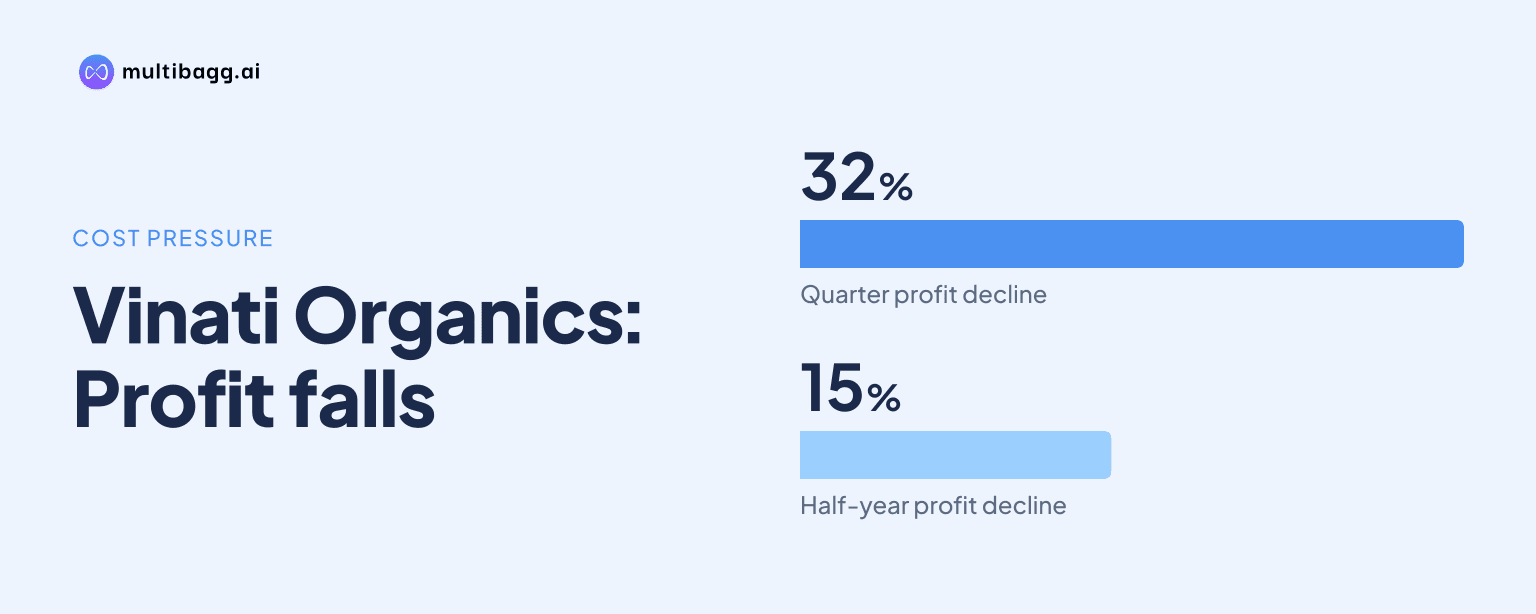
Vinati Organics Limited reported consolidated profit after tax of Rs 78.36 crore for the quarter ended 30 September 2026, down 32% from Rs 114.88 crore a year earlier, despite revenue from operations rising 24% to Rs 680.21 crore. Higher material consumption and power and fuel costs increased total expenses faster than sales.
Know Vinati Organics inside out
Results, valuation, peers and who's buying, in one view.
Why did Vinati Organics’ quarterly profit decline?
Vinati Organics’ quarterly profit declined because operating costs rose more quickly than revenue in the quarter ended 30 September 2026. Total expenses increased 44% year on year to Rs 587.25 crore, while total income increased 22% to Rs 692.86 crore, reducing profit before tax to Rs 105.61 crore from Rs 157.25 crore.
Cost of materials consumed was the largest driver of the increase, rising to Rs 404.24 crore from Rs 263.68 crore in the corresponding quarter a year earlier. That was an increase of Rs 140.56 crore, compared with a Rs 129.99 crore increase in revenue from operations. Power and fuel cost added another Rs 15.57 crore year on year, reaching Rs 57.44 crore.
The consolidated, unaudited comparison below sets out the changes between the quarters ended 30 September 2026 and 30 September 2025.
Other expenditure rose to Rs 54.65 crore from Rs 45.95 crore, employee benefits expense increased to Rs 48.98 crore from Rs 44.67 crore, and depreciation rose to Rs 32.71 crore from Rs 26.08 crore. These increases were partly offset by a Rs 10.77 crore reduction from changes in inventories, compared with a Rs 13.79 crore reduction in the year-earlier quarter.
How much did Vinati Organics’ margins change?
Vinati Organics’ profit before tax margin narrowed to about 15.2% of total income in the September 2026 quarter from about 27.8% a year earlier. This calculation compares reported profit before tax of Rs 105.61 crore with total income of Rs 692.86 crore, against Rs 157.25 crore on Rs 566.23 crore in the comparable period.
Profit after tax represented about 11.3% of total income, down from about 20.3% in the quarter ended 30 September 2025. Tax expense increased to Rs 27.25 crore from Rs 12.37 crore, comprising current tax of Rs 25.30 crore and deferred tax of Rs 1.95 crore; however, the larger movement was the Rs 51.64 crore reduction in profit before tax.
Earnings per share, or EPS, from continuing operations fell to Rs 7.56 from Rs 11.08. The reported basic and diluted EPS were identical in both quarters, while paid-up equity share capital remained Rs 10.37 crore, with a face value of Rs 1 per share.
Vinati Organics reported no exceptional items in either September quarter. The decline in profit before tax from Rs 157.25 crore to Rs 105.61 crore therefore occurred before any exceptional-item adjustment within the stated consolidated results.
Got a follow-up? Ask IRIS
How did the September quarter compare with the June quarter?
Vinati Organics’ revenue and profit both declined sequentially from the quarter ended 30 June 2026. Revenue from operations was Rs 680.21 crore in the September quarter, compared with Rs 695.91 crore in the preceding quarter, while profit after tax declined from Rs 108.86 crore to Rs 78.36 crore.
The sequential reduction in revenue was Rs 15.70 crore, or about 2%, whereas profit after tax fell by Rs 30.50 crore, or about 28%. Profit before tax decreased to Rs 105.61 crore from Rs 147.76 crore, as total expenses rose to Rs 587.25 crore from Rs 557.15 crore despite lower total income of Rs 692.86 crore versus Rs 704.91 crore.
Material consumption increased to Rs 404.24 crore from Rs 380.62 crore over the two quarters, while power and fuel cost rose to Rs 57.44 crore from Rs 49.43 crore. Employee benefits expense declined to Rs 48.98 crore from Rs 50.46 crore, but this reduction was smaller than the increases in the two input-cost lines.
Depreciation increased to Rs 32.71 crore from Rs 31.72 crore, and other expenditure rose to Rs 54.65 crore from Rs 49.58 crore. The inventory-change credit was Rs 10.77 crore in the September quarter, compared with Rs 4.67 crore in the June quarter, providing some offset to the cost increases.
What do Vinati Organics’ half-year results and balance sheet show?
Vinati Organics’ consolidated half-year profit after tax fell 15% to Rs 187.22 crore for the six months ended 30 September 2026, while revenue from operations rose 37% to Rs 1,376.12 crore. In the prior-year half, revenue was Rs 1,002.19 crore and profit after tax was Rs 219.07 crore.
Half-year material consumption rose to Rs 784.86 crore from Rs 545.16 crore, a Rs 239.70 crore increase. Power and fuel cost rose to Rs 106.87 crore from Rs 80.02 crore, while total expenses increased to Rs 1,144.40 crore from Rs 817.18 crore. Profit before tax fell to Rs 253.37 crore from Rs 298.41 crore.
At 30 September 2026, consolidated total assets were Rs 3,726.52 crore, compared with Rs 3,589.53 crore at 31 March 2026. Inventories increased to Rs 354.60 crore from Rs 311.13 crore, trade receivables rose to Rs 582.23 crore from Rs 521.26 crore, and property, plant and equipment was Rs 2,113.27 crore, versus Rs 2,121.63 crore at year-end.
Total equity was Rs 3,260.67 crore at 30 September 2026, up from Rs 3,161.68 crore at 31 March 2026. Total liabilities increased to Rs 465.85 crore from Rs 427.85 crore, including trade payables other than those due to micro and small enterprises of Rs 130.35 crore, compared with Rs 114.38 crore six months earlier.
Conclusion
Vinati Organics delivered higher consolidated sales in the quarter and half year ended 30 September 2026, but cost growth reduced earnings. In the September quarter, material consumption rose 53% and power and fuel cost rose 37% year on year, contributing to a 32% fall in profit after tax to Rs 78.36 crore despite 24% revenue growth.
The unresolved point is the source of cost movements within Vinati Organics’ chemicals business. The filing identifies manufacturing of chemicals as one primary operating segment under Indian Accounting Standard 108, so it does not provide separate product, division or business-line figures to isolate the contributors to the Rs 404.24 crore material-consumption cost in the September quarter.