










Vinati Organics guides FY27 EBITDA margin recovery at 24%-25%
Key highlights
- Vinati Organics guided for a 24%-25% FY2027 EBITDA margin after reporting a 21% Q2 FY2027 margin.
- Standalone Q2 FY2027 EBITDA fell 27% year on year to Rs 142 crore, while profit after tax fell 33% to Rs 87 crore.
- ATBS represented approximately 27%-28% of Vinati Organics' H1 FY2027 top line, and management expects volume recovery in H2.
- Vinati Organics announced Rs 500 crore of internally funded specialty-chemicals capital expenditure with commercialisation expected in two years.
powered by IRIS
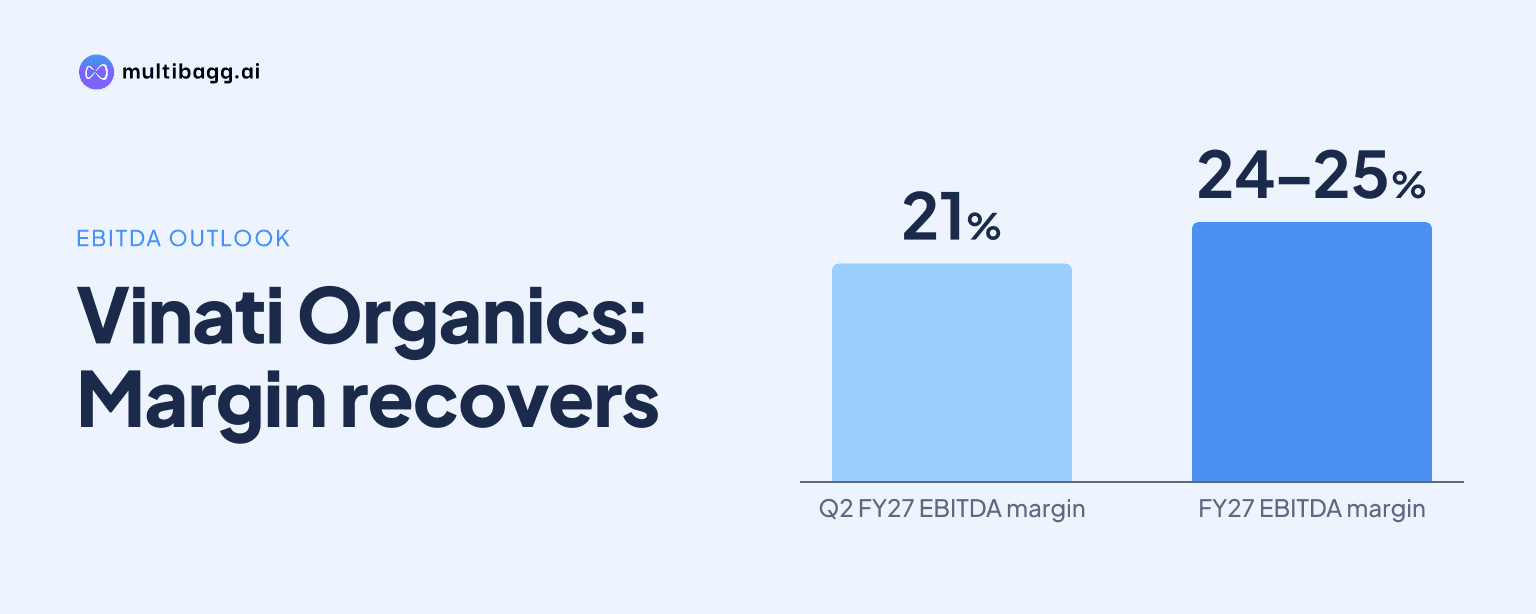
Vinati Organics Limited expects a 24%-25% earnings before interest, tax, depreciation and amortisation (EBITDA) margin for FY2027 after its Q2 FY2027 margin fell to 21%, as ATBS sales shifted into the second half and logistics and energy cost increases were not fully passed on to customers.
Know Vinati Organics inside out
Results, valuation, peers and who's buying, in one view.
Why did Vinati Organics' Q2 FY2027 margin fall to 21%?
Vinati Organics said its Q2 FY2027 EBITDA margin fell to 21% primarily because sales of ATBS, or 2-acrylamido-2-methylpropane sulfonic acid, shifted from the second quarter into Q3 and Q4. Management said customer destocking meant ATBS demand did not improve as anticipated at the start of FY2027, preventing the company from meeting its first-half volume target.
Higher energy and logistics costs added to the pressure. Vinati Organics said the Middle East conflict had increased raw-material, energy and logistics costs; it largely passed raw-material inflation to customers, but could not fully pass through increases in freight and energy expenses. Management said this lifted the top line without producing comparable bottom-line growth.
The reported standalone trend shows that divergence. In Q2 FY2027, standalone EBITDA declined 27% year on year to Rs 142 crore from Rs 195 crore, while profit after tax fell 33% to Rs 87 crore from Rs 129 crore. Consolidated EBITDA declined 24% to Rs 138 crore from Rs 183 crore, although consolidated net income including other income increased 23% year on year to Rs 693 crore.
The H1 comparison indicates that margin pressure extended beyond Q2, although ATBS timing had a specific effect in that quarter. In H1 FY2027, the 25% increase in net income including other income was accompanied by a Rs 35 crore decline in EBITDA and a Rs 32 crore decline in profit after tax.
What EBITDA margin does Vinati Organics expect for FY2027 and FY2028?
Vinati Organics has guided for a 24%-25% EBITDA margin in FY2027 and 25%-26% in the following financial year. Managing Director Vinati Saraf Mutreja initially indicated a margin of around 24% for FY2027 before confirming the 24%-25% range with Chief Financial Officer Gulshan Sakhuja. These are management targets rather than reported results.
Management linked the expected recovery to two developments in H2 FY2027. First, it said logistics rates had started cooling in Q3 and were expected to reduce further in Q4, which management expects to support profitability in both quarters. Second, management said ATBS volumes were improving, with Q3 demand looking strong after the first-half destocking period.
Vinati Organics also expects FY2027 top-line growth of 20%-25% over the previous year, supported by volumes and pricing. That outlook contrasts with Q2 FY2027, when standalone net income including other income rose 21% year on year to Rs 707 crore while EBITDA declined 27%. Management did not provide quarterly margin guidance for Q3 or Q4.
Got a follow-up? Ask IRIS
Which Vinati Organics businesses could support second-half volumes?
Vinati Organics expects ATBS to recover in H2 FY2027 after customer destocking delayed demand during the first half. ATBS accounted for approximately 27%-28% of H1 FY2027 top line, making it the largest disclosed product category. Management did not provide an ATBS volume-growth target but said the Q3 demand uptick was meaningful.
The other disclosed businesses are expected to provide continuity alongside ATBS recovery. Vinati Organics said Butyl Phenols delivered stable H1 performance and should improve with demand conditions, while the antioxidant business maintained what management described as strong H1 performance. Isobutylene, or IB, also performed strongly in H1 and is expected to continue in H2.
Isobutyl benzene, or IBB, recorded strong H1 volume and pricing performance, and management expects similar conditions in H2. In the H1 sales mix, IBB contributed about 12%-15% of top line, Butyl Phenols accounted for about 16%-20%, and antioxidants contributed about 15%-17%. The projected H2 improvement therefore relies on ATBS recovery as well as continued contributions from IBB, IB, antioxidants and Butyl Phenols.
How could Vinati Organics' projects affect future profitability?
Vinati Organics has announced Rs 500 crore of capital expenditure for specialty chemicals used in fragrances, personal care, water treatment, oil fields and other applications. The company said the project would be funded entirely through internal accruals and commercialised in two years. Management described the products as adjacent to existing chemistries through backward, forward or horizontal integration.
For the announced project, management expects asset turnover of about 1 to 1.5 times and a return on investment of 15%-20%. Vinati Organics said it had tested the products for about a year, but those project economics remain management expectations rather than achieved results. Management expects 65%-70% of sales from the new products to be exports and estimated average realisation at about $3 per kilogram, within a $2-$4.5 range.
Vinati Organics is also considering a further Rs 500 crore of capital expenditure, although management said the project was not confirmed. It expects more clarity within six months after land acquisition and pilot trials are completed. Management said the potential project could have similar economics, including asset turnover of up to 1.5 times and a 15%-20% return on investment.
Vinati Organics also disclosed process re-engineering at VOPL, where some products require work before contributing meaningfully to consolidated results. Mono methyl ether hydroquinone, or MEHQ, is being produced at lower volumes for internal use in butylated hydroxyanisole, or BHA. Commercial MEHQ sales are expected to begin in April, while management expects VOPL revenue of around Rs 75 crore to Rs 100 crore in FY2027 and said re-engineering should be streamlined by April or May of the next financial year.
Conclusion
Vinati Organics' FY2027 margin target depends on reversing two defined Q2 pressures: ATBS volumes deferred by customer destocking and freight and energy costs that were not fully passed through. The H1 FY2027 results show the effect, with standalone EBITDA declining 10% to Rs 333 crore despite a 25% increase in net income including other income to Rs 1,387 crore.
The next disclosures to watch are whether logistics rates decline through Q3 and Q4 as management expects, whether ATBS volume recovery continues in H2, and whether VOPL begins commercial MEHQ sales in April. Management has also said it expects clarity within six months on the unconfirmed additional Rs 500 crore capital expenditure, which remains subject to land acquisition and pilot trials.