










Vinati Organics targets April MEHQ sales after re-engineering
Key highlights
- Vinati Organics expects commercial MEHQ sales to start in April after re-engineering and debottlenecking work.
- VOPL revenue is expected at Rs 75 crore-Rs 100 crore in FY2027 and will not exceed Rs 100 crore.
- Standalone H1 FY2027 EBITDA was Rs 333 crore, down 10% from Rs 368 crore in H1 FY2026.
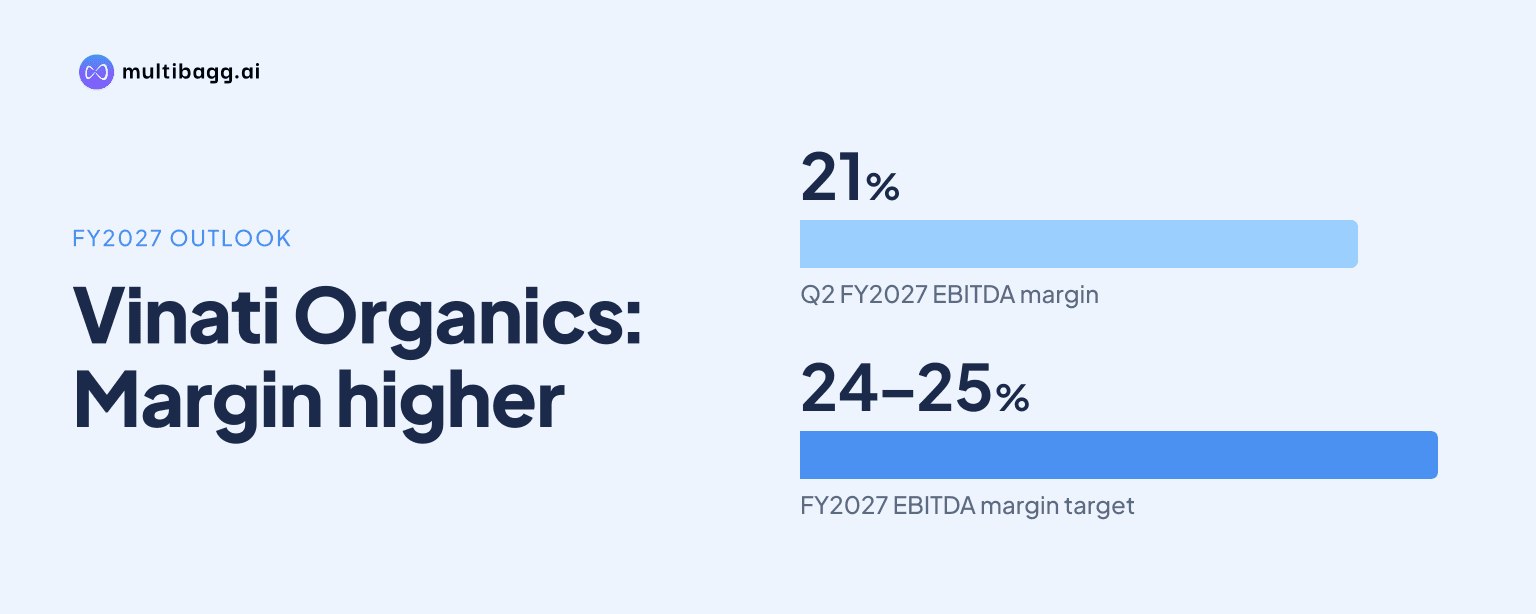
- Management expects FY2027 EBITDA margin of 24%-25%, after a stated 21% margin in Q2 FY2027.
powered by IRIS
Vinati Organics Limited expects commercial sales of MEHQ to begin in April after process re-engineering, expansion and debottlenecking delayed its scale-up, while VOPL revenue in FY2027 is expected at Rs 75 crore-Rs 100 crore and will not exceed Rs 100 crore. Vinati Organics is already producing lower MEHQ volumes for internal BHA production.
Know Vinati Organics inside out
Results, valuation, peers and who's buying, in one view.
Why has Vinati Organics delayed commercial MEHQ sales?
Vinati Organics delayed commercial MEHQ sales because its expansion and debottlenecking work is taking longer than expected. Management said during the Q2 FY2027 call that it had begun making MEHQ at lower volumes, but was consuming that output internally to make BHA rather than offering MEHQ to external customers. It expects commercial sales to start in April.
The immediate issue is internal production execution, not a stated change in MEHQ demand. In response to questions on the MEHQ and BHA value chain, management described production problems at VOPL and said a re-engineering process was under way. The finance team said this process should be streamlined by April or May of the next financial year, later specifying April as the expected timing.
VOPL has five products, according to management: MEHQ, guaiacol, anisole, 4-methoxyacetophenone, and isoamylene-based products including tertiary amyl alcohol and PTAP. Vinati Organics said the latter products had just started and that revenue from them would begin coming from December or January. That means the VOPL FY2027 contribution is not dependent only on commercial MEHQ sales.
What VOPL revenue does Vinati Organics expect in FY2027?
Vinati Organics expects VOPL revenue of Rs 75 crore-Rs 100 crore in FY2027 and said it will not cross Rs 100 crore in the financial year. The finance team gave that range after an analyst referred to an earlier expectation of roughly Rs 100 crore from the MEHQ-BHA value chain during the year.
Management first suggested that VOPL could cross Rs 100 crore, but the finance team corrected this during the same call. The revised Rs 75 crore-Rs 100 crore range reflects the slower production ramp and re-engineering timetable. Vinati Organics did not say it was withdrawing from MEHQ, BHA or the wider VOPL portfolio.
The delayed VOPL ramp comes during a weaker profit period for Vinati Organics. For H1 FY2027, standalone net income including other income rose 25% to Rs 1,387 crore from Rs 1,112 crore in H1 FY2026, but EBITDA, or earnings before interest, tax, depreciation and amortisation, fell 10% to Rs 333 crore. Profit after tax declined 15% to Rs 210 crore from Rs 242 crore.
When could Vinati Organics reach optimum MEHQ output?
Vinati Organics indicated that MEHQ could take about one year to reach optimum utilisation after commercial sales begin. Management said customer evaluations, testing and qualification had already started, and it expected plant operations to begin alongside the completion of those customer processes. This was management's working estimate rather than a disclosed capacity or utilisation target.
Management also referred to another four months to reach optimum capacity for the plant and other VOPL products. The comments indicate a staged process: April commercial sales, further customer qualification, and a subsequent production ramp. The call did not disclose MEHQ capacity, current utilisation, customer names, sales volumes, external selling prices or a quarterly MEHQ revenue target.
Vinati Organics said its product was qualified and was being used to make BHA internally. This internal use provides an outlet for lower-volume MEHQ production while external sales are deferred. Management also said MEHQ is used as an inhibitor in polymers and described the current downturn as temporary, while saying polymer applications are growing.
Got a follow-up? Ask IRIS
How does the VOPL delay affect Vinati Organics' FY2027 outlook?
Vinati Organics still expects FY2027 top-line growth of 20%-25% over the previous year, supported by volumes and pricing across its portfolio. Management said ATBS demand did not pick up as expected in H1 because customers were destocking, but it was seeing a meaningful volume improvement and stronger demand in Q3.
The H1 FY2027 sales mix shows why performance outside VOPL remains material. ATBS contributed about 27%-28% of top line, IBB contributed 12%-15%, Butyl Phenols contributed 16%-20%, and antioxidants contributed about 15%-17%. Management said IBB delivered strong H1 performance in volume and pricing, antioxidants performed strongly, and Butyl Phenols was stable with better H2 conditions anticipated.
Management attributed the lower profit outcome partly to higher energy and logistics costs arising amid the Middle East conflict. It said raw-material cost increases were largely passed to customers, while logistics and energy costs were not fully passed through. It also said ATBS sales shifted from Q2 into Q3 and Q4, contributing to a Q2 FY2027 EBITDA margin of 21%.
Vinati Organics expects an EBITDA margin of 24%-25% for FY2027. Management said logistics rates had started cooling in Q3 and expected further reductions in Q4 to support profitability. For the following financial year, management indicated a 25%-26% EBITDA margin expectation, alongside better ATBS volumes and pricing.
What is Vinati Organics changing in project execution?
Vinati Organics said it has applied lessons from past project execution to its new investment programme, including selecting suppliers, technology providers and process engineers in which management has more confidence. That approach is relevant as VOPL requires re-engineering before MEHQ can be sold commercially at scale from April.
The company announced Rs 500 crore of capital expenditure for specialty chemicals used in fragrances, personal care, water treatment, oil fields and other applications. Management said the products are adjacent to existing chemistries, had been tested for about one year and are expected to be commercialised in two years with internal accruals. It cited expected asset turnover of about 1 to 1.5 times and return on investment of 15%-20%, which are management expectations rather than reported outcomes.
Vinati Organics is also considering an additional Rs 500 crore investment, but management said it was not fully announced and might not proceed. It expects more clarity over the next six months after land acquisition and pilot trials. Management said the proposed products would serve domestic and export markets, with exports expected to account for 65%-70% of sales from the announced project.
Conclusion
The April MEHQ commercial-sales target identifies VOPL's shortfall as an execution and production issue rather than a stated retreat from the product line. Vinati Organics is producing MEHQ at lower volumes for internal BHA use, but delayed debottlenecking and re-engineering have limited FY2027 VOPL revenue to Rs 75 crore-Rs 100 crore. The delay occurs alongside weaker H1 EBITDA and profit despite a 25% increase in standalone net income.
The next disclosed milestones are commercial MEHQ sales in April, further customer qualification and the plant ramp-up that management estimates could take about one year. Investors will also watch whether ATBS volume recovery in H2, lower logistics rates in Q3 and Q4, and management's 24%-25% FY2027 EBITDA-margin expectation are realised.