










Thomas Cook (India) Limited Reports 5% Q2 FY27 Income Decline
Key highlights
- Thomas Cook (India) reported Q2 FY27 total income of ₹2,003 crore, down 5% year-on-year.
- Revenue from operations fell 6% year-on-year to ₹1,944.2 crore in Q2 FY27.
- PBT before exceptional items rose 1% to ₹84.8 crore, with a 4.2% margin.
- Forward bookings rose 30%, mainly in the India outbound business, including B2B holiday and MICE travel.
powered by IRIS
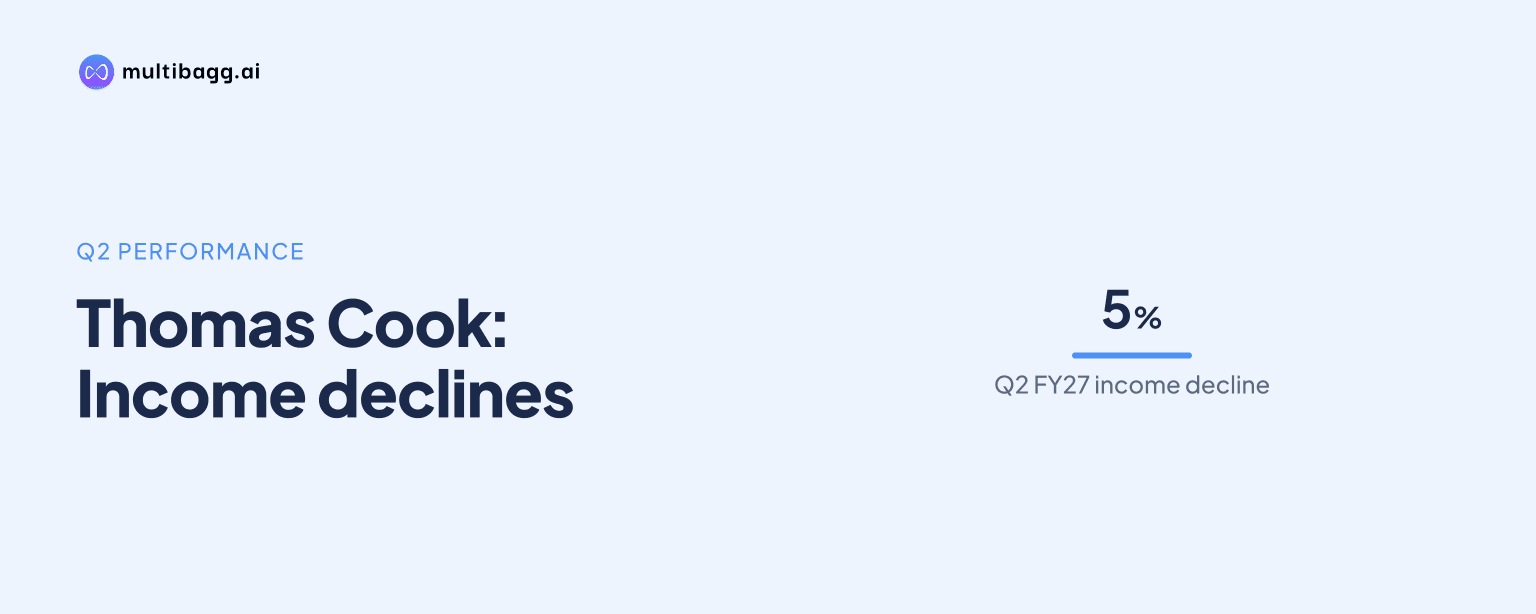
Thomas Cook (India) Limited reported total income of ₹2,003 crore for Q2 FY27, down 5% year-on-year, while profit before tax before exceptional items rose 1% to ₹84.8 crore as cost controls helped contain the effect of weaker travel and DEI performance.
Know Thomas Cook (India) inside out
Results, valuation, peers and who's buying, in one view.
What did Thomas Cook (India) report for Q2 FY27?
Thomas Cook (India) reported revenue from operations of ₹1,944.2 crore in Q2 FY27, a 6% decline from the corresponding quarter a year earlier. Total income was ₹2,003 crore, down 5% year-on-year. The company said its travel and DEI businesses faced pressure during the quarter, while Financial Services and Leisure businesses delivered growth.
Profit before tax before exceptional items stood at ₹84.8 crore, compared with a level 1% lower in the year-earlier quarter. The resulting pre-exceptional PBT margin was 4.2%, according to the earnings-call summary. Profit after tax was ₹53.6 crore, down 24% year-on-year.
The difference between the movement in operating income and pre-exceptional PBT indicates the role of cost management during the quarter. Management described this as cost agility, with cost actions helping the group retain profitability despite lower income.
Which businesses supported Thomas Cook (India)'s quarterly performance?
Financial Services and Leisure were the businesses that offset part of the weakness in the quarter. The earnings-call material identified these segments as growth contributors, while Travel and DEI recorded declines. Sterling Holidays Resorts was also cited as a business that helped counter softer international travel trends.
Thomas Cook (India)'s India travel business remained under pressure at the earnings level, but the company reported an improvement in its EBIT deficit from 31% to 22%. This change was attributed to cost agility. The disclosure does not provide an absolute EBIT figure for the India travel business, but it shows that the operating loss gap narrowed during the period.
Management also discussed demand in the India outbound business. Mahesh Iyer, Managing Director and Chief Executive Officer, said that forward bookings had increased 30%, largely in India outbound travel, including the business-to-business holiday and meetings, incentives, conferences and exhibitions segment. He attributed the growth to double-digit increases across long-haul, short-haul and domestic travel.
Why did travel and DEI weigh on the quarter?
Travel and DEI were the principal weaker areas identified in the Q2 FY27 summary. The company also filed a Regulation 30 press release relating to Indian travel seasonality trends, placing the quarter's performance in the context of seasonal demand patterns in the travel market.
International travel was specifically described as weak in the earnings-call material. This affected the overall income trend even as Financial Services, Leisure and Sterling provided support. The available disclosures do not quantify the revenue or profit contribution of each business, so the relative size of their effect cannot be independently measured from the reported information.
The company operates across travel services, foreign exchange and related financial services, hospitality and digital imaging. Such a portfolio can create offsets between businesses when travel demand varies by geography or season. In this quarter, the disclosures show that those offsets were meaningful enough to keep pre-exceptional PBT broadly stable, but not sufficient to prevent lower total income and PAT.
Got a follow-up? Ask IRIS
What does the Q2 FY27 result mean for investors and operations?
For investors, the main financial point is that Thomas Cook (India) maintained pre-exceptional PBT at ₹84.8 crore even as total income declined 5%. However, PAT fell 24% to ₹53.6 crore, making the difference between operating cost control and bottom-line performance relevant when assessing the quarter.
The 4.2% pre-exceptional PBT margin and the narrower India travel EBIT deficit show the operational effects of the company's cost actions. At the same time, revenue from operations declined 6%, so income recovery remains dependent on business demand across the group's travel and non-travel operations.
For customers and industry participants, the reported 30% increase in forward bookings in India outbound travel signals stronger booking activity in the segments cited by management. This is a forward-booking indicator, not reported revenue, and the company did not disclose the value of those bookings or the period over which they are expected to be recognised.
Vishal Suri, Managing Director and Chief Executive Officer of SOTC, said the company had received approvals from the NSE, BSE and SEBI and had filed with the National Company Law Tribunal. The available summary does not specify the underlying transaction or its financial impact, so no conclusion can be drawn on its effect on the reported quarter.
How should the forward-booking data be viewed?
The 30% growth in forward bookings is relevant because it relates primarily to Thomas Cook (India)'s outbound business, including B2B holiday and MICE travel. Management said the growth was broad-based across long-haul, short-haul and domestic categories, rather than concentrated in a single travel category.
But forward bookings should be distinguished from recognised income. The Q2 FY27 results capture income and profit recorded during the quarter, whereas future bookings may be subject to travel dates, customer changes and the timing of service delivery. The company has not provided a revenue outlook or a conversion estimate for the stated booking growth.
The quarter also illustrates the significance of segment mix. Growth in Financial Services, Leisure and Sterling helped moderate the effect of soft international travel and declines in Travel and DEI. Investors tracking future disclosures may therefore assess whether segment-level demand continues to provide a balance to the core travel business.
Conclusion
Thomas Cook (India) recorded a softer Q2 FY27 on income and PAT, with total income falling 5% to ₹2,003 crore and PAT declining 24% to ₹53.6 crore. Cost management, growth in Financial Services and Leisure, and support from Sterling helped keep PBT before exceptional items broadly stable at ₹84.8 crore.
The next disclosures to watch are the progression of the 30% outbound forward-booking growth, demand across international travel and DEI, and any further information on the filing with the National Company Law Tribunal. The company has also made the audio recording of its Q2 and H1 FY27 earnings call, held on November 3, 2026, available to investors.